Then there was Russia’s financial pariah status in 2022. The isolation of that one nation was more than a punishment; it gave capitals around the world pause and put their reliance on the dollar in a new light. Still, in a wide-ranging history, Eichengreen makes the case for the stickiness of dollar dominance. It is a matter of when any change might come, not whether it will.

Global rethink after sanctions
With Russian assets frozen, governments have been compelled to consider what life would be like in a system not centred on the dollar. Eichengreen observes that this has prompted ‘a global rethink of dollar dependence’ in some quarters, especially where there are concerns over future political spats with Washington.
The debate on de-dollarisation has taken on an urgency as a result. But do not mistake debate for destiny. What Eichengreen puts forward is that dominant currencies have a way of outliving national power by centuries, given the slow-moving nature of deep markets and institutional trust.

Why the dollar still sits at the centre
The network effects at work in the current system are hard to ignore. Some 90 per cent of foreign exchange transactions now call on the US dollar, and it is the instrument of choice for invoicing roughly 40 per cent of trade worldwide.
Central banks are part of the cycle. Monetary authorities hold US dollar assets in the bulk of their international reserves, a preference that in turn keeps dollar markets broad and liquid while lowering borrowing costs for those who issue in dollars.
There is a flip side to this ‘exorbitant privilege’. A stronger greenback is good for the American importer and makes travel abroad more affordable. Yet it also renders US exports less competitive, a trade-off that is always present.
How currencies win trust
Credibility is what gives a currency its heft, as history shows. Be it in modern New York or London, or back in Ancient Greece, the world has tended to prefer money from stable, commercially pre-eminent hubs where value is consistent.
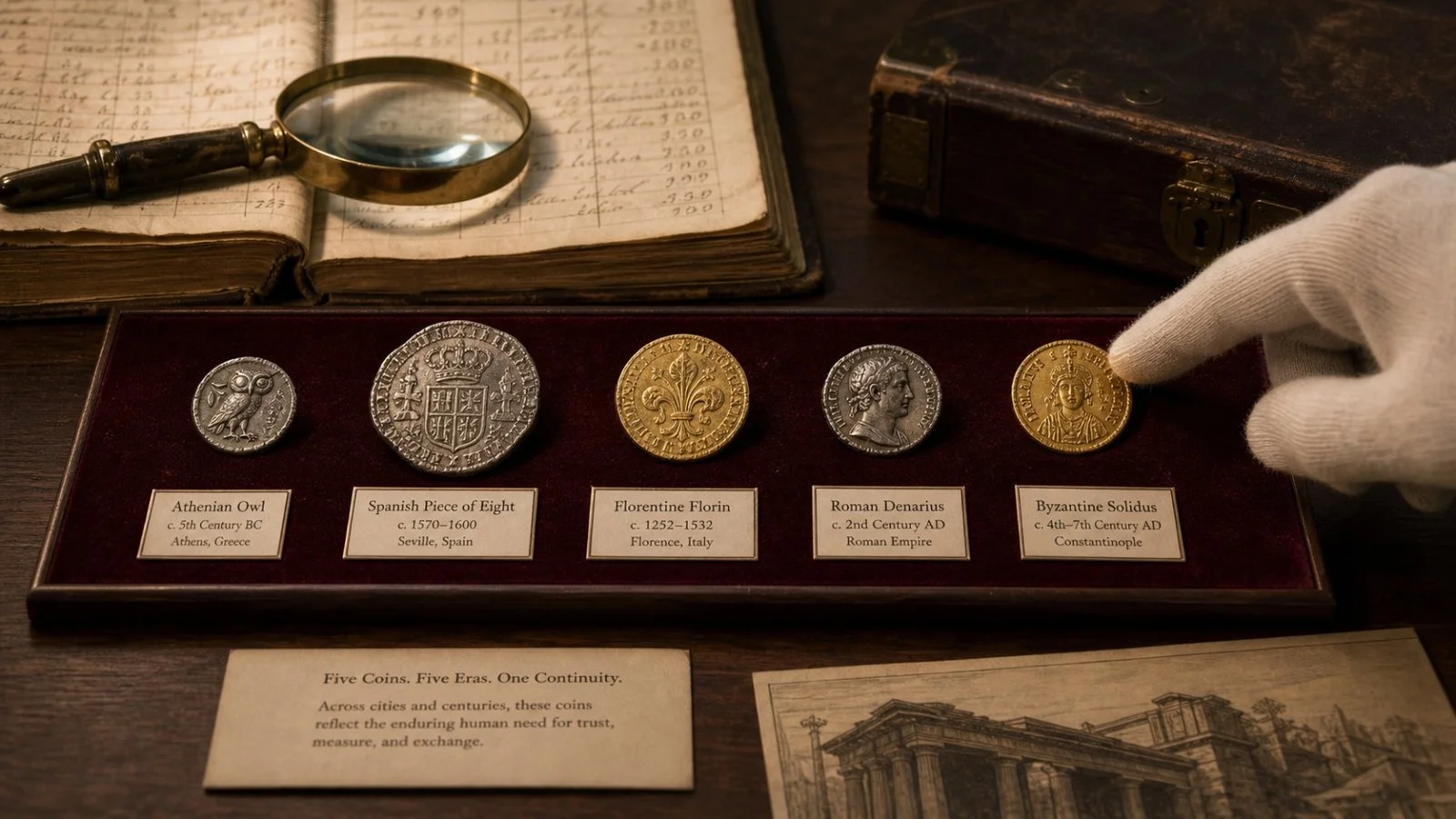
Long before the sterling or the dollar, the Athenian ‘owls’ instilled trust by not tampering with their weight or fineness. The Spanish real later became so ubiquitous in imperial trade across the oceans it was known as ‘pieces of eight’.
You see the same hallmarks elsewhere. The Florentine florin rose on the strength of its unaltered gold content over three hundred years. The Roman denarius went beyond the empire, and by the fifth century CE the Byzantine solidus was the linchpin of commerce from Britain to India.
According to Eichengreen, the winners had something in common. They were politically stable and economically sophisticated, they anchored key trade routes and often had colonial networks to extend the reach of their currency.
The pattern held in more recent times. Sterling ascended with the British Empire and London’s financial muscle. The dollar did the same, propped up by US industry, a huge bond market and a central bank ready to provide liquidity in a crisis.
Before the financial reset of the Second World War, two events set the stage for the dollar’s position:
– 1913 saw the founding of the US central bank
– The Allied powers convened at Bretton Woods in 1944
They were significant. The Federal Reserve’s establishment allowed for greater international use as the economy grew. And the 1944 accord, by fixing the price of gold in dollars and tying other currencies to it, made the dollar’s role a given.

The contenders and their constraints
Should the dollar’s time run out, what then? Eichengreen is clear that ‘no other currency … is positioned to fill the dollar’s shoes’. There are alternatives, but they are hampered by structural issues that no amount of goodwill can fix.
The euro may be second in the world, but it is a distant second. Its bond market is fragmented across member states, a weakness that prevents it from matching the scale and simplicity of the US Treasury.
China’s renminbi is another story altogether. Capital controls restrict convertibility and, as Eichengreen points out, the central bank lacks full independence. Global investors want transparency and legal certainty, not just yield, and these factors put them off.
As for a fully digital option, the book is having none of it. Privately issued cryptocurrencies are dismissed as not being currencies in any practical sense.
One is hard pressed to find a legitimate purchase of goods or services made with them, and in Australian terms the Bitcoin price has been cut in half over the last twelve months. Such volatility is anathema to trade and reserve managers. Digital assets can evolve all they like, but they have yet to pass the functional test: does the currency hold its value, clear payments in a predictable fashion and stand up to enforcement by credible institutions?

Dominance that outlives dominance
Eichengreen sees reserve status as something with a long life cycle. ‘International currency status is not forever,’ he writes, though he makes the point that the leading currencies of history have kept their place well after their domestic economies have fallen from the top rank. The dollar is a case in point. Rivals may be putting on speed, but markets have gravitated to the safety and convenience of the dollar’s infrastructure. It is a self-sustaining web where regulation, contracts and habit prop each other up.
This is no stasis; the US portion of the global economy has shifted in the past and will do so again. But you cannot easily put in place the kind of scaffolding found in the derivatives markets and payments systems, let alone in any hurry.
A framework for the next decade
Should policy disputes heat up, there will be some who try to diversify. Most will still go the way of the dollar, however, as it is the path of least resistance when under stress. In a crisis an investor wants depth and only the US market has that in sufficient quantity. So the dollar tends to firm up when fear is in the air, politics and the complaints of trading partners notwithstanding. Convenience and safety are paramount until other institutions can make good on the same promise.
In a sense Eichengreen puts his finger on the paradox: the dollar is for now “the cleanest dirty shirt in the pile”. It is hardly perfect, but in comparative measure it is the most serviceable option for shock absorption, savings and trade.

Lessons from older monetary empires
Then there is the cautionary tale of history which argues against linear thinking. Take the Dutch guilder, which did well enough when Amsterdam was the centre of corporate and foreign exchange power with the East India Company. In time sterling would supplant it as London’s influence waned. But it was no quick changeover. Sterling held sway through the 18th century and more while others caught up; it took decades for the legal and credit arrangements to rewire.
Viewed in this light, what we see is evolution rather than revolution. A modest increase in currency plurality is entirely in keeping with a dollar that continues to underpin most reserves and pricing.
What the data implies for investors and policymakers
The steady demand for dollar assets goes some way to explaining why US yields are lower than one might expect given the supply. For the exporter it is a headwind. And central banks have to be realistic about liquidity if they are to diversify.
For those in policy looking for a work around, the book is blunt: unless an alternative has the legal clarity and market depth of America’s, any shift will be limited. Networks do not move in droves without institutional equivalence. The recent round of sanctions made a point of the leverage that comes with being the incumbent; even those with grievances will transact through the same channels because nothing else clears with the same reliability.
Inside the scholarship guiding this debate
With Money Beyond Borders, Eichengreen has produced what amounts to a definitive reference on reserve currencies. One could call it rigorous to the point of being dry at times, and it is written for the reader who prefers argument to graphics. At over 300 pages it is amply documented, with 45 of endnotes and 30 of bibliography to boot. An economic journalist has already put it forward as one of the best of 2026. The analysis, from the days of ancient mints to today’s treasury auctions, leaves a lasting impression: the day will come when the dollar’s reign is done, but not in the manner the headlines would have us believe.

The road ahead: slower shifts, clearer conditions
Incremental diversification is the order of the day, not a wholesale change. Nations can trim their exposure at the edges while continuing to depend on the scale and safety of the dollar. For that to alter, the US system would have to lose credibility for good or a rival would need to put down roots in stable governance and build a market to match. According to the book, neither is in prospect.
So investors and governments are left with a familiar map. The greenback may ebb and flow in its share of reserves, but its moorings are sound. Those anchors are not moving and the world’s default settings are not about to be reset.