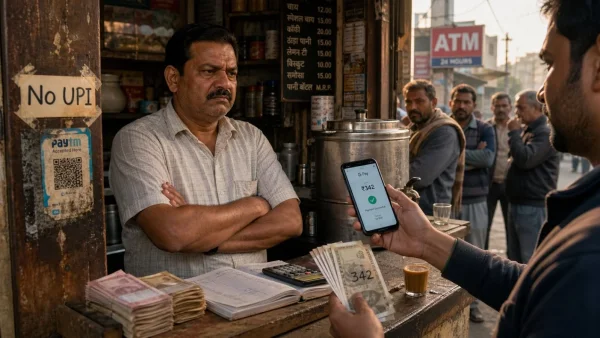
A ₹342 bill at a neighbourhood shop should hardly be news.
Tea, samosas, water bottles and some namkeen. A quick scan of a QR code, a few seconds, and the payment is done.
But one customer recently encountered a very different version of Digital India.
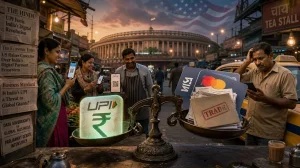
After asking, “QR kidhar hai?”, the shopkeeper reportedly replied that QR payments were no longer being accepted and that customers should carry cash.
The reason, according to the customer’s account, was concern among merchants about what happens when their earnings are completely recorded through digital transactions.
That small exchange raises a much larger question:
After making UPI part of everyday life, could India be creating circumstances in which some merchants prefer cash again?
From “Cashless
India” to “Cash Please”
UPI transformed everyday transactions in India.
A customer doesn’t need to carry ₹10, ₹20 or ₹100 notes.
A roadside tea stall can accept payment from a customer who has no change.
A vegetable vendor can receive money instantly.
A shopkeeper can send a payment request without handling cash.
The QR code became almost synonymous with modern Indian commerce.
So being told to “carry cash” for a ₹342 purchase in 2026 feels like an unexpected step backwards.
But the underlying concern is more complicated than nostalgia for cash.
Why Are Some Merchants Worried About Digital Payments?
For small businesses, every additional cost matters.
Merchants may worry about:
payment-related charges,
taxation and compliance,
transaction records,
reconciliation,
fraud and disputed transactions,
settlement issues,
and the possibility of future charges on digital payments.
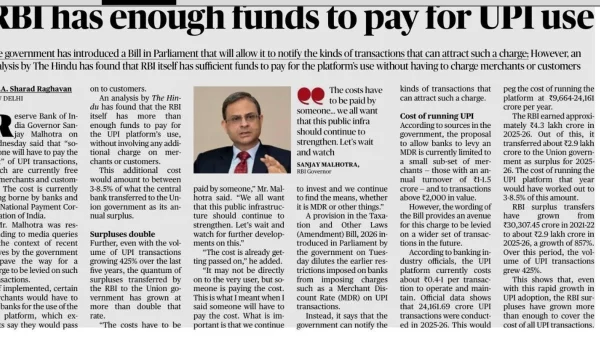
The recent debate around Merchant Discount Rate (MDR) has added another layer to these concerns.
However, an important distinction needs to be made: The possibility of charges on certain transactions does not mean that every UPI payment currently carries a fee. The exact impact depends on the payment mechanism, merchant category and rules applicable to the transaction.
The UPI Paradox
Here lies the irony.
The government has spent years encouraging digital payments.
Banks, fintech companies and payment platforms have made QR codes ubiquitous.
Consumers have adapted.
And now imagine the reverse happening:
Shopkeeper: “UPI nahi chalega.”
Customer: “Why?”
Shopkeeper: “Cash rakho.”
Customer: “ATM kidhar hai?”
Suddenly, the great digital revolution has transported us back to the era of searching for an ATM with ₹342 worth of optimism.
But Is This Really a Nationwide Trend?
This is where caution is necessary.
One shopkeeper refusing UPI does not establish that merchants across India are collectively abandoning digital payments.
The claim that unions are discussing coordinated refusal of UPI would require independent verification before being presented as a nationwide movement.
There can also be perfectly ordinary reasons for a merchant not accepting UPI on a particular day—technical problems, connectivity issues, settlement concerns or account-related problems.
Therefore, the ₹342 incident should be viewed as a warning signal and a question worth investigating, not proof that India’s UPI system is collapsing.
The Bigger Issue: Can Digital Payments Remain Attractive for Small Businesses?
This is perhaps the real policy question.
If policymakers want merchants to embrace digital payments, the system must remain:
Affordable.
Reliable.
Simple.
Predictable.
A small shopkeeper should not feel that accepting digital payments puts him at a disadvantage compared with accepting cash.
At the same time, consumers should not suddenly discover that the QR code they have relied upon for years has disappeared from their neighbourhood shops.
And Then Comes the Tax Question
The shopkeeper’s reported comment—essentially, “If all our earnings are recorded, what happens to us?”—touches a politically sensitive issue.
Digital transactions create an electronic trail.
That can be beneficial.
It can reduce certain forms of tax evasion, improve transparency and help businesses establish financial records.
But for small merchants operating on thin margins, greater formalisation can also mean greater compliance responsibilities.
The solution shouldn’t be to encourage people back into cash.
It should be to make formalisation simple enough that small businesses don’t see transparency as punishment.
Sarcasm: Digital India, Version 2.0
For years:
“Don’t carry cash. Scan the QR.”
Now:
“Don’t scan the QR. Carry cash.”
Next update:
“UPI unavailable. Please visit the nearest ATM.”
And the ATM:
“Cash unavailable.”
Congratulations.
We’ve completed the digital transformation and somehow unlocked the retro mode.
What Should the Government Do?
If merchant concerns about UPI economics are increasing, policymakers should address them before they become a broader problem.
1. Keep small-value digital payments inexpensive
The convenience of UPI depends heavily on merchants being willing to accept it.
2. Explain proposed payment charges clearly
Confusion creates rumours. Consumers and merchants should know exactly who pays, when they pay and how much they pay.
3. Protect small merchants
Any future payment-cost framework should consider the margins of small retailers, street vendors and micro-businesses.
4. Improve grievance mechanisms
Failed transactions, delayed settlements and fraud can discourage merchants from accepting digital payments.
5. Don’t punish digital adoption
If merchants believe digital transactions create disproportionately greater compliance burdens, policymakers should simplify the system rather than allowing cash to become the easier alternative.
Should Consumers Be Worried?
Not yet.
There is no basis to conclude from one incident that India is abandoning UPI.
The country’s digital-payment ecosystem remains enormous.
But individual incidents can reveal something important: how people at the ground level are reacting to policy changes and economic incentives.
And that’s worth paying attention to.
The ₹342 Question
The most interesting part of this story isn’t actually the ₹342.
It’s what the ₹342 represents.
For millions of Indians, UPI changed the definition of convenience.
No wallet.
No change.
No ATM.
Just scan → pay → leave.
If merchants begin rejecting digital payments because they believe cash is economically safer or simpler, the government has a policy problem to solve.
Not because India is suddenly becoming a cash economy again.
But because a successful digital-payment system ultimately depends on two sides agreeing to use it.
Final Take: Don’t Let the QR Code Become the Casualty
The viral account should not be treated as proof that a nationwide merchant revolt against UPI has begun.
But it does raise a legitimate question:
If UPI is supposed to be the future of Indian payments, why would a small merchant ever feel better off refusing it? The answer cannot simply be “because digital is the future.”
The economics have to work too.
Because consumers may love the QR code—but the person standing behind the counter has to be willing to keep it there.
And if ₹342 once meant “just scan and go,” policymakers should make sure it doesn’t become:
“Please find an ATM first.”