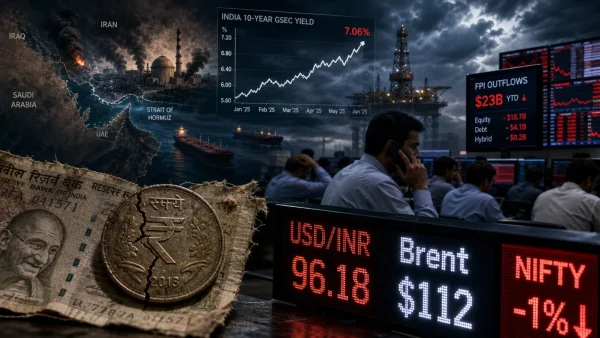
You could see the strain in Friday’s close of 95.97. It was a one-two punch of a firmer dollar on good US numbers and risk aversion that led to the selloff. Then there was the crude: Brent was up over 2 per cent to $111 a barrel after a nuclear facility in the UAE was hit, which is only adding to inflation concerns.
This kind of slide has been in the making since the Iran war got under way on February 28. The rupee is down some 5.5 per cent in 2026, the worst of any in Asia. Even before this, with Brent nigh on $110, there was talk of a tighter monetary policy on the horizon.
Sentiment has been hard to come by with the diplomatic front looking grim. President Trump made it clear the ‘clock is ticking’ for Iran, and his sit-down with Chinese Premier Xi Jinping didn’t produce much. For now, traders are bracing for more depreciation.
Policy response shifts to defence mode
On the ground, authorities have had to step in. To head off balance of payments stress and some of the rupee’s wilder moves, they’ve put the brakes on certain imports – precious metals and most silver, for instance – and have been active in the currency markets to cap what the banks can do.
“Growing balance of payments pressures will have to be absorbed in a number of ways,” say J.P. Morgan economists, from a softer rupee to FX intervention. One trader at a state-run bank put it bluntly: if the central bank eases off, you could see USD/INR push past 97-97.50 in a hurry.
Bonds under pressure, yields eye higher range
It’s not just the spot market. India’s 10-year benchmark finished at 7.0644% on Friday, an 8-basis point gain for the week and the third time it’s moved up in a month. With eyes on oil and the rupee, the range for the week is 7.00% to 7.14%.
In the end, high oil and a soft currency are chipping away at the country’s buffers. When you import 90 per cent of your crude, it makes for some difficult budgeting, not to mention a wider current account deficit. And with the Strait of Hormuz – where a fifth of the world’s oil and LNG goes through – all but closed, the problem is compounded.
Markets are pricing in higher yields. “We see the 10-year bond yield going to 7.25% in the first half of the fiscal, ahead of a 50 bps rate hike later on,” says Arun Srinivasan of ICICI Prudential Life Insurance.
Risk-off flows weigh on equities and currency
There’s little room for error. Global yields are up and no one is in the mood for emerging market risk. The Nifty 50 was down more than a per cent, with the usual suspects like banking and auto in the red. FPIs have been the steady sellers, unloading over $23 billion in 2026 alone, well past 2025’s record.
What to watch next
For India, it’s about how you position yourself. An oil shock of any length means imported inflation and outflows. So the call for policymakers is to keep the volatility in check without putting a dent in growth.
Near-term market direction hinges on a handful of stress points and policy choices:
– The Brent path around $110-$112 a barrel
– The scale and frequency of RBI interventions
– Any new import curbs or capital flow incentives
– Moves in US yields and inflation data
– Geopolitical signals that alter supply risk
– Whether USD/INR tests 97-97.50