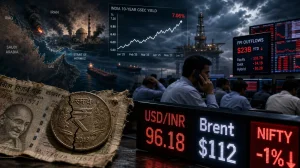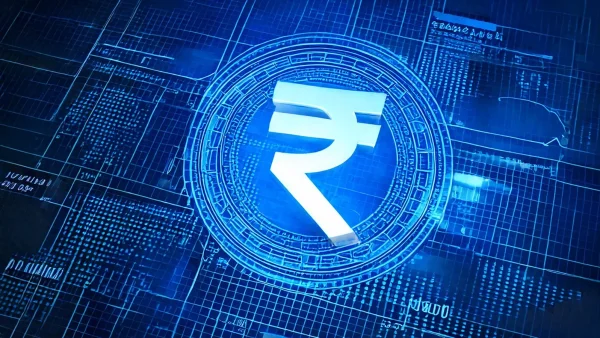
Barely a week after the Indian rupee closing transactions were gone in at less than 90 per greenback, it continued to plummet to a great extent. To be more specific, it went down to as low as 90.13 thus beating the yesterday’s nadir of 89.95 by an inch and after that it started to recover losing ground. The traders seemed to be already prepared for this fall a few weeks back, but it was the rapidness with which it slid made the market exceptionally surprised.
Small fluctuations were observed when the central bank made injections to control the situation and it seemed effective. However, the exchange rate between the two currencies did not go farther than a few points up and down during most of the trading time, thus once again pointing to the great duress that had emanated from external and internal markets. The breaking of the certain level, according to some, signals that the battle is not over.
What has the Indian Rupee Downfall Triggered
The US dollar’s strengthening is still the major point of friction. Dollar asset issuance has been a lot more attractive in the global context, resulting in the dollar index surge and, respectively, capital outflow from developing countries. Moreover, the foreign investment in Indian equities has been in the form of outflows throughout the year. The outflows are all in dollars which is directly the case when the demand for rupees decreases it leads to the currency value suffering from deficit supply.
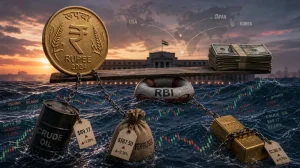
A country’s financial situation such as India’s plays an important part in the current global tension. It is clear that the growing trade deficit of the country, caused by the use of high amounts of money to purchase gold, silver, crude oil, electronics, and industrial inputs, have made the manufacturers of the country to get more dollars for the transaction. In the meantime, the slow export growth which has not been giving an equal impact, has caused the pressure to pile up on the current account.
To add on, there was also a problem with policy uncertainty. The problems concerning the United States and India trade deal have taken a long time to resolve, along with the consequences of the US’ tariffs that have taken place this year, but they have obscured what is to be the medium-term trade flows. Regardless, the importers have started to increase their hedges, which can potentially lead to the high dollar demand during stressful times.
In the case of the rupee, 90 has always marked an informal but widely recognized dividing line between strong and weak. In the past weeks, the central bank has applied certain restrictive policies in order to prevent a strong depreciation and also to regulate the pace of the market. At present the issue remains in the forefront if stronger measures should be taken.
Immediate impact on the economy
A weaker rupee immediately leads to costlier imports for the consumer, companies having to pay more for raw materials and parts from abroad and the like. Thus, higher prices will have to be paid for oil, gadgets, and household appliances which would also translate into inflation eventually, though to a small extent.
Unhedged borrowers with foreign loans will find that their repayment costs increase with the weakening of the currency. Students paying foreign tuition fees and international tourists will experience higher expenses. The positive side is that exporters will probably be more competitive but the relief can be inconsistent and may not be felt immediately and fully.
How the RBI can respond
Central bank has numerous strategies to control the instability. For example, it can utilize the reserves by selling the dollars in both types of markets, spot, and forward ones, hence smoothening the fluctuations and even managing the rupee liquidity in a manner to discourage speculative pressure. Another factor is the communication, which if it focuses on stability, can also result in confidence beingy returned to the market.
However, one must keep in mind that intervention is an interim measure, yet not a final solution. In many cases, when the instability underlying problem does not go away totally but rather slows down, the authorities would rather set up a different target than to stand in the way of the market. Thus, the main consideration is to preserve the reserves and make sure that the credibility issue is taken care of while trying to fix the target number.
Do you think the rupee will depreciate in value as well?
The key factor behind this is the huge possibility of the market being still undergoing a deep turbulence phase and also staying in that same level for whatever reason, thus, intervening with market forces or trying to peg the currency at a specific level has the secondary importance to the preservation the nation’s reserves and its credibility which equilibrium the appreciation as well as depreciation of the currencies.
There is a higher possibility that in the near term the rupee will depreciate further as according to the mentioned conditions. One of the negatives will be the weak portfolio flows as they continue to flow out while the country still has a big trade deficit.
Still, a couple of developments would be able to turn the situation around for USD/INR. One of them can be a drop in the oil price, another one, better foreign investments, or the third, a more visible progress in negotiations to help the external financing situation. Leads about the Federal Reserve policy and the dollar index shall be the sources of the main signals to be watched.
How companies and individuals can act at present
– Firms mostly dependent on imports are advised to reconsider their hedging strategies and opt for the step-by-step booking of the forward cover to avoid the risk of losing money by paying too much for the protection.
– Exporters can negotiate with banks on some currency hedges and safeguard their competitiveness with a certain amount of revenue protection.
– Corporates with foreign currency borrowings should review their open position and if necessary use the swaps or options to put a limit on the losses.
– Travelers and students may consider purchasing foreign exchange in advance or setting up alerts to convert the money at the right time and thus, save some money.
Conclusion
The rupee surpassing the level of 90 against the US dollar is a historical moment for both the markets and the policymakers. Although the depreciation can be somewhat curbed by the authorities, persisting appreciation would more likely necessitate increased inflows of foreign currencies, lessened trade imbalance and a more supportive global atmosphere. This means the next period will be turbulent trading-wise and the direction of the USD/INR exchange rate is likely going to be close to the 90 mark.