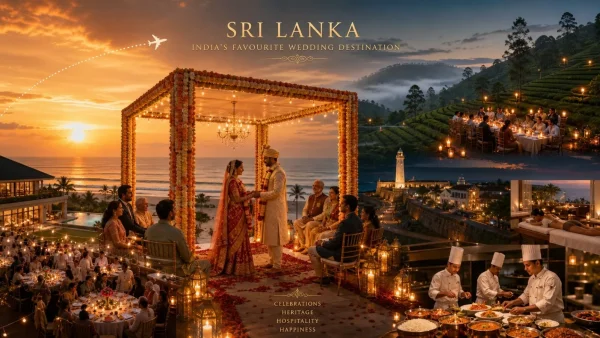
You could say Sri Lanka is moving up the ranks as Indian couples put a new spin on where to have their big day; WedMeGood has put a 25% figure on the 2025 popularity. The destination wedding is not waning despite any travel hesitancy. What you see is larger budgets and longer plans, with the appeal of being nearby outweighing the draw of a long-haul trip.
Sri Lanka’s short-haul edge is reshaping the market
In its 2026 report, WedMeGood puts Sri Lanka at the top of the list for growth. They point to the ease of access, the fact it is right next door to India, and the quality of hospitality as the why. We can expect to see a 20-25% year-on-year increase in Indian bookings to the island in the coming years.
Those in the know in the industry will tell you the same. “Sri Lanka is no longer just an option,” says Cheranka Mendis, Area Director of Communications for Shangri-La Colombo and Hambantota. “For Indians, it has become a proper short-haul luxury venue.”
The figures from the Tourism Development Authority back this up. India is still the number one source of visitors: 302,844 in 2023, 416,974 in 2024, and we are looking at over 530,000 for 2025.
Budgets climb as experiences take centre stage
Couples are putting their money in different places. Destination wedding outlay is up 8% from last year. For a domestic affair, the average is Rs 58 lakh, but if you are going abroad, you are looking at more than Rs 1.5 crore. It is less about how many guests you can fit in and more about what you can put in front of them.
Then there is the matter of time. A typical destination wedding is 3.2 days now, compared to 1.8 before 2020. Some 42% of couples are for a smaller, more in-depth kind of celebration – think well-planned menus, some downtime and a good deal of personalisation.
What you eat is part of who you are, and there is a move towards having Indian food even when you are overseas. In a short-haul market like this, it is easier to make the logistics, the chefs and the produce work.
Thailand leads on volume; Sri Lanka steps into the spotlight
If you are talking pure numbers, Thailand is still king, with 25 lakh Indian arrivals in 2025 – 16% more than the year prior. But Sri Lanka is putting on ground quicker, thanks to its location and a solid line-up of luxury hotels ready for a multi-day schedule.
Most of the 2025 action in Sri Lanka was at the top-tier spots. You had The Grand in Nuwara Eliya, the two Shangri-Las in Colombo and Hambantota, Jetwing Lagoon in Negombo and Amaya Hills in Kandy all seeing a lot of interest.
And it is not just these two. For the Indian market, there is also the pull of Bali, Vietnam and Malaysia across the region. There is a clear preference for Italy, France, Greece, Spain and Portugal in Europe, where the look of a place is as important as the smoothness of its operations.
These are the kind of numbers you get when you put 2.5 lakh consumers and some 24,000 vendors and pros from the WedMeGood network through a survey. The report’s data has that much heft to it because the segment is so well established.
Geopolitics is a test of travel, not of will
The US and Israel’s move on Iran on February 28 and what followed put some strain on international travel. With longer routes and the cost of aviation turbine fuel, airfares have been less forgiving, and some of the immediate demand has given way.
But the desire to go is there. “What we see with the situation in West Asia is that people are looking for a bit more certainty,” says Shashank Gupta, Chief Dreamer & Nurturer at TailorMade Experiences. “We’ve had a lot of interest in Sri Lanka for that reason – it’s stable, the logistics are simple and the experience is without a hitch.”
In short, the model is the same, but the map may be redrawn. A destination wedding is no longer a whim; it is a calculated plan with some built-in fortitude.
What to be watching for
According to the report, there is a rebalancing of how things are done. For the trade and for the couple, these are the changes:
– Short-haul spots are firming up their prices
– Vendors are being pushed to step up by the kind of itineraries on offer
– Cross-border logistics are held together by the menu
– Hotel clusters are turning into all-in-one operations
The line between home and abroad is blurring. In 2025, one in four weddings was a destination affair; by 2028, the report puts that figure at 30-32% for India. Venues are feeling the need to be more of a one-stop shop for planning and space.
At home, it is not just the old standbys. Dehradun, Mussoorie, Rishikesh, Shimla and Jim Corbett are in the top five, with Udaipur, Jaipur, Jaisalmer, Jodhpur and Goa not far behind. They have the suppliers and the ground game to back it up.
Sri Lanka is on the upswing because you can do a lot in a short hop. A city function, a sunset by the beach, some time at a heritage site or for wellness – it is all within reach and does not require a long drive, which is a plus for any multi-generational party.
It is not so much about the venue anymore. It is about who can put together a 3.2-day, multi-venue event with very little room for error. That is where Sri Lanka and Thailand are making their mark, and they will be the story for 2026 and on.
The figures make it plain: a 25% lift in Sri Lanka’s appeal in 2025, with bookings set to grow 20-25% a year. Budgets are running to Rs 58 lakh in India and in excess of Rs 1.5 crore for an overseas tie. The destination wedding is here to stay, only now it is made to last.