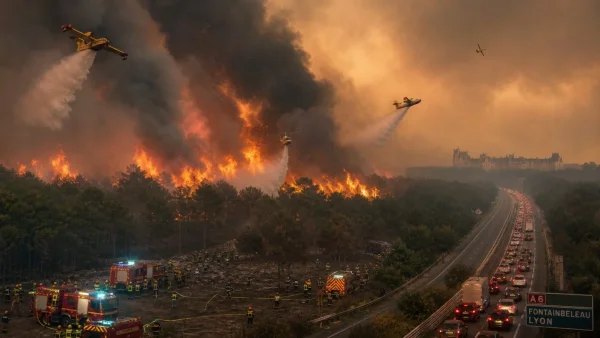
Some 60 km to the southeast of Paris, a quick-spreading fire in the Fontainebleau has made a mess of holiday travel and required mass evacuations. While authorities look into whether this was set on purpose, they have been in a hurry to get planes and ground personnel in position to put up a wall for the communities and open up the roads that need to be used.
Evacuations and travel disruption intensify
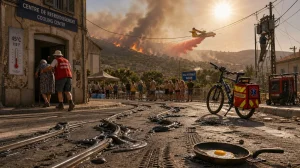
When the fire made its way toward some villages on Sunday night, residents had to be told to leave. In all, 900 or so homes were cleared, which is about half of Le Vaudoue’s population. The good news is there have been no injuries and, as of Monday, no houses have been lost.
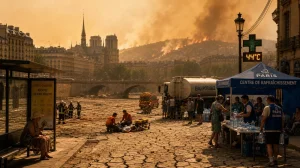
The height of the summer exodus saw traffic come to a standstill. Smoke forced a section of the A6 to be closed. Then there was the high-speed rail; at the Gare de Lyon on Sunday, some passengers were in for an eight-hour wait. Things were back to a more normal rhythm by Monday morning.
Firefighting push around a historic forest
It all started late on Sunday and 800 hectares were blackened by the time Monday rolled in. Those on the scene say it will be a matter of days, if not weeks, to see the last of the flames. The size and temper of the fire is something to be reckoned with.
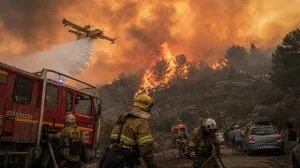
There are 400 men and women on the ground. Water-bombing planes were brought in from the south of France, with two choppers and an observation plane to back them up. Once the sun goes down, the air support is done for the day and it is up to the crews on the ground to hold the line and keep the wind from turning things around.
“We have never before had to send in water bombers from the drier south to deal with a fire in the Paris area,” said Eric Brocardi of the national federation of firemen. The priority is to protect lives and what people have built. For his part, operations chief Olivier Compta put it bluntly: without the aircraft, you would have seen more villages empty out.
Heatwave turns risk into reality
This is the third time since May that France has been under a heatwave, and the danger of wildfires has only grown with it. The kind of record-breaking heat we have seen in parts of Europe has, in some estimates, cost thousands of lives in Belgium, Britain, France and Spain. The World Weather Attribution group is of the opinion that what we saw in June simply would not have happened in the absence of climate change.
The strain is being felt in other ways. Three nuclear plants in France were put on a temporary close. Even the Tour de France had to make do with a 30-kilometre shorter stage on Sunday when the mercury neared 40C along the course.
Cause under investigation
Interior Minister Laurent Nunez was on site on Monday to put the word out that a police inquiry is underway. His view is that the fire was put in 10 or so places at once, and that does not happen by accident.
Nunez pointed out that the forest fires have been particularly bad this year, with 32,000 hectares of French land already to the torch. He also noted 44 arrests this summer for those suspected of being the ones who lit them.
What to expect next
It is a question of the weather and the lay of the land, but putting this out could be a long process. The rails are in order now, but the roads may be another story as the lines of containment move.
Here is the word from officials:
– Could be days or weeks to put the fire out
– Some normalcy at the Gare de Lyon as of Monday
– Planes are in for the night; the work on the ground goes on
– A look at where the multiple start points were
Before the Fontainebleau situation, there was another one on Sunday that put a stop to a motorway and a rail line to the east of the capital. With Bastille Day and the heaviest travel of the season in full swing, the aim is to put a lid on any new evacuations and get people moving again, while the question of whether someone made use of the heat to set fire to the country’s most popular forest is looked into.