You could say the US private sector was unyielding in June. ADP put the job count at 98,000, with services keeping the recovery where it should be. After some up and down months, this kind of consistency tells you the market isn’t about to let up, and it puts a finer point on what the Fed might do with policy before the year is out.
Hiring momentum steadies despite forecasts
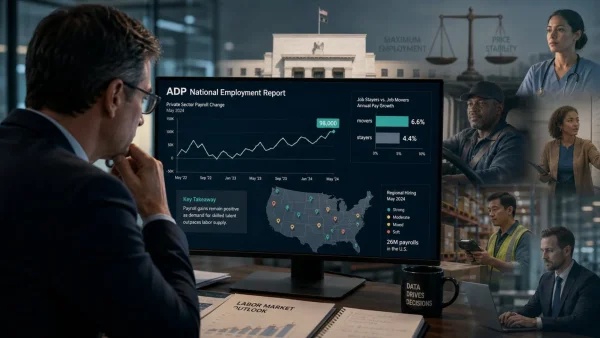
ADP Research had 98,000 on the books for June, on the heels of 122,000 in May. Bloomberg’s survey of economists called for 120,000. Either way, it’s the kind of run we haven’t seen in over a year and it means there is a firmer pull for workers in the economy at large.
It wasn’t just one area or size of company, says ADP; the increases were all over the map. They put together this data with the Stanford Digital Economy Lab from the payrolls of some 26 million private employees in the US, so it gives you a head start on the official word.
Where the jobs are appearing
Roughly half of what was put on in June came from education and health. You can put that down to a lasting need for care and schooling. But you also see it in trade, transportation, utilities and finance. When you have staff being added in nearly every corner, it’s a broad-based expansion, not a narrow one.
Pay dynamics show a split between movers and stayers
There is a divide in the numbers. ADP saw those who hopped to a new job get a 6.6% raise over the year, up from last month. The ones who didn’t make a move were at 4.4%, more or less the same. It’s a reminder that even as the heat comes off on pay in general, there is still a premium for moving around.
Nela Richardson, the chief economist at ADP, notes it’s a longer process to land a position these days and some of the old supply issues in certain industries are with us. That’s what you have to look at to understand why pay for the mobile worker is so solid, even with hiring more level-headed than it was a while back.
Why this matters for the Fed and the outlook
With openings up and few people being let go, the case for a firming labour market is hard to argue with. Should the government’s data back it up, you can expect investors to bet on the Fed having to nudge rates up to keep a lid on prices.
The report from the government on Thursday is supposed to include public-sector work and come in at 115,000 for June. If it does, we’ll be looking at the best six-month period for hiring since the middle of 2024, and it will only add to the sense of steady demand.
Key context and the next test
We are seeing some give in energy costs and there is an interim deal with Iran to put an end to the war, so confidence may well pick up. The trouble in the Middle East had been a drag on sentiment and a push on inflation. A little more demand could work its way into the numbers for hiring and wages.
Then again, what ADP shows is a prelude, not the whole story. The market will be watching to see if this kind of hiring holds and if wage growth eases to a point where the Fed is happy but doesn’t put a crimp in what families can spend.
Here is what you need to know from the release:
– 98,000 in private payrolls for June
– 122,000 in May
– 120,000 was the median call from economists
– 6.6% year-on-year for those who changed jobs
– 4.4% for the rest
– 115,000 is the number we’re after in the government report
The bigger trend behind June’s numbers
Compared to May, June was a bit of a letdown, but in the context of the last three months it is no cause for alarm. Health and education are the ballast for hiring, and most of the rest of the industry is chipping in. It’s good for growth, but it makes you watch the inflation side of things.
For the average household, the difference in raises is what stands out. You make a change, you do better. For the employer, there are still some tight spots in the labour pool, so you have your work cut out for you in places even as the market as a whole settles down.
If the official print on Thursday is in line with ADP, then the story is written: the engine is not sputtering, just running a little cooler. It leaves the Fed in a spot where it has to be careful not to stifle a market that is still putting up opportunities, while it guards against price rises.