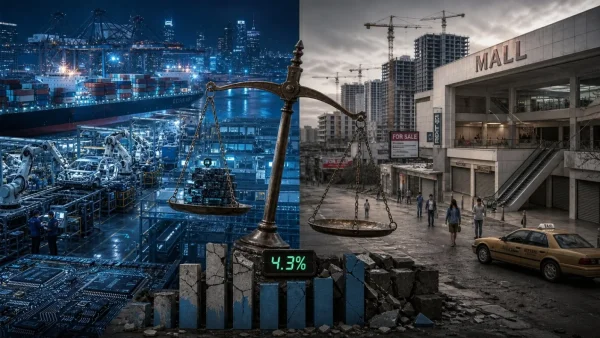
In some ways, the latest figures show a recovery that is no longer as even-keeled. The 4.3% rise for the April-June period is the softest in three years, with anemic household spending and a protracted lull in real estate more than making up for the sturdiness of the factory floor. It was not the 4.5% the market was after, and it leaves the authorities with the unenviable task of putting some heft back into the economy without opening old wounds.
Factories hum, households hold back
There is still plenty of life in the supply side. Production lines are well occupied by the likes of AI and electric vehicle makers, which in turn have propped up the export ledger.
Home front is another matter. You can see the lack of confidence in the way home prices have come down and developers have been put on a tighter rein. Then there is the Iran war and the oil shock, which has driven up the cost of power and done little for sentiment.
Growth cools below target range
The 4.3% year-on-year mark in Q2 is under the 4.5% to 5% band set for 2026. It is also a drop from the 5.0% seen in the first quarter and the least robust showing since Q4 2022.
On a quarterly basis, output put in a 0.9% gain, a bit of a let-up from the 1.3% in the first three months and in line with what was called for. Over the first half, the 4.7% growth rate means the end-of-year objective is still in play, though it will be a harder sell if the domestic side of the ledger does not pick up.
June offered a split screen
Some signs of life in the consumer data. Retail sales were up 1.0% in June, a turn around from May’s 0.6% loss and better than the 0.1% slide that was on the table. Services have been the outperformer so far this year with 5.3% in sales, well ahead of the 1.1% for goods.
The industrial side has been steady. Output in June was 5.3%, an improvement on May and above the 4.7% that was predicted. It is a testament to the kind of advanced exports that are still moving, even if the rest of the country is not as eager to spend.
Investment and property remain the brake
Where you see the drag is in capital. Fixed-asset investment was down 5.7% in the first half of 2026, steeper than the 4.9% decline and a further move from the 4.1% in the five months prior. Private money has been hard to come by, with an 8.5% fall, and the state has not been immune to a 2.3% pullback either.
With fiscal spending not keeping up, infrastructure has given up 2.4%.
Real estate has been the epicentre of the property slump, with investment in the first half off 18%, a steeper drop than the 16.2% seen over the prior five months. June brought another round of lower new home prices, if at a marginally slower rate.
External lift, internal gap
On the other side of the ledger, exports have provided some cover for the growth numbers. The first half of the year saw shipments up 17.6%, on the back of orders for AI hardware, EVs and the like. It is a one-sided story, though: while those figures keep the factories busy, home-grown demand is not holding up.
“The high-tech industrial engine is in full swing, but you have to look at the domestic consumption and investment to see how lopsided the growth is,” says Andi Ji of ITC Markets.
Policy choices as targets come into view
The conversation among policymakers is moving on from what ails the economy to how to fix it. “We see a continued emphasis on underwriting domestic demand, be it in infrastructure or consumer spending,” says Hao Zhou of Guotai Haitong Securities. He notes there is an inclination to be more measured in any support, as opposed to a blanket stimulus.
Premier Li Qiang has put in a call for a firmer counter-cyclical approach and a clear-eyed view of where things stand, according to state media. A new five-year plan was also put forward with an eye on racking up 60 trillion yuan in retail sales by 2030.
For a recovery to stick, household confidence has to be shored up. “Without more in the way of social transfers and a better safety net for healthcare and pensions, people will keep putting money aside and we won’t see a self-sustaining upturn in consumption,” Minxiong Liao of GlobalData.TS Lombard APAC puts it.
What to look for in the second half:
– Any word from the Politburo in late July
– Action to put more in the pockets of households
– Moves to ease the strain in the property sector
– How much and how fast fiscal measures are put in place
– Whether the export tailwind can be sustained
It is a tightrope for the near term. With the 4.3% mark in the second quarter missing the target band, there will be calls for more if domestic numbers wane. For now, so long as the world keeps buying, the authorities may hold off on anything too drastic.
The 2026 objective of 4.5% to 5% is still doable, even after a soft quarter. The IMF and Fitch have both put their 2026 number at 4.6%.
Put simply, China heads into the latter part of the year with its industrial base carrying the load and the consumer in the background. Bridging that divide is what will tell us if the economy can find its footing or if a harder turn in policy is in order.