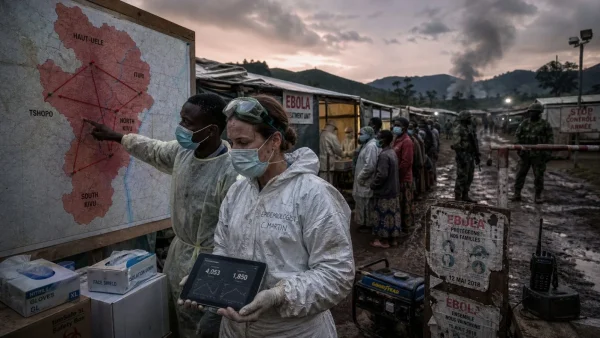
The emergency has passed a point of no return. Officials are sounding the alarm on the accelerating nature of the spread as confirmed infections top 4,000. By the government’s own numbers, there are 4,053 cases and 1,850 fatalities, which makes this the second-largest Ebola event on record and, by present reckoning, the fastest to take hold.
In eastern Congo the stakes for containment have been reset. Health personnel are having to work with what they have in an environment of conflict and limited means to deal with the virus species at hand. Some experts would have you believe the outbreak was underway months before its formal declaration on May 15.
Scale and speed
The latest figures from the government show the total has climbed to 4,053 for the first time, with 1,850 dead. It is a number that researchers and officials say makes this the quickest epidemic on record, one where keeping ahead of transmission is no easy task.
The public health institute in the Central African nation put out the new tally, noting a pace that is leaving conventional response methods in the dust and compelling some hard decisions on how to deploy resources.
Where and how it spread
One finds cases in five provinces: Tshopo, Haut-Uele, South Kivu, North Kivu and Ituri. In a number of these zones, military action has stood in the way of routine contact tracing and disrupted surveillance efforts.
There is a broad geographic footprint to the Bundibugyo virus outbreak, according to reports, which have tallied 1,850 deaths across those five provinces and put a strain on clinical capacity that was already stretched thin.
Why the outbreak got ahead
The consensus among experts is that the virus had a head start, with infections running for months prior to the May 15 declaration. The actual figure may be well above what is on the books.
A paper in Science last month put the start date in Ituri at January or before. The researchers laid out a timeline of some 500 suspected cases from mid-January through to May 15 that goes some way to explaining the current scale of things.
Those on the ground point to a combination of structural and situational hurdles. There is no vaccine or treatment in wide use for the species in question, detection has been slow and surveillance systems have been swamped.
Reports identify the principal impediments to a full response as:
– Early transmission going undetected
– Surveillance networks that are simply overwhelmed
– Field operations hampered by military conflict
– An absence of vaccines and treatments for this particular species
Global context and comparisons
Congo’s 4,053 cases do not compare with the 2014-16 West Africa crisis, where Guinea, Liberia and Sierra Leone saw more than 28,000. But the velocity of the present outbreak has raised eyebrows globally when it comes to containment.
What the data implies
To put it another way, passing 4,000 is a turning point. While the government confirms the momentum, expert opinion is that undetected cases were likely in play before the May 15 announcement. All of which points to a wider dispersal than was first thought and a sterner challenge in curbing it.
The fact that the outbreak has left its mark in five provinces speaks to complex movement and hotspots. The update from the public health institute is a call for swift isolation and case finding to put a brake on further acceleration.
Outlook for containment
If the response is to be anything other than reactive, authorities must see to it that surveillance is stabilised and that there is room to operate in areas affected by conflict. They also need to ensure proper medical tools are available for the virus in question.
It is a matter of safe care and quicker detection for the people of Ituri, North and South Kivu, Tshopo and Haut-Uele. Given the designation of this as the world’s second-largest and most fast-moving outbreak, any delay risks letting the virus run further ahead of control.