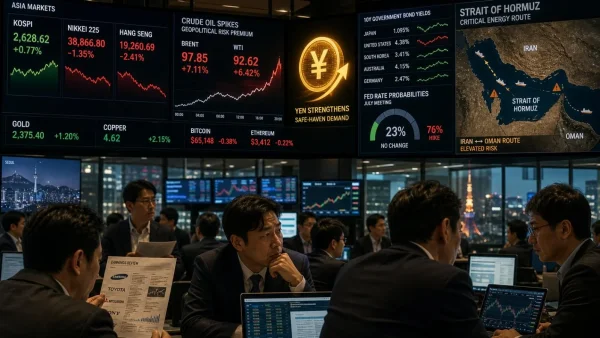
The latest spike in oil was enough to rattle Asian stocks and put investors on the hunt for safe havens as inflation concerns came back to the fore. The yen’s surge is a clear indicator of changing currency dynamics. While South Korea’s Kospi showed some defiance, Japan and Australia lagged as traders made sense of the firming yen, global interest rate direction and risk out of West Asia.
Energy traders were left on edge by new cautions from the Strait of Hormuz. Reports point to a shipping deal between Iran and Oman close to being finalised, yet there are warnings that vessels off the Omani coast are still exposed. This has prompted speculation over how Washington will react in the wake of the weekend strikes on Iranian ships.
Energy tension resets inflation calculus
As oil continues its run, it has fuelled a debate over how persistent inflation might become should energy costs hold their course. In the last session Brent crude put in a brief move past $98 a barrel and West Texas Intermediate was up 1.2% at $92.59.
You can see the unease in the bond markets. The US 10-year Treasury yield has crept up 0.6 basis points to 4.788%. With Friday’s inflation data coming up, traders are still assigning a 60% implied chance of a 25-basis-points hike in the Fed’s next two-day meeting, trying to gauge if the central bank will raise or stand pat.
Liquidity was thin to start with after the Monday US holiday, which put a damper on risk appetite and made equity futures choppy in the early hours in Asia. For now, attention is fixed on this week’s data and earnings.
Currency moves reshape the playbook
The yen has been the story, climbing to 153.94 to the dollar on Tuesday for its best level since February. That is on top of a 1.2% jump the day before which saw it go past the high set when the US and Japan had to step in to prop it up. A 0.3% gain like this carries weight across assets.
At one point intraday it was as strong as 153.51, a 0.6% move that spoke to the two-way nature of the volatility as positions were reworked. The offshore yuan was unchanged at 6.7090, and the dollar index was hovering around a two-week low of 98.82.
Equities split across the region
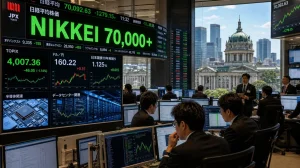
There was a general air of caution in regional benchmarks; the MSCI Asia Pacific Index gave up 0.2%. The Nikkei in Japan was down a fraction at 0.018% and the Topix fell 0.46%, no doubt under pressure from the yen and oil prices.
South Korea was an exception, with the Kospi up 1.13%. Hong Kong’s Hang Seng futures were 0.3% lower. Over in the US, Nasdaq 100 futures were all over the place and S&P 500 e-minis were off 0.1%, a hesitant handover to Wall Street.
India’s GIFT Nifty pointed to a soft opening, the implied index more than 80 points in the red. It is a sentiment shared across much of Asia where a stronger yen and costlier oil are muddying the waters on near-term earnings.
Macro signals and what comes next
It is a pivotal few days for investors. Thursday brings Oracle and Adobe to report on software demand and AI infrastructure spend, but the marquee event is Friday’s inflation print.
Then there are the commodities. Copper has made a fresh record on the London Metal Exchange on talk of Trump expanding US tariffs to include refined metal imports. Gold was 0.5% higher in early trade at $4,428.23.
Crypto has been quiet. Bitcoin inched up 0.1% to $79,333.01 and ether 0.2% to $2,498.94, in step with the pause in risk-taking among traditional assets.
Key pivots to follow as the day develops:
– Oil holding firm means inflation risk is still there
– A powerful yen makes for a tricky outlook in Japanese equities
– The market has a 60% probability on a 25-basis-point Fed hike
– Tech mood could be set by the AI earnings
Japan and Australia: local dynamics
Business spending helped the Japanese economy post better growth in the April-June quarter than the first estimates from the prior three months, though it did not meet what analysts were calling for. And with real wages up 2.4% in July, the highest in over two years, the argument for a measured policy shift is gaining ground.
Australia has taken a harder hit to sentiment. After consumer confidence took a nosedive in September, shares were down 0.6%, a stark reminder of the squeeze on retailers and households from pricier energy and borrowing.
In the end, geopolitics have put an energy shock back into the macro equation at a time when policy was finding its footing. Whether price pressures abate or compel a tighter stance will dictate Asia’s next steps given the firm yen and the inflation data due.