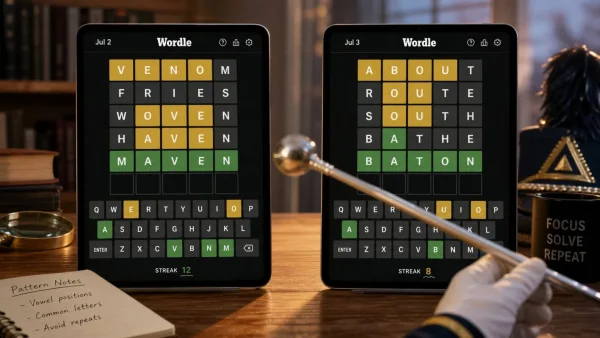
Two days in a row, two different kinds of snare. The July 2, 2026 edition (1839) had you rethinking your vocabulary, and 1840 on the 3rd put a common item right in front of you but made you work for it. If your streak was in some danger, don’t feel bad; you were in good company.
They gave you some room to maneuver, but they didn’t make it a handout. The clues would point you in a direction, the tiles would dangle options, and more than one player will tell you they had to take a Hail Mary to get it done.
Why there was some talk about these two
It’s because the answers were poles apart in how well you might know them. One is a term for expertise you don’t necessarily have on the tip of your tongue. The other is a stick you are familiar with, even if you wouldn’t be the first to type it in.
You could call it the essence of Wordle: the pull between knowing and remembering. The game doesn’t change, but the way it’s set up can be devious, and the tiles have a way of keeping you in check when your run is on the line.
Puzzle 1839 on July 2, 2026: the inside track
This one was about mastery. The hint was for an expert, someone who has their head in the game. But the most straightforward synonym wasn’t the one you were after.
Then you had the mechanics of it: five distinct letters, two of them vowels, an ‘M’ to start and an ‘N’ to finish. Some even put in a test word to see what would happen and got some color on the board for it.
The ones you needed to pay attention to:
– M at the front, N at the back
– No letter is used twice, and you have two vowels
– Try ‘venom’ and you’ll see four yellows
‘MAVEN’ was the one. It’s your go-to for a specialist with some depth of knowledge. If you only put two and two together after the fact, you’re not the only one.
Puzzle 1840 on July 3, 2026: what was in front of you
A bit of a change of pace. You could tell you were after something of a long, thin nature, the kind of thing you use in a number of things. Figuring out the five letters was where the skill came in.
Structure was your friend here. Two vowels, no repeats. And once you had the ‘B’ and the ‘N’ in place, the rest of the word started to come into focus. A good opening move or two made the difference.
Here is what you were working with:
– A long stick of some kind
– B to N
– ‘about’ puts four in the yellow zone
– Vowels are in there, but you don’t see any of them twice
So it was ‘BATON’. The kind of stick a band member twirls, or a runner hands off, or an officer has on his belt. Once it’s out there, it makes sense.
Keeping your streak alive by reading the room
The rules are as plain as day. Green is in the right place. Yellow means you have the letter but it’s in the wrong spot. Grey is a no-go.
Make the most of it and you cut down on the guesswork. On the 2nd, ‘venom’ with its four yellows was like a signpost. ‘About’ did the same on the 3rd, making a path out of the clutter.
Looking ahead
You still have six tries to put a five-letter word to bed. A new one comes in every morning and the clues are there to do away with the hiccups. It’s a good way to test your eye for patterns without any fuss.
Put both to rest? Well done. Had to have a little help? That’s fine too. For the books: 1839 on July 2, 2026 was ‘MAVEN’ and 1840 on the 3rd was ‘BATON’. We’ll be back with a new grid and a fresh angle tomorrow.