Gold has re-emerged as the go-to haven, putting on nearly 2% in early Asian trade after the new US-Iran understanding put a dent in the dollar and oil. It’s a quick change of tune on inflation and policy that should see bullion stay in vogue so long as the pressure from energy costs keeps receding.
The strategic shift: from oil shock to easing risk
US and Iranian officials have put together a framework to put an end to the months of trouble, with plans to open up the Strait of Hormuz and call off the US blockade. Pakistan’s PM, Shehbaz Sharif, put it out there that the agreement will be signed in Switzerland this Friday.
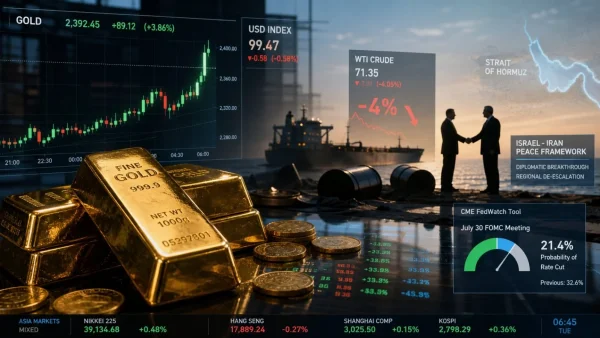
You could see the effect in the markets right away. Brent and US crude were down over 4 per cent on the idea that we might see some Iranian exports and a let-up in supply worries. Since energy is at the heart of inflation, that kind of repricing makes gold's hedging value hard to ignore.
Gold seizes the haven lead from the dollar
The dollar’s retreat only made it easier. The greenback was at a 10-day low versus its peers and the index dropped under 100. When the dollar is weak, gold is a better buy for those with other currencies, and you can count on that to drive some cross-border interest.
Even with risk sentiment in better shape, bullion is moving because of the way the currency and rate outlook have been put in order. For the well-diversified investor, it’s a compelling mix.
Key market moves at a glance:
– Spot gold is up 1.8 per cent to $4,297.42
– US gold futures are 1.9 per cent higher at $4,318.10
– Oil is in the red by more than 4 per cent
– The dollar is at a 10-day low
– The dollar index has given up ground below 100
Policy expectations tilt, aiding non-yielding assets
Then there are the rates. With less of a chance of inflation being stoked by energy, traders have dialed back their wagers on the Fed to do more tightening later in the year. Gold doesn’t pay you to hold it, so when the talk of rate hikes cools, it tends to do well.
CME’s FedWatch has the odds of a December hike at 64%, a bit lower than the 69% we saw last week. On a metal where opportunity cost is everything in a high-rate world, even a little like that counts.
From recent lows to one-week high
It’s a come-back of sorts. We had a lull earlier in the month when the spillover from the US-Israeli situation with Iran drove oil up and made people nervous about inflation. You could feel it in the mood; capital was heading for the safety of cash and the dollar.
Monday put an end to that. As of 0010 GMT, spot was 1.8 per cent in the black at $4,297.42 an ounce, the best it’s been since June 9. August delivery for US futures was 1.9 per cent up to $4,318.10. It shows how fast a geopolitical turn can change who’s in charge of the commodity space.
What to watch next
Now the question is whether they can make good on the deal. A signature on Friday would cement what we’ve seen in oil and the dollar, but we’ll be looking to see if shipping in the Strait of Hormuz gets back to normal and how much supply comes back into play.
For an investor, the choice is straightforward. If crude holds at these levels and the dollar remains soft, bullion has the edge on cash and the like. But if the market starts to think the Fed is going to get tougher, the metal won’t be without some headwinds.
Here are the near-term signposts investors are on to:
– Any word on the Friday signing
– Signs of traffic in the Hormuz returning to usual
– Oil following through on its drop
– How the Fed and real yields are being priced in
In short, the peace plan has taken some of the sting out of the energy markets and given gold room to run as a macro hedge. The dollar is on the defensive and rate jitters are down, so the bid for bullion is holding up – until we see the fine print and put it to the test.