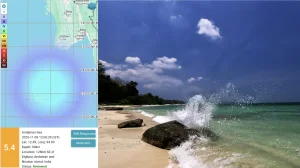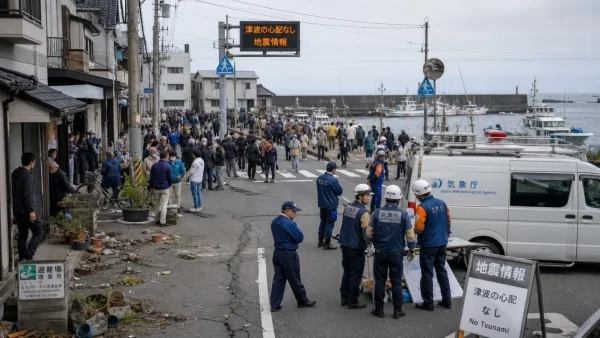
According to the Japan Meteorological Agency, the epicentre was close to Okinawa Main Island. At 50 km down, it was a moderately deep one, but that didn’t stop the ground from moving with some force in the southern part of the country.
Here are the confirmed points officials have shared so far:
– Magnitude 5.9 earthquake
– Intensity upper 5 on the Japanese scale
– Depth recorded at 50 km
– Focus near Okinawa Main Island
– No tsunami warning issued
– No immediate casualties or major damage
Shaking across the south
In the worst of it, the JMA put the intensity at an upper 5 on their 0-to-7 scale. You can expect things to come off the shelves and people to be rattled, but it doesn’t quite reach the level where you see real destruction.
What authorities have said
We have NHK to thank for the word on the 5+ readings. If you were in any of the towns in those prefectures, you would have been in on the jolt. Some buildings gave a little, and folks in the neighbourhoods made for the outdoors as the tremor went through.
Key information at a glance
There was a bit of a stir in some places as the strong tremors rolled in. But as authorities have done their initial walk-throughs, they haven’t found any serious harm to the infrastructure in the main hubs. And the agency has been clear: no tsunami risk.
It was a sudden lurch more than a long roll, by all accounts. Since there was no advisory, the ports and transit in the southwest could carry on without a hitch.
Second alert within days raises preparedness questions
This one puts a spotlight on the alerting systems here. Not that we needed a reminder; this was only four days after a strong one off the coast of Honshu that put a crimp in train service and set off alarms in Tohoku. No harm or tsunamis there, either.
Why this matters
When you’re on the Ring of Fire like Japan is, this is just part of the landscape. A day like Wednesday shows how fast things can turn, whether you’re in the northeast or down in Okinawa.
Even when you don’t have to deal with the aftermath of a big one, having back-to-back warnings is a test of how well the different levels of government can work together. A quick “no tsunami” from the top helps you avoid a mass exodus while you stay in the loop.
You only have to look at 2011 to know what’s at stake. That 9.1 off the east coast, with its 15,000 dead and the mess at Fukushima, is still fresh in memory. This was nothing like it, but it’s a nudge to stay on your toes.
What comes next
For now, officials are out and about making sure everything is sound. For the people and businesses in Kagoshima and Okinawa, it’s a good time to be ready. There’s no threat from the sea, so life goes on as the all-clear is put in place.