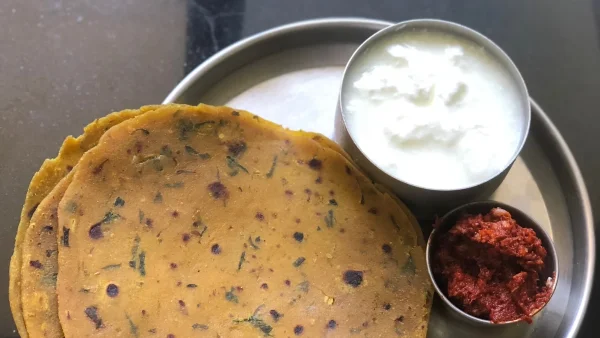
When you are planning your next trip and want a meal you can count on, this is what you pack. The thepla and its yoghurt accompaniment make for a good bite that doesn’t make a mess, holds up at room temperature, and keeps you going when you’re in transit.
Why you’ll see it in every Indian rucksack
Out in western India, this has been the go-to for as long as anyone can remember, and for good reason. The soft, golden-green thepla is made to handle a bumpy road or a long train ride. A drier cook and the right mix of spices mean it won’t get soggy if you put it away for a few days.
It is unobtrusive in a lunchbox – compact, stackable, and easy to put down. And even when it’s not warm, it still has plenty of character, which is handy for an early departure or a late one.
What makes this one different
With our version of thepla and curd, the fresh fenugreek is the star, not an afterthought. You get an earthy, herbal quality and a bit of a green tint from the leaves. Some theplas don’t use much, if any, but here it is front and centre.
Then there is the curd. It is a cool, creamy foil to the thepla, taming the faint bitterness of the fenugreek and letting the other spices have their say without being overbearing.
On the palate
The thepla is soft with a hint of a crisp edge and a mellow kind of heat. Have it with some cold yoghurt, a bit of pickle or chutney, and it is just right.
The numbers and what you need
We like to be precise with the ratios so you get the same old result. It is all about having a firm hand with these pantry items:
– 1 cup of chopped methi
– 2 cups whole wheat flour
– 1/2 cup besan
– 2 tablespoons of curd
– 1 tablespoon oil
– 1 tsp turmeric
– 1 tsp red chilli powder
– 1/2 tsp ajwain
– Salt and water, as you see fit
Put that together and you have a dough that is thin enough to roll but won’t give way, and it will cook up into something that can stand up to travel.
Putting it in order
Toss the flours in with the methi, your turmeric, chilli, ajwain, salt, curd and oil. Work in some water a little at a time and knead it to a smooth finish.
Give it ten minutes to rest and hydrate. Then break it off, roll it out, and put it on a hot tawa. Cook until you see some colour on both sides. A brush of oil is fine. Put it in front of someone with some chilled curd and you are set.
A few things to bear in mind
Small details are what keep the texture and longevity in check. Here is how to do it right:
– Go for the freshest, most tender methi you can find.
– Make sure to wring the moisture out of the leaves first.
– The besan is what will keep the thepla from hardening up.
– Don’t add too much water; the methi will put some out on its own.
– Thin is better for even cooking.
– Let the dough sit before you start rolling.
Some facts and figures
There is no artifice to this meal. The whole wheat is your carb, the besan is for protein and fibre, and the methi has its share of iron and plant-based good stuff. The curd is where you get your probiotics and calcium, for a plate that is kind to your system.
You are looking at around 140 calories a piece, so it is fine for a morning, a mid-day pick-me-up, or a light supper. It is as good coming off the tawa as it is in a container for later.
So why the love? It is because you can trust it. It will be as good at room temp as it was when you made it, which is why you see it on trains and in briefcases.
Can you substitute? Sure. Leave out the besan and use only whole wheat, but you will miss the softness and a bit of protein. No fresh leaves? Kasuri methi will do, with a note of difference in the taste.
And the curd? It is there to put out the fire of the spice and to make the fenugreek pop. It is the contrast that makes the meal worth having, from the first to the last.
These days with all the pre-packaged options, the thepla and curd is the home-cooked solution to a busy life. It is not complicated to put together, you can take it with you, and it is a pleasure to have, be you on your way to the office or in the middle of a holiday.