A sharp rise in turnout and a tragic death marked the opening days of this year’s Amarnath Yatra. Officials reported over 56,000 pilgrims offered prayers at the cave shrine in the first three days, even as a devotee from Uttar Pradesh died after a snakebite at Jammu’s Bhagwati Nagar base camp.
Attendance surge and registration squeeze
Authorities said the flow of devotees between 3 July and 5 July exceeded last year’s pace by nearly 18.6 per cent. The comparable figure for the same window in 2025 was 47,972 pilgrims.
With demand outpacing capacity, the administration has declared registration slots fully booked until 9 July. Only those with confirmed registration are being allowed to proceed towards the shrine.
Pilgrims without valid permits are being stopped at check posts and will be allowed onward travel only after 9 July, subject to availability. Officials have urged devotees to defer travel to base camps until they secure a slot.
Tragic death at base camp
Amid the rush, a pilgrim from Uttar Pradesh, identified as Amit Kumar, died after being bitten by a snake at the Bhagwati Nagar base camp early Sunday. Officials said the incident occurred around 2:30 a.m.
He was immediately shifted to Government Medical College Hospital, where his condition deteriorated during treatment. Doctors later declared him dead. Authorities have not indicated whether additional precautions will be introduced at the base camp.
Fresh batch moves under tight security
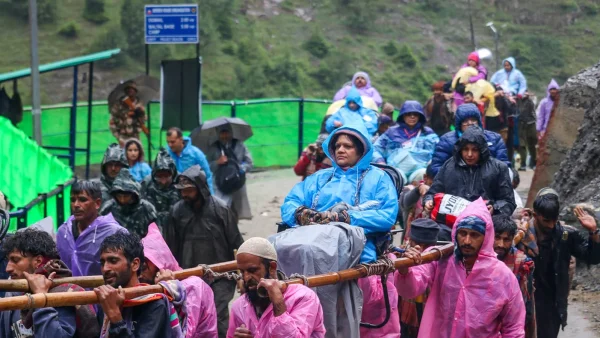
Despite the incident, outbound movement continued. On Monday, 6 July 2026, a fresh batch of 5,794 pilgrims, including 1,211 women, left the Bhagwati Nagar base camp under tight security, according to officials.
They added that the fifth batch included 21 children, 599 Sadhus and 76 Sadhvis. The convoys departed between 3.10 a.m. and 3.45 a.m., splitting towards the two routes.
Of these, 3,490 pilgrims in 139 vehicles were bound for the Nuwan base camp in Pahalgam, while 2,304 pilgrims in 128 vehicles headed to the Baltal base camp. Officials also said around 60,000 pilgrims have offered prayers since the yatra began on 3 July.
Routes, safety and what to know
Pilgrims are trekking on both corridors: the traditional 48-kilometre Nunwan-Pahalgam route and the shorter but steeper 14-kilometre Baltal route. Security and logistical arrangements have been reinforced across the mountain stretches.
Rescue teams are active on the slopes, with the Mountain Rescue Team providing oxygen support when needed. Porters, palanquins, and ponies remain available from base camps to assist those who require help.
If you are planning travel in the coming days, officials stress these checkpoints:
– Only registered pilgrims are permitted onward movement
– Unregistered devotees will be stopped at designated check posts
– Slots are fully booked until 9 July
– Post-9 July travel depends on slot availability
Shrinking ice lingam and the road ahead
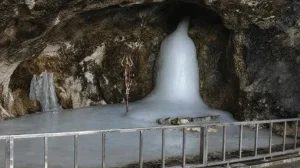
The naturally formed Shivling inside the cave has reduced in size over recent weeks. Photographs released by Border Security Force personnel on 23 May showed it at approximately seven feet.
By 29 June, when the first puja was performed, its height had reduced to more than five feet. Latest images from 3 July indicate an approximate four-foot height, with a noticeable reduction in width.
The 57-day pilgrimage to the 3,880-metre cave shrine began on 3 July and is scheduled to conclude on 28 August, coinciding with Raksha Bandhan. The yatra traditionally culminates with the Chhari Mubarak procession reaching the cave.
Why the numbers matter
The higher early turnout signals renewed confidence in the arrangements and improved access on both routes. But the registration cap underlines the limits of mountain infrastructure at peak demand.
For devotees, the message is clear: plan ahead, register in advance, and follow official advisories. For authorities, the focus remains on safety, regulated flow, and ensuring a dignified pilgrimage experience as the season intensifies.