Adani Defence has moved to reshape India’s missile supply chain, committing Rs 2,500 crore to a new complex in Shivpuri, Madhya Pradesh. Framed as South Asia’s largest private-sector missile ecosystem, the project pulls the entire value chain under one roof and targets faster, homegrown production under Aatmanirbhar Bharat.
Strategic shift in India’s missile supply chain
The company says the Shivpuri site will be the first in India’s private sector to take missiles from raw materials to mission-ready systems at a single location. Executives positioned it as a break from import dependence, built in close coordination with the Armed Forces and the DRDO.
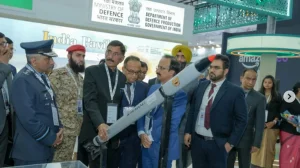
Images from the ceremony showed Jeet Adani alongside Union Minister Jyotiraditya Scindia and Chief Minister Mohan Yadav as ground was broken for the facility in Shivpuri, signalling high-level political backing for the project.
Here are the headline numbers behind the plan:
– Investment of Rs 2,500 crore over the next three years
– 5,000 direct and indirect jobs projected
– Over 50 MSMEs expected in the supply chain
What the Shivpuri complex will build
Adani Defence plans to manufacture medium- and long-range missile systems at Shivpuri. The site will include a missile complex, a composite propellant complex and a TNT complex, with capacity for explosive-grade material production.
Company leaders stressed the move goes deeper than assembly. By internalising composite propellant and TNT manufacturing, the unit aims to secure critical inputs, reduce lead times and control quality across the production cycle.
Impact on Madhya Pradesh’s defence cluster
The Shivpuri facility is designed to complement Adani’s existing operations in Gwalior, which produce light machine guns, assault rifles and carbines. The firm said its Light Machine Guns programme has already delivered 2,000 units to the Armed Forces, 11 months ahead of schedule.
Together, Gwalior and Shivpuri are being positioned as twin engines of defence manufacturing in the state. The cluster approach aims to pool skilled labour, advanced processes and MSME partners to support a sustained pipeline of defence orders.
Collaboration and self-reliance push
The project is aligned with the government’s push for self-reliance in defence. Adani Defence said it is working closely with the DRDO and the Services to replace foreign dependency with domestic production, framing Shivpuri as the next leap in that strategy.
Bigger bet on Madhya Pradesh’s economy
The missile ecosystem fits into wider Adani Group plans in the state. At the Global Investors Summit in Bhopal last year, Chairman Gautam Adani announced Rs 1.10 lakh crore of investments across hydro pumped storage, cement, mining, smart meters and thermal power, targeting 1.2 lakh jobs by 2030.
According to the company, over Rs 4,000 crore has already gone into the Ametha and Kymor cement plants in Katni district. Adani Power supplies 1,200 MW to Madhya Pradesh, with another 5,600 MW under development, and wind energy projects are underway in Dhar, Ratlam and Ujjain.
The group also pointed to a proposed cement plant in Ujjain and the recently launched Rs 1,060-crore cement project at Guna. At the Shivpuri event, state leaders additionally inaugurated and performed the groundbreaking for development projects worth Rs 211.29 crore.
Why this matters now
For India’s missile programmes, integrating propellants, explosives and final assembly in a private plant could shrink production cycles and broaden capacity beyond legacy setups. For Madhya Pradesh, it creates a defence corridor anchored by two specialised hubs drawing in over 50 MSMEs.
Over the next three years, the focus will be construction, workforce build-out and supplier onboarding. If timelines hold, the Shivpuri complex could become a pivotal node in India’s missile ecosystem, reinforcing the private sector’s role in high-end defence manufacturing.