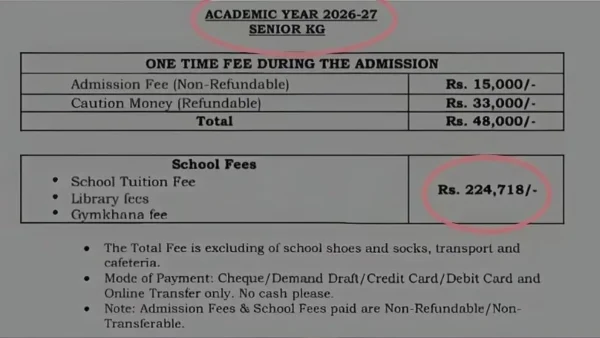
That one picture of the fees for kindergarten has brought up the problem of school getting more expensive in India again. It shows that a year of early education will cost over Rs 2.5 lakh, which makes many people ask: are parents paying very high prices just for their kids to learn “Twinkle Twinkle Little Star”?
What the fee sheet shows
The picture that’s been shared shows a one-time fee of Rs 48,000 to get in, made up of Rs 15,000 for the admission itself and Rs 33,000 as a security deposit you get back. Then the yearly fee is about Rs 2,24,718 for classes, the library and use of the gymkhana (sports facilities).
The schedule specifically says certain costs aren’t in that amount. It doesn’t include the bus, lunch at school, or even shoes and socks. It also says parents have to pay in official ways and that some of the fees won’t be given back or moved to another time.
When you add together the initial and yearly costs, the total for one year of kindergarten goes over Rs 2.5 lakh. For many families, this is closer to what you’d pay for university than for preschool.
Why do kindergarten fees climb this high?
Parents visiting nicer or international schools in big cities are usually told a lot of good things. The schools talk about classrooms with air conditioning, areas for activities, swimming pools, skating rinks and meals served at school. They promise a safe, complete experience with a look at the world and lots of things to do outside of lessons.
But all of those features cost real money to have. The price of land in cities, security systems, food that follows the rules, buses, and following all the regulations all add to the costs of running the school. Schools also say they spend money on training for teachers, special staff and ways of teaching that use technology and go beyond the normal curriculum.
And on top of that, prices in general are going up. It’s not unusual for private schools in cities to raise fees by 8 to 12 percent each year. This leads to fees increasing quickly, and soon becomes too much for families in the middle classes to afford, especially if they have more than one child.
Do higher fees equal better learning?
This is where people disagree. A lot of parents think that better buildings and smaller classes are worth the extra money. They also believe that organised activities outside of lessons help children gain confidence, improve how they communicate, and learn social skills early on.
However, others say how well a child does depends more on the teacher, how much time is spent in the classroom, and how much the family is involved, rather than on expensive facilities. They point out that some government and cheaper private schools provide a good start to learning, specifically in reading and math, without all the luxuries.
Experts usually suggest finding a balance. Buildings are important for safety and to give children a wider experience, but they shouldn’t be more important than how things are taught. Clear goals for learning, good teachers and a way to see how well students are doing are the most reliable ways to tell if a school is good.
Public reaction captures frustration
The discussion really started when Sakshi, a person who writes computer code, shared a picture of the fee breakdown with the words “Rs 2.5 lakh for learning Twinkle Twinkle”. Lots of people saw the post and thousands expressed shock and anger at what they think is an unreasonable amount of money for kindergarten.
Many comments said that these kinds of fees are now normal at better schools. Others asked if early education should be considered a luxury. These different reactions show a deeper disagreement about what parents think is most important in a child’s first years at school.
What parents can do before paying a premium
Think about the total cost of everything. Add up the tuition, admission fees, deposits, bus fares, lunch money, uniforms, books and the cost of activities. Compare the total cost of each school, not just the amount for tuition.
Get all the details. Ask for a written list of all the fees, what happens with refunds, and how much the fees will go up each year. Find out what’s required and what’s not, and what happens if you take your child out during the year.
Check the quality of the education, not just the facilities. Look at the number of students per teacher, the teachers’ qualifications, if you can watch a class, and how student progress is measured. Ask for examples of lesson plans and how students should be doing in reading and math at the beginning of school.
Find out about extra help. Understand the school’s safety rules, if there’s someone to talk to, help for children with special needs, and what the school does if a child gets sick or there’s an emergency. These things can be key to deciding if the extra cost is worth it.
Look at other options. Think about good, middle-range private schools, schools in your neighbourhood that have good results, or public schools that have done well. See if there are scholarships, discounts for brothers and sisters, or ways to pay in instalments.
The policy and market path forward
Parents who want help with the costs want two things: to know what to expect, and to have the costs clear. If schools gave full details, put reasonable limits on fee increases during the year, and had someone independent checking the extra charges, families could plan better.
Schools, on the other hand, want to be able to spend money on quality and safety. A fair system that rewards being open about costs, checks the extra fees, and helps children from poorer families could reduce the tension without stopping schools from being innovative.
The fee schedule that went viral touched a nerve because it showed a very clear problem. Early education is very important, but it’s now being sold as something expensive. Until being open and getting good results are the main focus, the question will remain: what are families actually paying for when kindergarten costs as much as university?