There is a new objective for what is now the most in-demand market in South Korea: to make a case for joining the MSCI’s developed-market fold. Given how much the Kospi has climbed this year, Seoul is at a crossroads that will have an impact on everything from fund flows to where the country sits in the global indices.
You can put the date in your calendar for June 23rd, when MSCI will do its once-a-year review of how it classifies markets. Being put on a watchlist is the way to start, but it is about more than a name change; it is about capital, risk and how you are governed.
Why MSCI status matters now
It is not all about the optics. BNP Paribas Securities figures that as many as $30 billion in assets could come in as index hounds adjust their books. That would be a nice counterweight to the kind of rough patches we have seen in Korea of late and open the door to more permanent holders.
Then there is the matter of the Korea Discount, the valuation chasm that has been with us for a while. Wei Li, who heads up multi-asset at BNP, says an upgrade would put a different spin on the place – no longer just an EM with high growth, but a solid DM holding and part of the supply chain you can’t do without.
You might see the market calm down, too. Kieron Poon of Aberdeen Investments points out that the type of investor you get in a developed market is after sustainability and good governance, not just the next quick pop. Some of that restraint would be welcome after one of the more erratic weeks in recent memory.
AI trade eclipses the label
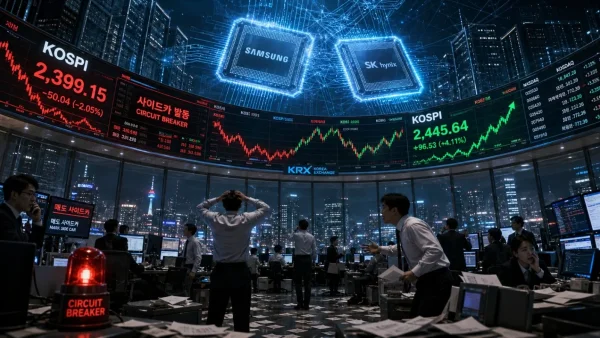
Some are of the view that a reclassification won’t be the end-all for Korea’s story. Put Samsung and SK Hynix together and they are well over half of the Kospi; in effect, the market is a stand-in for the chip frenzy you see everywhere else.
‘In a way, it is a moot point because Korea is a global play now,’ says Arjun Jayaraman of Causeway Capital. ‘You are not in there for Korea. You are in there for the AI.’
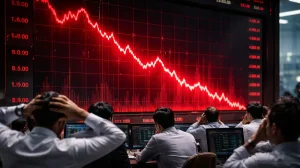
Sure, that has been the engine behind the Kospi’s performance, but it has also ratcheted up the danger. The benchmark has set off exchange circuit breakers time and again, a reminder of how a market like this can be more of a rollercoaster than its neighbours.
What could hold Korea back
Access is the rub. MSCI put Korea off its watch in 2014 over things like currency rules. And as recently as last year, they were still pointing to FX and compliance as areas that needed work.
Things are moving in the right direction. Short selling is back and won trading hours are set to be lengthened in July, which is what the big investors have been after. President Lee Jae Myung has made it a priority to clean up the capital markets.
Even so, if you talk to the 15 or so people Bloomberg has spoken to, the feeling is MSCI will leave Korea in the emerging camp for the time being. The reforms have to show they can hold up first.
Then again, the way the wind is blowing, you could say it’s only a matter of time. “It is more of a matter-of-time issue,” is how Young Jae Lee of Pictet Asset Management puts it.
A market of unprecedented scale
If you go by the old numbers, Korea is a developed economy in all but name. In the last 12 months or so, the equity market has put on nearly three times its value to hit $4.4 trillion, and for a while it was even bigger than India’s, making it the sixth in the world. You have firms with a firm hold on the supply side of semiconductors, batteries and manufacturing.
You don’t often see a reclassification of this order. Chetan Seth at Nomura calls it “unprecedented.” He can’t point to any recent case where a market with as much heft as Korea’s has made the jump. And when it does, both EM and DM allocators will feel it.
Right now, South Korea is 23% of the MSCI Emerging Markets index. Compare that to Greece or Israel, the last to be made DMs; they were a lot smaller when they were put forward. A move for Korea would mean a wholesale reworking of EM trackers and the strategies built around them.
Flows, limits and the path to stability
There has been a lot of cross-border shuffling to go with the volatility. This year alone, we’ve seen some $78 billion in foreign outflows from Korea, no small part of it due to the run-up in the tech names. When funds ran up against single-stock caps in the likes of Samsung and SK Hynix, they had to sell into strength.
Some of that mechanical selling could be a thing of the past if Korea is let into the developed club. Park Jinho of NH-Amundi says the limits may be relaxed with DM status, giving investors room to put their money where they are most sure of themselves.
You also get a different kind of investor. The typical DM mandate is less churning and more focused on governance, which could do away with the need for the exchange to put in place the kind of safeguards we’ve been seeing of late.
The decision point and what comes next
All eyes are on June 23rd to see if MSCI will put Korea on the developed-market watchlist. Most are in a wait-and-see mode, but there’s little question where this is heading. Yi Ping Liao of Templeton Global Investments sees policy as a factor that makes inclusion more likely down the line.
For those wanting to size up the situation before the call is made, here are the figures:
– 23% of the MSCI EM index
– A 90% plus run in the Kospi
– $4.4 trillion in value
– Over $78 billion in outflows
– Some $30 billion in potential DM inflows
– Longer hours for won trading come July
Should MSCI add Korea to the list, a full upgrade will still depend on some housekeeping in terms of accessibility and operations. If not, the AI boom will probably keep the classification talk at bay until the waters calm.
One way or another, Korea is done with the old EM playbook. It is the front line in the chip wars now, and while index status and reforms will give it an edge, they aren’t what’s moving the needle. MSCI will just determine how fast the rest of the world’s capital gets on board.