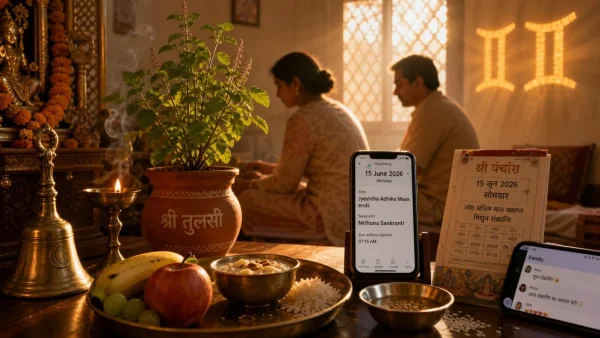
You can tell it’s a day like this when the phone won’t stop ringing before you’ve even had your coffee. People are asking: does the extra month end today? Is Mithuna Sankranti the one to follow? When can we pick up where we left off with our plans? With so many calendars showing the two in step, there is a need for some straight talk on custom and timing.
Why you’re seeing two signals this week
If you look at the panchang PDFs and event round-ups for New Delhi, Adhik Maas is set to wind up on or about June 15, 2026. You’ll see a number of them put down June 15 as the day Jyeshtha Adhika Maas is over and the Sun has made its way into Mithuna, or Gemini. That’s what’s driving the inquires at home.
But don’t expect the same date to hold in Toronto, Dubai, Singapore or Sydney just because a Delhi almanac says so. Once the sun is up, you start to see the local side of things. Tithi and Sankranti are not one-size-fits-all. If you are outside India, the best thing to do is go by the panchang for your own city.
So what are we putting to rest? Adhik Maas, or Adhika Masa, is the intercalary month we have to make the lunar and solar sides of the calendar agree. In a lot of Vaishnava households it is known as Purushottam Maas, and is given over to Shri Vishnu in his form as the Supreme Being.
For a while, the faithful will be at japa, or doing some dana and vrata. There is an inwardness to it, and that puts a certain spin on the last day. It is more than a change of date; it is the kind of feeling you get when a spiritual undertaking from weeks back is finally put to bed.
How it ends in the home
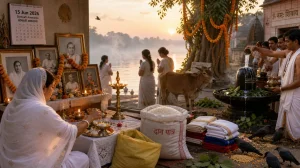
Go in on a morning like this and you won’t find much in the way of show. An early bath, the altar put in order, a few lamps and a word to Vishnu or Krishna. Some water for the Tulsi. The food is sattvik, and the whole atmosphere is more hushed than you might think.
Those who have been at their books may put them down for the last time. A bit of the Gita, the Vishnu Sahasranama, or something from the Bhagavata. And if a vrata has been in place for a month, you will often see an udyapana – a proper way to close it out with a little offering to a priest or someone in need.
There is no point in making it complicated. In most of the Smriti ways of doing puja, it is the achara, the way ‘we’ have always done it, that counts. A simple rite with some shraddha behind it is no less for being unadorned.
Mithuna Sankranti: a matter of the sun and where you are
Then you have Mithuna Sankranti, which is all about the Sun crossing into Mithuna rashi. It is a solar thing, and that is why it can be confusing to have it land on the same day as a lunar one. They are not the same, even if they are side by side on the page.
What you do for Sankranti is usually a ritual bath, some charity, and giving due to the Sun. You might be pouring arghya at dawn, or putting sesame and rice in a donation. It is a different sort of observance.
It is hard to say which will be more of a presence without knowing where you are. In Odisha, the Raja Sankranti period has a way of overshadowing the rest. In some of eastern India, the solar move can put the end of Adhik Maas in the background for a while.
It comes down to the kind of panchang you follow. The amanta and purnimanta systems put Adhik Maas front and centre. But in Tamil, Malayalam, Bengali, Assamese and some of the Odia world, where the solar side is stronger, Sankranti is the one you are more likely to be thinking about at home.
And after the lull?
Families will ask you point blank: now that the extra month is over, can we go ahead with what we put on hold? Be it a wedding, an engagement or a griha pravesh, these samskara are usually in abeyance. Everyone is looking for a yes, but it is not that easy to give one.
The priests and the older ones in the family will be on the lookout for a muhurta that is right for the occasion and the spot. Just because the month is done doesn’t mean any hour is open for business. You still have to factor in the tithi, the nakshatra, the day of the week and so on.
A short answer can be deceptive. The end of the month is your cue to make plans, not necessarily to act. Your panchang has the details. Use it to find a good opening rather than let the calendar make the call for you.
Some will use the day to be a bit reflective. A chapter of the Gita, or a recitation of Om Namo Bhagavate Vasudevaya. For those who have been at it all month, it is a fitting note to end on.
You can tell a lot by how some people put their day together: an uncluttered altar, a no-fuss plate, and a thankful head.
Simple plates, old mistakes, clear answers
What you eat today is down to the way your household has always done things. There’s no one-size-fits-all for India. You’ll see light, sattvik fare in most places, with the odd home leaving out onion and garlic as part of the fast. It’s about being easy on yourself after a month of holding back, not making a show of it.
In Maharashtra or Gujarat, you might have some dal, rice, roti, a bit of dudhi or lauki, maybe some kheer or fruit. A Telugu or Kannada family will put up a humble naivedya for the deity before they sit down to their own meal. And where Sankranti is the bigger deal, you’ll find offerings to Surya coming first.
These are just different ways of putting emphasis on the same thing. In the North, when you hear "Adhik Maas khatam ho raha hai,” it usually means it’s time to get around to what was put off. Vaishnavas, for their part, are often just giving thanks for the extra nama japa they’ve put in over the last few weeks.
Where the moon has a strong hand in the family, like in parts of the west, the end of this extra month is something you don’t want to miss if you’ve been into your readings or fasting. Over in Odisha, Mithuna Sankranti and the local temple’s rhythm tend to be more of a factor than the lunar calendar.
Some of you make the same blunders. Here is how to avoid them:
– Don’t take every e-card at face value
– Leave Ekadashi parana rules for another day
– Not everyone needs a grand send-off
– If you’re overseas, check a panchang
Take New Delhi in 2026: most panchangs will have you closing on June 15, with Mithuna Sankranti on top of it. But if you’re in a different time zone, don’t let convenience win. A couple of hours after sunrise can change which morning you’re on.
If your house does both, there’s no need for a tangle. You can have your Vishnu prayers in the morning and your arghya to the Sun at the same time. The intent is the same even if the calendars aren’t.
When you get home, keep it small. Put a lamp on, give some water to the Tulsi, set out some flowers. Make a prayer for what’s to come. Any donations you put aside for the month should be given before or on the day it ends.
For those who like a straight answer, here you go:
– June 15 in Delhi? Yes.
– Good for charity? Both the close of Adhik Maas and Sankranti are.
– Do I have to throw a feast? No. A little goes a long way.
– Can I start up all my good works? See what the muhurta says.
If you have kin in another country, my advice is to open a panchang for their city before you plan anything. The truth is in the sunrise column, not in a card someone forwarded from a different longitude.
On paper, having a lunar and solar event on the same day looks like a headache. In a home, you just go with what you know. Start with tradition, verify the date, and keep the altar and your charity in order.
This month was meant to set the calendar right, but really it was for you. Your japa, your vrata, your quiet work. When it’s over, you don’t want a break in the routine, just a steady way forward.
Are you more of a Mithuna Sankranti person? Then do your Surya upasana like you were shown. Did the Adhika Masa run your month? Then see it through with some reverence to Purushottama. One way or the other, you’re looking for the same kind of renewal.
And to the relative who wants to know which one wins when they overlap: it’s not a competition. If your year is guided by the moon, the Adhik Maas is the centre of attention. In a solar region, Sankranti is.
Worried that a home ritual isn’t enough? It is. We don’t do uniformity in the house. What matters is you mean it. A lamp you light with some thought is worth more than a fancy rite you put on without feeling.
So for the planners out there: pin down the city, then the date from a local source. If you have something to restart, find a clean muhurta and let the family in on it.
There is a certain satisfaction in an ending, or perhaps a sense of relief. The calendar gives you the lines, but you put the meaning in. On June 15 in New Delhi, you’ll have both. Be ready for them.