New Zealand did very well to get a 61-run win over Sri Lanka in Colombo, and now has a better chance of going further in the Super 8s. They scored 168 for 7, and then got the home team all out for 107 in 20 overs, at the R Premadasa International Cricket Stadium.
How the match went
The Black Caps set a hard 169 to beat, after a strong end to their batting from captain Mitchell Santner and all-rounder Cole McConchie. Sri Lanka wasn’t able to make the partnerships they needed to catch up, and ended up a long way short – 107 for 8 in their attempt to win. New Zealand’s bowlers put the Sri Lankans under pressure from the start, and all the way to the end of the innings.
New Zealand’s 61-run win shows how important it is in the 2026 T20 World Cup to be able to hit a lot of runs and bowl very well. The result also gives New Zealand a bit of an advantage as the Super 8s get tougher, and every point becomes more important.
New Zealand’s batting and the late push
The openers, Tim Seifert and Finn Allen, got things going quickly, with Allen getting 23 off 13 balls. Rachin Ravindra then made the middle of the innings more solid, with 32 off 22, and Glenn Phillips and Daryl Mitchell also helped out a little when it was important.
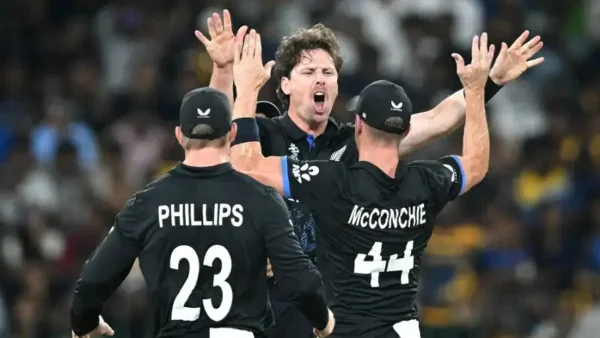
When Santner came in, the speed of the scoring changed. He hit 47 off 26 balls – including four sixes – and made a partnership with McConchie of 84 runs for the seventh wicket, which really decided the match. McConchie was not out for 31 off 23 balls, and this partnership helped New Zealand to a good 168 for 7.
The Santner-McConchie partnership also made a new T20 World Cup record for the best seventh-wicket partnership, going past the old record of 74 runs which had stood since 2010. That push at the end was very important in giving the Black Caps a score that they could defend.
Sri Lanka’s chase and problems with their batting
Sri Lanka’s attempt to win never really got going after they quickly lost Pathum Nissanka, who was out for a single-ball zero. Kusal Mendis only got 11, Charith Asalanka made five, and a lot of middle-order wickets broke up the innings.
Kamindu Mendis was the top scorer with 31 off 23 balls, and Dunith Wellalage added 29 off 23. Captain Dasun Shanaka and Dushan Hemantha put up a little bit of a fight, but weren’t able to make partnerships that lasted. The runs from the lower order weren’t enough to cause New Zealand’s bowlers problems.
Needing to chase 169, Sri Lanka needed more help at important times, and had trouble turning the strike over. The pressure of the score led to more risky shots and quick losses of wickets, and they finished on 107 for 8.
Bowling – what the bowlers did, and the match figures
Rachin Ravindra had a really good all-round match, taking impressive figures of 4 for 27 in his four overs. The effect he had with the ball was as good as his contribution with the bat, and helped to stop Sri Lanka’s middle order.
Matt Henry bowled very well and took wickets, getting two for just three runs in two overs. Mitchell Santner and Glenn Phillips each took a wicket as well, and kept Sri Lanka under control. Cole McConchie, Lockie Ferguson and Ish Sodhi didn’t get wickets, but still put the Sri Lankans under pressure at important times.
For Sri Lanka, Maheesh Theekshana and Dushmantha Chameera had some early success with the ball, getting three wickets each when New Zealand were batting. Their efforts limited the Kiwis, until the late partnership changed the game.
What Santner’s achievement means
Mitchell Santner reached a personal landmark by being the first New Zealander to score 1,000 runs and take 100 wickets in T20 Internationals. His 47 not only helped New Zealand’s chase, but also put him among the best all-rounders in T20Is.
Santner is now one of a small number of players from full member nations to have done this, and his continuing contributions with bat and ball make him a very important leader for the Black Caps in the 2026 T20 World Cup. The achievement showed how valuable he is, even apart from being captain.
What the result means for both teams
The win makes New Zealand's chances in the Super 8s better, and sends a message about how much strength in depth they have, and how well they can deal with pressure. The Black Caps showed that they can get over difficult times and finish strongly, which is important in tight tournament groups.
Sri Lanka must get themselves together quickly, deal with the problems of their middle order not being steady, and find ways to make longer partnerships. The R Premadasa pitch will almost certainly have more important moments as the Super 8s go on, and both teams will make plans for their next matches.