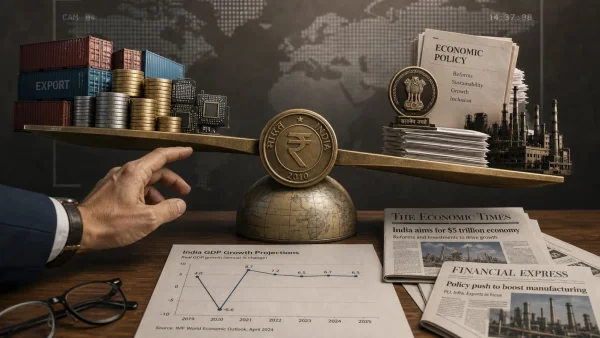
India’s currency is back at the centre of a larger fight over economic sovereignty. The rupee's slide is not just market noise, argues Dr Ashwani Mahajan, National Co-Convenor, Swadeshi Jagaran Manch. He calls for a policy reset that treats the exchange rate as strategy, not a statistic.
His case lands amid a global rethink of open markets. Trade rules, payment pipes and chip supply chains, once seen as neutral, are now tools of power. For a country reliant on foreign inputs and capital, the rupee reflects that exposure in real time.
At stake are growth, jobs and the policy space to protect them. The prescription, according to Mahajan, is clear: reduce avoidable dollar outflows, curb avoidable imports, discipline volatile capital, and revisit rules that send income abroad in the name of technology.

The exchange rate debate is shifting
For decades, economic common sense said currency values mirror demand and supply in free and fair markets. That framing is frayed. When markets are shaped by sanctions, export controls and network chokepoints, the rupee’s level can no longer be treated as a neutral outcome.
Policy choices, therefore, matter. If India can alter the flows that set demand and supply of foreign exchange, the rupee’s path can change too. The question is whether the country uses the tools it already has, rather than watching global tides alone.
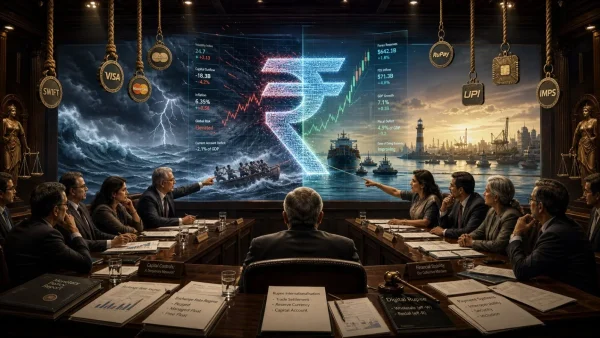
Recent years have exposed how dependent systems amplify currency stress. Payment rails like SWIFT, trade routes, and critical technologies have become levers in geopolitical contests. When the rules shift overnight, balance-of-payments math does too.

Why the rupee weakens, according to critics
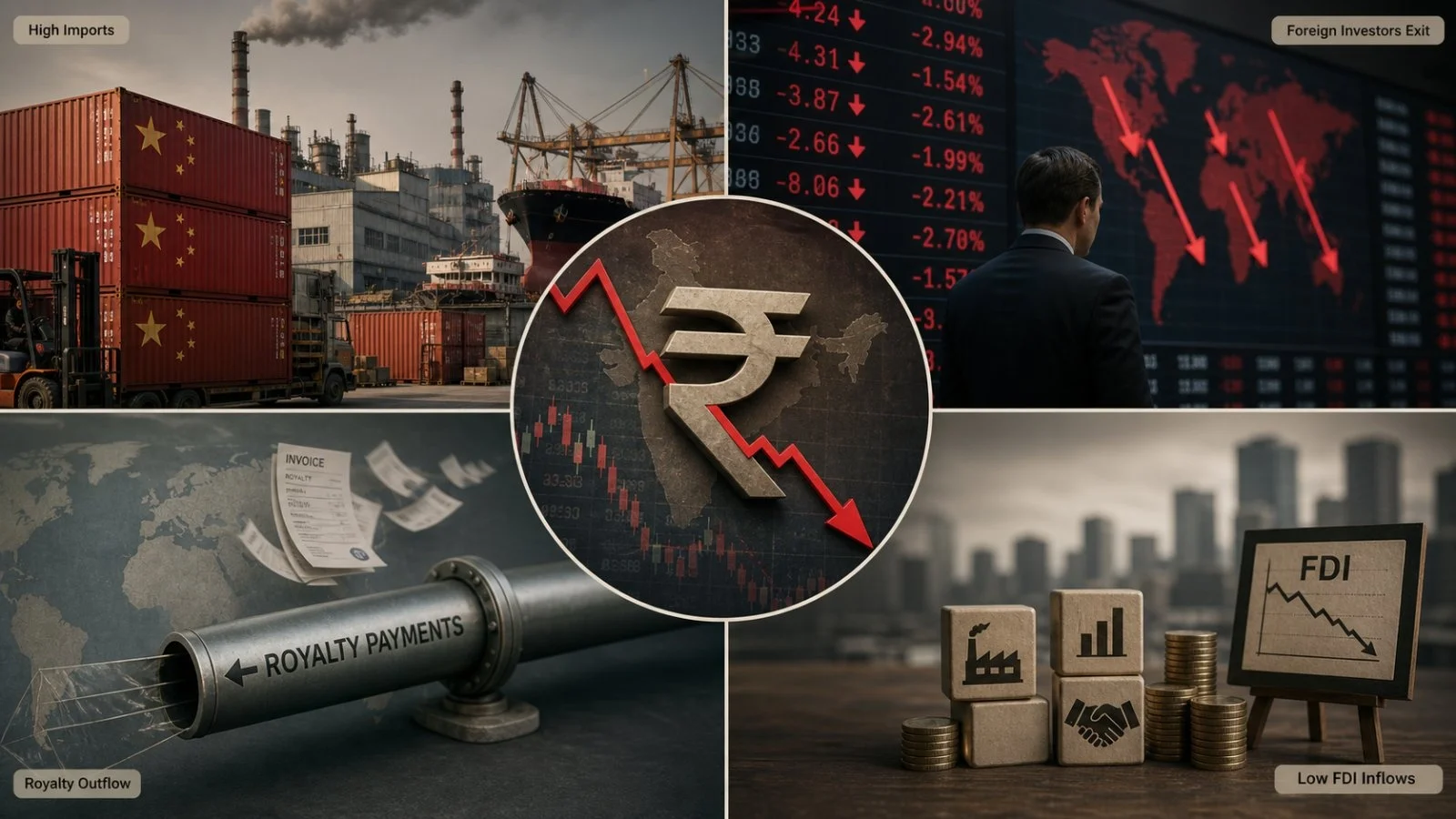
Mahajan links depreciation to four forces: rising imports, especially from China; withdrawals by foreign portfolio investors from domestic markets; growing profit repatriation by foreign investors; and lower net FDI inflows. Behind them lies a weak domestic production base in key segments.
Chip shortages after COVID-19 disrupted factories worldwide. Rare earth constraints tightened costs and timelines. Software and tech dependencies now carry legal and security strings. Each of these pressures feeds into India’s import bill and, in turn, the currency.
The issue, he suggests, is not a single headline. It is a web of outflows and exposures. When money leaks through royalties and fees, or when capital rushes in and out, the rupee bears it. Import surges merely add weight to the downward pressure.
From planned development to fragmented markets
India’s economic playbook has evolved sharply. Nearly 40 years after Independence were guided by planning. In 1991, the liberalisation turn ushered in deep market integration, lighter tariffs and the embrace of global value chains.
That consensus is now contested. Terms like de-globalisation, re-globalisation, fragmentation and decoupling have entered mainstream policy debate. The pandemic sped up the shift, but the reassessment was brewing even earlier as crises stacked up.
Voices at the World Economic Forum this year acknowledged that the last two decades of tight integration created vulnerabilities. Financial turmoil, health shocks, energy disruptions and geopolitical rifts exposed how interdependence can be exploited and weaponised.
The toolkit that once unified markets is being repurposed. Tariffs have returned in punitive, reciprocal forms. Supply chains for semiconductors and rare earths are strategic assets, not abstract efficiencies. Payment systems can be turned off like a switch.

Policy levers being pushed
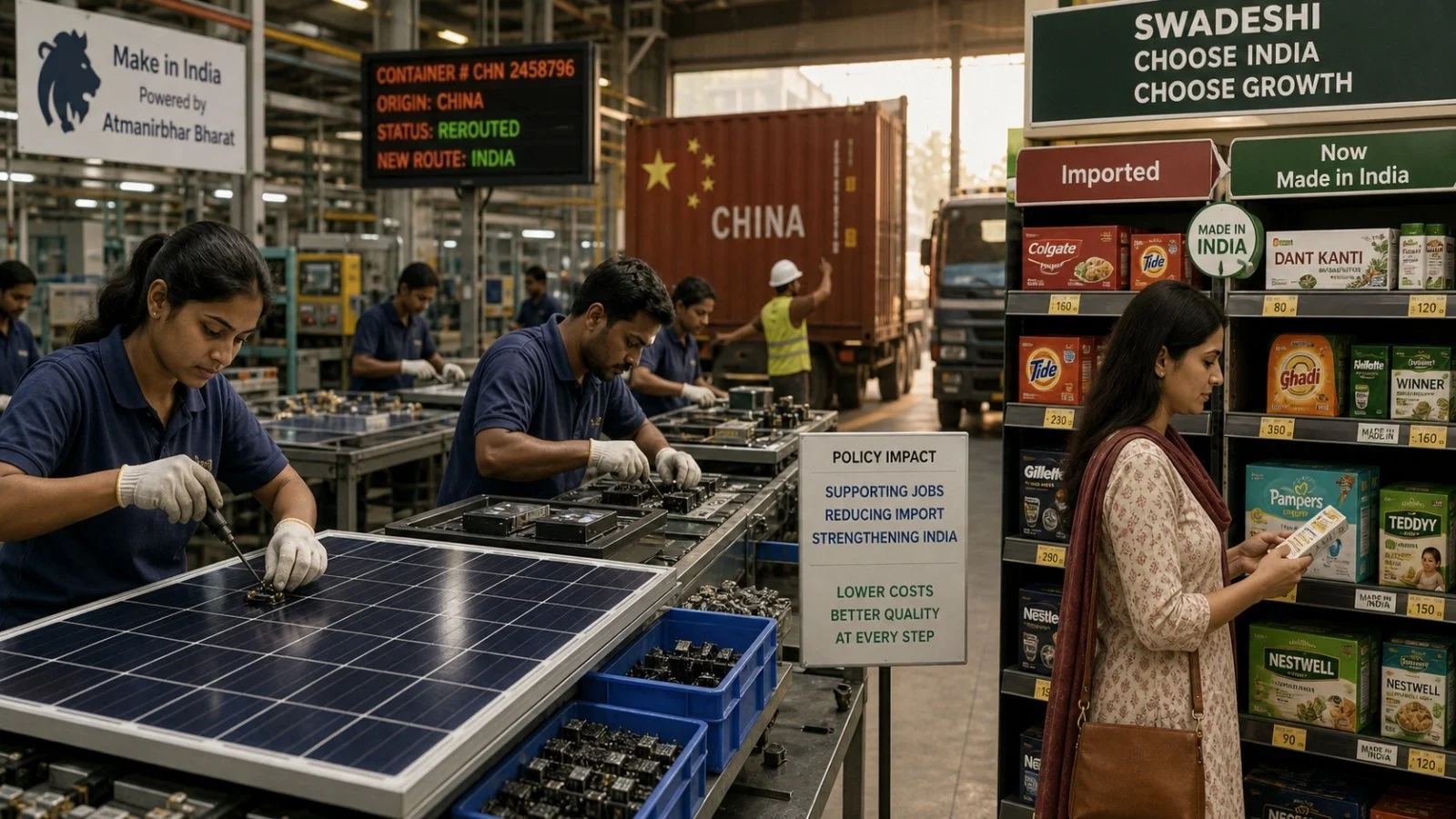
Mahajan’s argument is that India should act on levers within reach. One is trade policy. If domestic producers face structural cost disadvantages, targeted tariffs can calibrate incentives until competitiveness catches up, without abandoning openness wholesale.
He points to the government’s approach on solar panels. Mandating domestic content requirements for solar installations under any government scheme aims to build scale and reduce import dependency. He believes that template can extend to other items where India has capacity.
Cost disadvantages are not imagined. Higher logistics expenses, elevated electricity tariffs and cesses inflate domestic prices. These are beyond the control of individual firms. Policy can bridge the gap while reforms chip away at structural frictions.

Import strategy and domestic costs
The goal is to realign demand with domestic supply where feasible. If India already produces many of the goods now imported from China, a tariff nudge can tilt orders homeward while the country works on scale, quality and cost.
The risk, critics often say, is consumer price inflation. Mahajan counters that strategic, time-bound measures focused on sectors with latent capacity can avoid broad-based inflation, while protecting the currency from sustained import pressures.

Capital flows that come and go
On capital markets, he draws a line between foreign direct investment and foreign portfolio investment. FPIs, he argues, are inherently volatile and have been called fly by night operators. Their exit waves often erase gains and rattle the rupee.
Mahajan says permitting such flows without guardrails was a mistake. He opposes rewarding them with tax concessions and calls for tighter discipline. The aim is to reduce sudden outflows that magnify currency swings and hurt small domestic players.
He sees another source of pressure in income transfers abroad. FDI brings long-term capital, but profit repatriation has been rising sharply. A large slice comes from royalty and technical fee payments. Before 2009, a cap existed. It was lifted by a commerce ministry order.
In his view, that change has had compounding effects on the current account. Revisiting the cap is presented as a straightforward way to arrest outflows without deterring genuine investment that builds local capability and jobs.
What it means for sovereignty and the rupee
Treating the exchange rate as more than a number is about power as much as price. If the structures that determine the rupee’s value are not neutral, then currency management becomes a sovereignty question, not just a spreadsheet entry.
Households feel this in everyday budgets. A weaker rupee lifts the cost of imported essentials and capital goods. Businesses see project economics shift when dollar prices move overnight. Persistent depreciation also tightens the cost of borrowing from abroad.
Mahajan’s case is that policy must lower the economy’s need for foreign exchange and raise its ability to earn it. That means producing more at home where it is viable, and making sure the dollars that do arrive are not recycled out quickly as fees or speculative exits.
A tighter approach to royalty outflows is central to this view. If local subsidiaries can be nudged to localise technology and reduce annual fee drains, the balance of payments gains resilience. That, in turn, supports currency stability.
The same logic applies to FPIs. When short-term capital dominates, the rupee becomes a proxy for risk-on, risk-off moods abroad. Clear limits, better tax treatment alignment and supervisory vigilance can dampen those cycles without closing the door to long-term capital.

The global backdrop is not neutral
Behind these proposals is a diagnosis: markets today are not fully free or fair. Sanctions regimes can freeze reserves. Export controls can halt technology upgrades. A payment message on SWIFT can be halted for geopolitical reasons.
The experience of the chip shortage made this vivid. Automotive and electronics supply was squeezed worldwide. In parallel, price spikes in critical minerals and targeted restrictions on high-end semiconductors underscored how exposed integrated economies can be.
India is not short of rare earths, Mahajan notes. But mining, processing and manufacturing have lagged. That gap is both an industrial policy challenge and a currency risk. Imports fill the gap and drain dollars. Building the value chain at home can reverse the flow.
What to watch next
The contours of a new policy mix are emerging. Debate is no longer about openness versus closure. It is about sequencing and safeguards that fortify the rupee while creating space to invest in capacity, technology and infrastructure.
Three areas will likely define the next phase, if Mahajan’s approach gains traction. The first is tariff calibration in sectors with domestic depth. The second is rebalancing capital flows away from hot money and towards stable long-term investment. The third is curbing systemic outflows via royalty and fee rules.
A currency strategy built on these pillars would aim to reduce shocks rather than chase them. That could help the rupee decouple from episodic global storms and align more closely with India’s productive strength.
For policymakers, the currency debate now overlaps with industrial policy, competition policy and financial regulation. Coordination will matter. So will consistent signals, so producers invest with confidence and investors plan with predictability.
As Mahajan frames it, a credible path to rupee strength begins with accepting that the exchange rate is not a passive outcome. It reflects choices. In a world where the old rules no longer hold, that acceptance may be the first step to stability.
Here are the central takeaways from his argument, stated plainly:
– The rupee’s value is a strategic policy variable
– Market conditions shaping it are not neutral or fair
– Reducing avoidable dollar outflows is essential
– Import reliance must fall where India can produce
– Volatile portfolio flows need tighter discipline
– Royalty outflows warrant renewed caps and scrutiny
The arc from planning to 1991 liberalisation and into today’s fracturing landscape puts India at a crossroads. Choices on tariffs, capital and technology will tell us which way the rupee goes next, and how much control the country holds over that journey.
For now, the message is pointed. A currency is more than a quote on a screen. It is a mirror of production, policy and power. If India wants that reflection to brighten, the work begins at home with rules that keep value inside the economy.