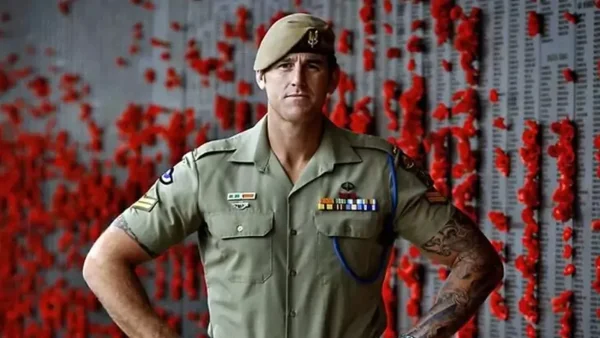
Ben Roberts-Smith was arrested at Sydney Airport on Tuesday, April 7th, 1996. Police say he’ll be charged with five counts of war crime murders, all related to the deaths of unarmed civilians in Afghanistan between 2009 and 2012. He could get life in prison for each of these charges.
Arrest and Charges
The Australian Federal Police (AFP) say the man accused is 47 years old and used to be in the Australian Defence Force. He is scheduled to go to a local court in New South Wales later on Tuesday.
Krissy Barrett, the Commissioner of the AFP, said investigators will claim the people who died weren’t fighting at the time. They were reportedly held by Australian Defence Force (ADF) members, had no weapons, and were in the ADF’s control when they were killed.
The police also say the victims were either shot by Roberts-Smith, or by soldiers under his command, acting as he told them to and while he was there. The prosecutors are getting ready to make five war crime murder charges, and they cover what supposedly happened during several different operations.
Allegations Outlined by Investigators
Australia’s authorities expect to hear from former members of the Special Air Service Regiment. They helped with a five-year investigation. The investigators are preparing to say Roberts-Smith either personally executed people they had captured, or told others to do it.
Reports in the media have previously given details about the specific accusations. These include allegedly kicking a tied-up Afghan man off a cliff in 2011 and then ordering his death, and shooting a prisoner who had a fake leg during a mission in 2009.
Other incidents that are claimed to have happened include telling someone to kill another person being held in the same 2009 operation, and in 2012 ordering a younger soldier to execute a person who wasn’t armed – a practice apparently called “blooding”. Roberts-Smith has always said he did nothing wrong.
From Hero to Defendant
Roberts-Smith became well-known in the country because of what he did during his six times being sent to Afghanistan between 2006 and 2012. He was awarded the Victoria Cross, and many other honors, for being brave and leading in battle.
From 2018, the media in Australia started publishing stories claiming he had unlawfully killed people and had been bad to his fellow soldiers. He tried to sue for defamation (damaging his good name) but lost in 2023. A judge in the Federal Court said, using a standard of proof for civil cases, that four of the murder claims were mostly true.
He tried to appeal this decision, and the High Court turned down his appeal in September 2025. However, those rulings didn’t decide if he was criminally guilty. The current charges have to be proven “beyond a reasonable doubt,” which is a higher standard than in the civil case.
A Wider War Crimes Investigation
The Office of the Special Investigator (OSI) was created to look into claims of war crimes by Australian forces in Afghanistan and has been working with the AFP since 2021. The OSI-AFP team started 53 investigations, and 10 are still in progress.
Another former soldier in the special forces will be going on trial for war crime murder next February. And officials have said there could be more charges if the evidence shows that’s necessary.
Evidence Challenges in Afghanistan Cases
Ross Barnett, the OSI’s director of investigations, said it’s been a complicated process and made harder by the fact they can’t get into Afghanistan. Investigators don’t have the usual places where crimes happen, pictures, maps of the area, or forensic evidence like bullets or blood patterns.
Instead of that, the team has used what people have said they saw, records of the missions, and things that confirm the accounts. This is the same as other international investigations of war crimes that happen when you can’t get to the actual battlefield.
Who Is Ben Roberts-Smith?
Roberts-Smith was born in Western Australia and joined the Australian Regular Army in 1996. After starting his career with the Royal Australian Regiment, he passed the SAS selection process in 2003 and was sent on several missions abroad.
He received the Medal for Gallantry in Afghanistan in 2006 and then Australia’s highest award for military achievement, the Victoria Cross. He left the army in 2013, got an MBA (a business degree), and went into management positions, including jobs in the media.
What Happens Next
Roberts-Smith is legally considered innocent until proven guilty. The prosecution will explain the charges in court and the defense will respond. If he is found guilty, he could be sent to prison for life. If he is found not guilty, the criminal accusations won’t hold up.
Officials have stressed that this is about making sure people are held responsible more generally. They said that if the evidence suggests other people should be charged, that will happen. This case will show how Australia deals with accusations of war crimes that happened a long way from home, and a long time ago.