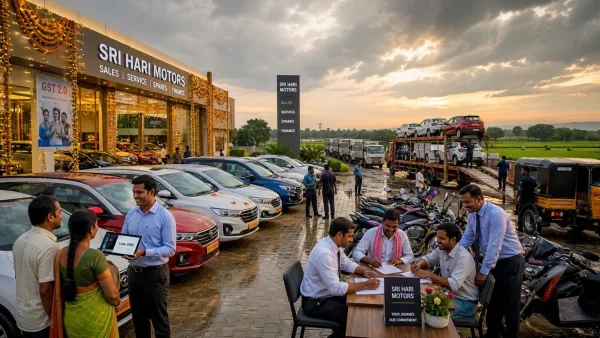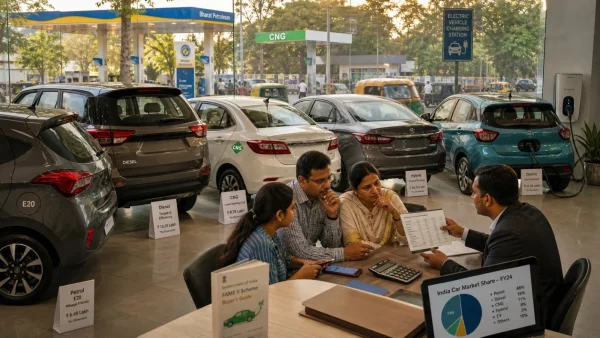
India’s passenger-vehicle market is sending an interesting signal: petrol/ethanol-powered cars lost some market share in July 2026, while diesel gained ground.
According to FADA data reported this week, petrol/ethanol vehicles accounted for 41.68% of passenger-vehicle retail sales in July, down from 43.15% in June. Diesel’s share, meanwhile, rose from 16.32% to 17.73%.
At first glance, that looks like a diesel revival.
But the bigger story is actually more complicated.
The Petrol Story Is Not Just About Diesel
The biggest mistake would be to conclude:
“People are abandoning petrol and buying diesel.”
The data doesn’t quite say that.
The real movement is toward alternative powertrains.
In July, CNG, hybrids and EVs together accounted for around 40.59% of passenger-vehicle retail sales—only about 1.1 percentage points behind petrol/ethanol’s 41.68%.
That is a dramatic change.
A year earlier, the gap between petrol and alternative fuels was more than 13 percentage points.
In other words, India’s car buyer appears to be saying:
“Petrol? Maybe. But let’s see what else is available.”
So Why Is Petrol Losing Share?
1. E20 Uncertainty Is Playing a Role
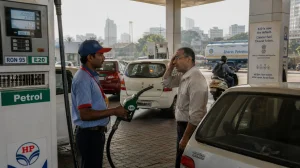
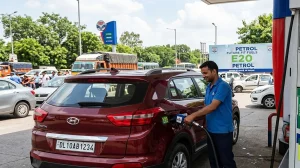
India has now moved to nationwide E20 petrol, meaning petrol containing up to 20% ethanol, with the government arguing that the programme improves energy security, reduces crude-oil imports and supports farmers.
But the transition has generated considerable consumer anxiety.
Questions about:
mileage,
compatibility with older vehicles,
long-term engine effects,
resale value,
fuel economy,
have become part of the purchasing conversation.
FADA has said consumer uncertainty surrounding E20 is influencing some buyers to consider CNG, hybrids and EVs instead.
Importantly, this does not prove that E20 is damaging vehicles.
In fact, the government says there has been no decision to increase nationwide blending beyond E20, and the petroleum ministry has defended the programme.
2. CNG Is Becoming a Serious Competitor
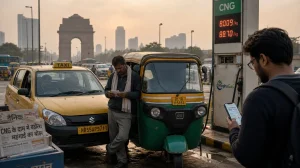
CNG accounted for roughly 24% of passenger-vehicle sales in July, according to FADA data cited by Reuters.
For urban buyers, the attraction is obvious:
Lower running costs + established technology + familiar refuelling infrastructure.
For someone driving thousands of kilometres every month, fuel economy can matter more than a flashy brochure.
The calculation is simple:
“Why should I pay more at the fuel pump if another powertrain can reduce my running cost?”
3. Hybrid Cars Are Quietly Entering the Mainstream
Hybrids contributed about 8% of July passenger-vehicle sales, according to the FADA figures reported by Reuters.
And hybrids offer an interesting compromise.
Consumers don’t have to worry about charging infrastructure in the same way as a pure EV, while still getting improved efficiency in many driving conditions.
So the Indian consumer is increasingly being offered a menu:
Petrol. Diesel. CNG. Hybrid. EV.
The days when buying a car meant choosing between petrol and diesel are disappearing.
4. EVs Are Taking Another Slice of the Pie
Electric vehicles accounted for roughly 8% of passenger-vehicle sales in July, according to the same FADA data.
That may still sound small compared with petrol.
But it is no longer insignificant.
And when EV + hybrid + CNG sales are added together, the alternative-fuel category is now almost level with petrol.
That is the bigger disruption.
But What About Diesel?
Here’s the interesting part.
Diesel’s share increased from 16.32% in June to 17.73% in July.
That’s a rise of 1.41 percentage points in one month.
But this should not automatically be interpreted as the beginning of a massive diesel comeback.
Diesel remains far below petrol/ethanol’s share.
The July movement may reflect specific vehicle launches, buyer preferences, discounts, fleet demand and monthly fluctuations, alongside broader consumer concerns about petrol.
So declaring:
“Diesel is back!” would be premature.
The Great Indian Fuel Plot Twist
For years, policymakers and environmental campaigners have pushed India toward cleaner and less oil-dependent transportation.
Now the market is producing an unexpected result.
Instead of everyone simply moving from petrol to EVs, consumers are spreading themselves across multiple technologies.
Petrol → CNG
Petrol → Hybrid
Petrol → EV
And, surprisingly, some → Diesel
The car buyer has apparently decided that India’s energy transition is not going to happen according to a single PowerPoint presentation.
The Sarcasm Department Has Arrived
For years:
“Diesel is finished.”
Diesel:
“Hold my fuel filter.” 😂
Then came:
“Everyone will move to petrol.”
CNG:
“Are you sure?”
Then:
“The future is electric.”
Hybrid:
“Let’s not get carried away.”
And now the Indian consumer is standing in the showroom asking:
“Bhai, which one actually gives the best mileage?”
Perhaps the most powerful energy policy in India isn’t a government notification.
It’s the middle-class calculator.
The E20 Controversy Needs Facts, Not Fear
There is genuine public concern around E20, but it is important not to turn consumer anxiety into proof of mechanical damage.
The government says E20 is safe for vehicles designed and certified for it and argues that the programme has delivered significant reductions in crude-oil imports and foreign-exchange outflows.
At the same time, FADA has identified consumer uncertainty around E20 as one factor affecting fuel choices.
And there has been another complication: India’s auto industry association SIAM recently withdrew an earlier warning concerning damage associated with contaminated ethanol-blended fuel, saying the underlying data needed further verification.
So the responsible conclusion is:
There are concerns. There are government assurances. There is still a need for clear, transparent, independent data.
What Does This Mean for the Government?
The numbers should make policymakers pay attention.
If consumers are uncertain about a fuel transition, simply saying “there is no problem” may not be enough.
The government and automobile industry need to communicate clearly about:
E20 compatibility,
expected mileage changes,
older-vehicle implications,
warranty coverage,
long-term maintenance,
fuel quality standards.
The transition to cleaner mobility cannot depend only on mandates.
Consumers need confidence.
The Bigger Picture: India Is Becoming Fuel-Agnostic
The most important number may not actually be diesel’s 17.73%.
It may be the 40.59% combined share of CNG, hybrids and EVs.
That means alternative powertrains are rapidly approaching petrol’s market share.
India’s automobile market is therefore moving toward a future where there may be no single dominant replacement for petrol.
Instead, there could be a mix of technologies suited to different consumers.
Urban commuter?
CNG or EV.
Long-distance driver?
Diesel or hybrid.
Family looking for flexibility?
Hybrid.
Budget-conscious buyer?
Whatever gives the lowest cost per kilometre.
Final Take: The Consumer Is Casting the Real Vote
The July numbers don’t prove that petrol is collapsing or that diesel is staging a dramatic comeback.
But they do show a changing consumer preference.
Petrol/ethanol’s share has slipped.
Diesel has edged higher.
CNG remains strong.
Hybrids are gaining.
EVs are growing.
And alternative powertrains together are now almost neck-and-neck with petrol.
The message from India’s car buyers is becoming increasingly clear:
Don’t tell us which fuel is the future. Give us the choice—and we’ll decide with our wallets.
Because when it comes to buying a ₹10–20 lakh car, ideology may sell the policy.
But mileage, maintenance and monthly expenses sell the car.