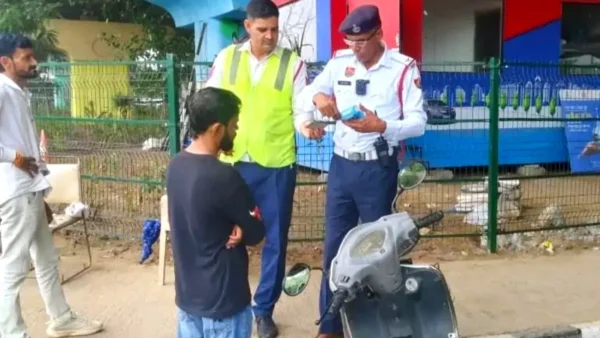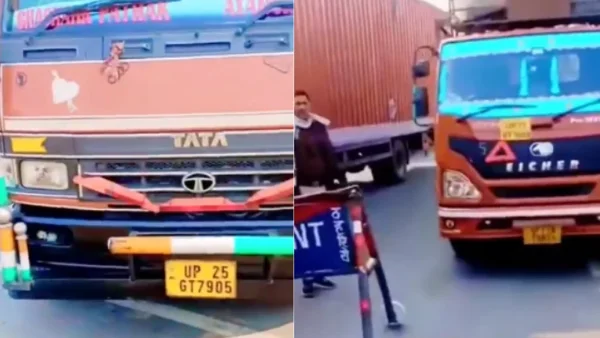
A routine vehicle inspection in Madhya Pradesh has reportedly turned into a controversy after a truck bearing a Uttar Pradesh registration number was issued a ₹3,500 challan for allegedly being driven without a valid driving licence.
The twist?
The truck driver reportedly had a driving licence.
If the allegation is accurately reflected in the challan, the incident raises an obvious question:
How does a driver with a licence end up being booked for driving without one? And perhaps an even bigger question:
Who checks whether a challan is actually correct before it is issued?
From Routine Checking to a ₹3,500 Dispute
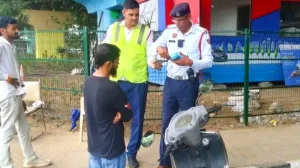
According to the account circulating about the incident, transport authorities stopped the UP-registered truck during an RTO checking operation in Madhya Pradesh.
During the inspection, officials allegedly issued a challan worth ₹3,500, citing driving without a licence.
The driver, however, reportedly disputed the allegation and maintained that he possessed a valid licence.
That changes the nature of the incident.
This is no longer simply a story about a traffic violation.
It becomes a question about documentation, verification and official accountability.
If the Licence Was Valid, How Was the Challan Issued?
There are several possibilities that need to be established rather than assumed.
The licence could have:
been valid but not properly verified;
been incorrectly entered in the challan;
been linked incorrectly in the digital system;
been expired or suspended despite the driver’s understanding;
belonged to the driver but not been accepted for another legal reason; or
been overlooked during the inspection.
Only the official challan record, licence database and relevant transport documents can establish what actually happened.
That is why the paperwork matters more than the viral version of the story.
The Driver’s Response Is the Real Turning Point
Rather than simply accepting the challan, the driver reportedly challenged the action and raised questions about the alleged violation.
And this is where a routine inspection can become an important accountability story.
A challan carries official authority.
For a truck driver, ₹3,500 is not necessarily a trivial amount. Commercial drivers often operate under tight margins, and an incorrect penalty can mean an immediate financial burden.
If a penalty is wrongly imposed, the citizen should have a straightforward mechanism to challenge it and get the record corrected.
RTO Checking Is Necessary—But Accuracy Is Non-Negotiable
Transport authorities have an important responsibility.
Commercial vehicles need to be checked for:
driving licences;
vehicle registration;
permits;
insurance;
fitness certificates;
pollution certificates;
overloading;
roadworthiness and other applicable requirements.
Such enforcement is essential for road safety.
But enforcement works only when it is accurate and impartial.
Strict enforcement is good. Incorrect enforcement is not. There is a difference between being tough on violations and treating every vehicle as guilty until proven otherwise.
The Bigger Question: Who Is Accountable for a Wrong Challan?
Suppose an official mistakenly issues a challan for an offence that did not occur.
What happens next?
Does the driver receive an automatic cancellation?
Is the officer’s error recorded?
Does the citizen get compensation for unnecessary expenses or lost working time?
Is there an internal review?
These questions rarely receive as much attention as the original penalty.
But they matter.
Because government authority comes with government responsibility.
And Here Comes the Sarcasm
Driver:
“Sir, I have a licence.”
Challan:
“Congratulations. You also have a ₹3,500 problem.”
Driver:
“But the licence is valid.”
System:
“Please prove that you are not guilty of the offence we just wrote down.”
That’s the part that needs fixing.
Technology was supposed to make verification easier—not turn citizens into full-time detectives of their own government records.
What Should the Madhya Pradesh Authorities Do?
If the driver’s claim is correct, the authorities should:
1. Verify the licence immediately
Check the licence number against the official database.
2. Review the challan
Determine exactly which violation was recorded and why.
3. Correct or cancel an erroneous challan
If the offence was incorrectly recorded, the driver’s record should be corrected promptly.
4. Investigate the circumstances
If the mistake resulted from negligence or improper procedure, appropriate departmental action should be considered.
5. Improve digital verification
Transport officials should be able to verify licences electronically wherever systems permit.
6. Make appeals easier
Drivers should have a simple mechanism to challenge incorrect challans without repeatedly visiting government offices.
One Incident, Two Sides of the Story
It is important not to declare the RTO officials guilty based solely on a circulating account.
The authorities may have a different explanation.
Perhaps the licence had another issue.
Perhaps the challan contained a technical error.
Perhaps the driver’s documents did not meet a separate legal requirement.
The official record should settle the dispute. That is precisely why transparency is important.
The Real Lesson
RTO enforcement exists to make Indian roads safer—not to create unnecessary harassment for drivers.
If the truck was genuinely violating the law, the ₹3,500 challan may have been completely justified.
But if a validly licensed driver was wrongly penalised for “driving without a licence,” that deserves investigation too.
Because accountability cannot operate in only one direction.
Citizens must follow the rules.
Authorities must follow them too.
And perhaps the most important rule of all is simple:
Before issuing a penalty, make sure the alleged violation actually happened.