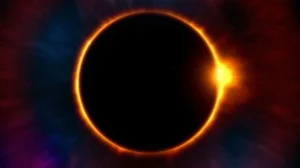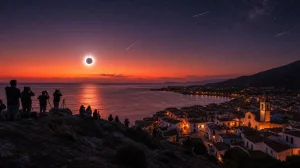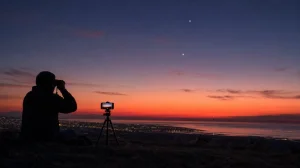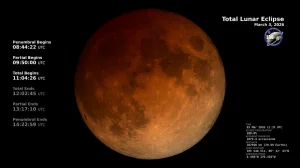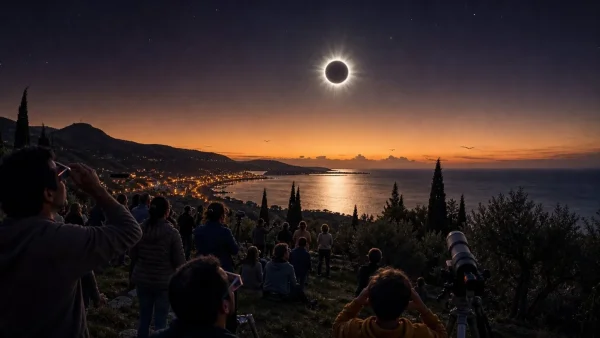
The skies put on a show of sorts next week when a total solar eclipse comes through on Wednesday, August 12, 2026. Its path will take in Greenland, Iceland, Spain, a small part of Portugal and the north of Russia. While much of Europe, North America and north-western Africa can expect a partial eclipse, India is going to miss it altogether.
Travellers will be drawn to Spain above all; the low altitude of the Sun at the time of totality near sunset makes for a dramatic sight. Even in Europe’s larger cities, the deep partial phases will put a different cast on the evening light. In the U.S., the northern states and Alaska will see some of the action, but Washington, D.C. will be limited to a sliver.
You can predict the mechanics of it, but the experience is no ordinary affair. Along the narrow track where the Moon puts an exact cover on the Sun, daylight gives way to twilight for a few moments, stars come out and the corona flares into view. Anywhere else and you are left with only a partial bite.
What is happening and why it matters
In a total solar eclipse the Moon positions itself between the Earth and the Sun to completely obscure the bright disc. This alignment is what allows one to see the corona, the outer atmosphere of the Sun that is usually lost in the daylight.
NASA has the numbers: the longest period of totality on 12 August will run for 2 minutes and 18 seconds, if that. Most places on the path will have less time with the spectacle. It is the first total solar eclipse mainland Spain has seen since 1905, the European Space Agency points out, so the moment is something to behold.
It is also the opening act of a remarkable run of three eclipses from 2026 to 2028 that will be visible from Spain, making the Iberian Peninsula something of a hotspot for eclipse chasers. That kind of rarity does not go unnoticed by astronomers or the casual skywatcher.
When to watch: key timings across regions
By the global clock of Universal Time, NASA expects the partial phase to start at about 15:37 UTC, peak at 17:46 UTC and be done by 19:52 UTC. The shadow of the Moon will be over the Earth for four or five hours, but any given location will only have a few minutes of it.
Put those figures in Indian Standard Time and they translate to 9:07 pm IST on the 12th, 11:16 pm on the 12th and 1:22 am on the 13th. These are merely conversions; one cannot view the eclipse from India.
There is variation in coverage across North America. Washington, D.C. should see the partial eclipse get under way at 1.17 p.m. ET with 4 per cent coverage. Over in Anchorage, Alaska, it begins at 7.36 a.m., hits 28 per cent at 8.21 a.m. and is over by 9.09 a.m. Iqaluit tops out at 61% at 1:24 pm EDT, St. John’s at 53% at 3 pm NDT, Fairbanks at 37% at 8:27 am AKDT, Quebec City at 24% at 1:46 pm EDT and Bangor at 23% at 1:53 pm EDT.
Some of the best partial views outside of totality will be in Europe this evening. Barcelona is set for a maximum of 99.8% at 8:29 pm CEST. London in the UK should peak at around 7:13 pm BST with 91 per cent or so, the partial phase running from 6:17 to 8:06 pm BST.
Local time is what counts in the path of totality. Reykjavik in Iceland will see the total eclipse start at 5.48 p.m., while in Leon, Spain it is 8.28 p.m. Those in the zone will have the Sun fully covered for a brief spell before the light comes back.
Best places along the path of totality
Those who have been doing this for years have a rule: you need to be in the path of totality. A 99 or even 90 per cent partial will not give you darkness or show you the corona. Only the narrow corridor of totality will do that.
Spain is likely to be the most convenient option given the transport and accommodation. With the Sun low in the west at the time of totality in some areas, northern Spain should prove a fine destination.
Iceland is right in the path and offers the ghostly glow of the corona against a changing sky. You will find totality in parts of Greenland and northern Russia as well, but the weather and logistics demand you plan accordingly. As for Portugal, only a small portion is in the totality zone; the rest of the country will have to make do with a partial eclipse.
The footprint for the partial eclipse is much broader. From the United States and Canada to large swathes of Europe and north-western Africa, onlookers will see the Moon make its mark on the Sun. The partial phase is set to be seen in Morocco, Algeria, Tunisia and the areas around them as well.
India: visibility and how to follow
Geographically, India does not fall within the eclipse’s zone of visibility. Converting the global timetable to IST for the August 12 date will not yield a view from Indian skies; there will be neither totality nor a partial phase. Skywatchers here can still be part of it in a digital sense. The most sensible way to take in the moment without making a journey is via the live streams and official webcasts that agencies like NASA and the European Space Agency are expected to put out from the path of totality.
Those who do decide to travel should bear in mind that conditions have a way of changing in a hurry. Traffic, local horizons and cloud cover can all get in the way. But if one can make it to the totality track in Iceland or Spain, even a minute of unobstructed sky is worth the trouble.
How to watch safely**
The National Solar Observatory is clear on the matter: during any partial phase, one must use certified eclipse glasses or proper solar viewers. A deep partial eclipse still has a portion of the Sun blazing, and it is hazardous to look at directly. Ordinary sunglasses offer no protection, however dark they may be.
There is good reason for caution. The American Academy of Ophthalmology notes that viewing the Sun with insufficient protection risks solar retinopathy, an injury to the eye that is painful and can be permanent. Unaided viewing is only safe when you are in the path and the solar disc is completely obscured by the Moon. As soon as totality is over, put your eye protection back on. For everyone else, it is required for the duration. Telescopes and binoculars need dedicated solar filters to be used safely.
Some simple rules to remember:
– Stick to certified eclipse glasses
– Do not make do with regular sunglasses
– Only remove protection for the period of totality
– Put it back on before that phase is done
– Keep an eye on children using viewers
Looking through a phone or camera lens is equally risky unless a solar filter is in place on every optical path. It is easy to be misled by the numbers; at 99 per cent coverage the sky is still bright enough to damage unprotected eyes. At 100 per cent, the corona shows and it is temporarily safe for those in the right spot.
Even thin clouds can let harmful rays through, so do not rely on them for safety. Eye protection is non-negotiable.
Then there is the scientific angle. NASA says its teams will be in pursuit of the Moon’s shadow in high altitude jets and with balloons to observe the Sun’s dynamics and its impact on our atmosphere. “From our unique perspective on Earth during a total solar eclipse, scientists can study the Sun’s corona in a way we can’t from anywhere else in the solar system,” said Kelly Korreck, the agency’s eclipse program manager.
For those not in totality, the partial eclipse is not to be dismissed. In London, for instance, the evening schedule is convenient after work, but at 91 per cent coverage in the UK and northern Europe, protection is still needed. In North America, the best partial views are in Alaska and up in Canada; Washington D.C. will be limited to 4 per cent. And while Barcelona is forecast for 99.8 per cent at 8.29pm CEST, that is not totality. To see the corona and the darkness, you have to be in the narrow corridor of the path.
A total eclipse is a matter of minutes, so plan accordingly. Get to your site early, whether it is a hillside in Spain or an Icelandic coast, and check the forecasts. Or simply enjoy the stream from India. The alignment will be something to remember.