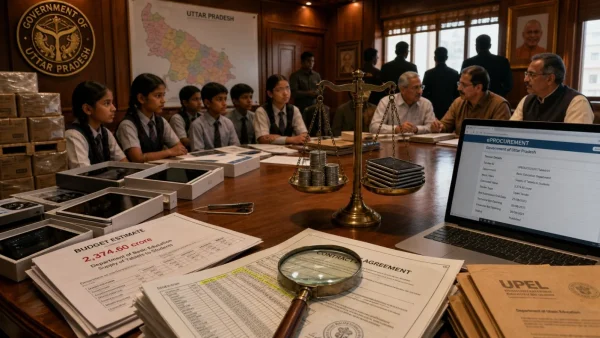
The Uttar Pradesh Cabinet has approved the purchase of 25 lakh tablets for free distribution among eligible youth under the Swami Vivekananda Yuva Sashaktikaran Yojana, with the state making a budget provision of ₹2,374.60 crore for 2026–27. The decision was taken at a Cabinet meeting chaired by Chief Minister Yogi Adityanath.
The programme is intended to expand digital access for students and trainees pursuing undergraduate and postgraduate courses, diploma programmes, skill-development courses and other eligible educational programmes. The government says the devices will help beneficiaries access digital learning, training, employment and self-employment opportunities.
The ₹9,498-per-tablet calculation
The headline numbers immediately invite scrutiny.
If the entire ₹2,374.60 crore provision were divided equally across 25 lakh tablets, the implied average expenditure would be approximately ₹9,498 per tablet.
That figure, however, should not automatically be described as the final purchase price of each tablet.
The ₹2,374.60-crore figure is the budget provision reported for the scheme in the financial year. The actual procurement price will depend on the tender, successful bidders, applicable taxes, accessories, warranty/support requirements, logistics and other contractual conditions.
The Cabinet decision also authorised purchase orders to institutions selected through the tender process.
Which companies will supply the tablets?
Social-media discussions around the procurement have highlighted models associated with Acer, Lava and Samsung, including the Acer One 8 T4-82L-G2, Lava LT4901 and Samsung Galaxy Tab A11 LTE.
However, these model names should not yet be presented as confirmed final winners or final government purchase prices unless the relevant tender documents and award results establish that.
The Uttar Pradesh government’s official e-procurement system provides tender schedules and bid information, while the Uttar Pradesh Electronics Corporation Limited (UPEL/UPLC) is the state’s electronics procurement organisation.
The real question: what will the government actually pay?
The most important financial question is not simply whether ₹2,374.60 crore divided by 25 lakh equals ₹9,498.
It does.
The more important question is:
What is the actual contracted per-unit price after competitive bidding?
A government procurement of 25 lakh devices is enormous. At this scale, even a difference of ₹500 per tablet represents ₹125 crore across the order.
A difference of ₹1,000 per tablet would represent ₹250 crore.
That is why the tender’s final price, rather than a simple division of the budget provision, deserves public attention.
Market price versus government procurement price
Large government purchases can legitimately cost more or less than retail prices.
A government tender may require specifications that ordinary retail tablets do not include, such as:
Extended warranty.
After-sales service.
Bulk delivery.
Device management or software requirements.
Specific connectivity specifications.
Quality-control requirements.
Replacement obligations.
Packaging and distribution.
Institutional support.
At the same time, purchasing 25 lakh units can provide substantial economies of scale.
Therefore, comparing the government price with the price of a single tablet listed on an e-commerce website would not, by itself, prove overpricing.
The meaningful comparison would be between the final tender price and comparable bulk procurement prices for devices with equivalent specifications and contractual obligations.
Transparency will matter
Because the procurement involves thousands of crores of public money, transparency around the tender will be particularly important.
Once the procurement process is complete, citizens should be able to determine:
The final number of tablets ordered.
The winning bidder or bidders.
The exact model supplied.
The technical specifications.
The price per tablet.
GST and other taxes included in the quoted price.
Warranty and after-sales obligations.
Delivery and distribution costs.
The total value of each purchase order.
The number of suppliers selected.
Whether the final price was lower than the government’s estimated procurement cost.
Whether there were any significant deviations from the original tender specifications.
These details would allow taxpayers to judge whether the procurement represents value for money.
Government’s stated objective
The Uttar Pradesh government says the five-year programme is designed to strengthen the technological capabilities of young people and improve access to digital resources.
According to the government, beneficiaries will include students in higher, technical and health education as well as trainees in skill-development and ITI programmes. The stated objective is to improve digital learning, training quality, employability and access to employment opportunities.
Providing devices to students who cannot afford them can potentially reduce the digital divide and improve access to educational resources.
But the success of such a programme ultimately depends on more than distributing hardware.
Distribution is only the beginning
The government will also have to ensure that the tablets actually reach eligible students, remain functional and are used effectively.
Questions will arise about:
How beneficiaries are selected.
How duplicate or fraudulent claims are prevented.
Whether devices are delivered on time.
What happens when a tablet is damaged.
Who pays for repairs after the warranty period.
Whether students in rural areas receive adequate internet access.
Whether educational content is actually available and useful.
How the government measures learning and employment outcomes.
A tablet sitting unused in a student’s home would not deliver the same public benefit as a device actively supporting education and skill development.
₹2,374.60 crore deserves public scrutiny—but not premature allegations
The scale of the procurement naturally makes it a matter of public interest.
However, the ₹9,498 figure is an implied average based on the budget provision, not proof that the government is purchasing each tablet for ₹9,498.
Likewise, the appearance of particular brands or models in discussions surrounding the tender does not by itself establish that those companies have won the final contract.
The decisive evidence will be the official tender documents, technical evaluation, financial bids, award decisions and purchase orders.
If the final procurement price is substantially below the implied ₹9,498 average, that would indicate savings against the budget provision. If it is significantly higher, the government should explain the additional costs and specifications involved.
The question taxpayers should ask
There is nothing inherently controversial about a government buying tablets for students. The policy objective—expanding digital access—can be legitimate and potentially beneficial.
But a procurement involving 25 lakh devices and ₹2,374.60 crore warrants complete transparency.
The central question is therefore not simply:
“Why is the government spending ₹2,374.60 crore?”
It is:
“Exactly what is the government buying, from whom, at what per-unit price, under what specifications, and with what safeguards to ensure that ₹2,374.60 crore delivers maximum value to students?”
Until the final tender and purchase-order details are publicly available, the ₹9,498 figure should be treated as a budget-derived average—not as evidence of overpricing or wrongdoing.
For taxpayers, the next stage of this story will be the procurement itself. That is where the real numbers will emerge.