The past week saw tension between those at the helm of America’s space activities as Elon Musk went on a social attack spree against acting NASA Administrator Sean Duffy. This feud had its origins in Duffy’s observation that SpaceX was falling behind the lunar Artemis programme, concluding contracts could be tendered to competitors, including Blue Origin. The wrangle has highlighted the splintering players-contending outfits and political appointees-who may set the course for U. S. space policy moving forward.
The Sparks that Ignited the Musk-Duffy Feud
The disagreement started with Duffy, the US Transportation Secretary and acting NASA Administrator, stating to CNBC that SpaceX was behind schedule with the Government’s plan to return humans to the Moon. The cancelation of the $2.9 billion lunar lander contract and opening it to other bidders were plans mentioned to emphasize the urgency of advancing America’s lunar ambitions. ‘We’re not going to wait for one company. We’re going to push this forward and win the second space race against the Chinese. Get back to the moon, set up a camp, a base,’ said Duffy.
Musk was prompt and caustic in his rejoinder; he posted a GIF and numerous messages on X that mocked Duffy: he called him “Sean Dummy,” accused him of attempting to “kill NASA,” and mocked his history as a competitive tree climimber. “Blue Origin has never delivered a payload to orbit, let alone the Moon,” he said in a not-so-subtle jab at Blue Origin. Still annoyed, he also said the person leading America’s space program “shouldn’t have a two-digit IQ.”
Political History and the Roots of Tension
The Musk-Duffy conflict is not entirely a recent phenomenon; it harkens back to political disputes during the Trump administration when Trump withdrew the nomination of Jared Isaacman, a Musk ally, as the head of NASA. Isaacman, who flew the private Inspiration4 mission of SpaceX, was Musk’s favored candidate for the top agency-marshal post. The nomination was rescinded, was decided upon, because of Isaacman’s alleged links to Musk and, therefore, his somewhat dubious political leanings, given the gist of which has led to much speculation about personal disputes within the administration.
With his appointment to the seat of Acting Administrator of NASA while also serving as Secretary of Transportation, Duffy has deepened the perception among Musk’s supporters that SpaceX is being sidelined. And loudly alleged, Duffy was at one time a foe of Musk on FAA budget cuts, thus adding still another layer of complexity to the professional relationship.
The Controversy over NASA’s Organizational Structure
Reports suggested at one time or another that Duffy had even considered closing NASA and subsuming it within the Department of Transportation. Musk and some others saw this as a threat to American space leadership, claiming that the move would erode NASA’s technical autonomy. NASA Press Secretary Bethany Stevens denied any personal aspirations by Duffy to hold the administrator’s position, yet the very thought destabilized scientists and industry observers who regard autonomy as crucial to the agency’s long-term credibility and the land-based planning of its task.
SpaceX, Artemis, and the Lunar Race
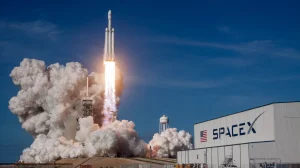
In the midst of the online wars, SpaceX stands at the forefront of collaborative efforts on the Artemis programme, along with Blue Origin, Boeing, Lockheed Martin, and Northrop Grumman. The goal of Artemis is to maintain a permanent lunar surface presence for further Mars-bound missions. SpaceX was awarded a $2.9 billion contract in 2021 to design the lunar lander system, with the goal of returning American astronauts to the Moon after more than a half-century.
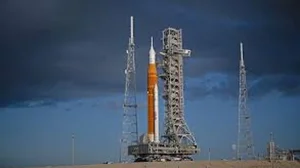
Delays have accompanied the programme since its onset. As things stand, the next crewed lunar flyby-Artemis II-is not expected to take place until February 2026; meanwhile, the first landing at the lunar south pole as part of Artemis III stands to be later in 2027 or 2028. Duffy stressed the importance of accelerating the timelines so as to keep ahead of China, which has put forth aggressive goals for its lunar activities by 2030.
In his view, despite all these developments, SpaceX remains at the top of the industry. According to him, his company is developing ‘like lightning’ with respect to competitors and is still confident to meet or even beat Artemis deadlines.
Implications for US Space Policy
Beyond the personal exchanges, the feud also underscores the clash of visions for America’s space policy. Whereas Duffy’s administration sits on the side of contract diversification and faster lunar exploration, Musk sees governmental intervention as an impediment to innovation. Both sides are playing for very big stakes, since the fate of NASA is not merely a matter of scientific advances, but also of national prestige and technological leadership.
With SpaceX and Blue Origin needing to submit their proposals by the end of October to present their ideas to speed up lunar missions, the next few months become very crucial. How these tensions between private entities and government oversight will settle could very well determine the fate of the US space exploration for decades.
A Race That Has the World’s Attention
While the Artemis programme gets underway, the gaze of the world space community remains fixed on the Moon. The rivalry between private contractors, joined by political scrutiny, demonstrates the complexities arising under the setup of modern space exploration. From just online snarks and jabs, it is deeper now as these indicate disputes over governance, competition, and how the future of humanity will be defined once subjected to Earth’s pull. So far, however, human excitement still keeps the race alive; ambition, ingenuity, and lots of controversies keep blossoming along the way.