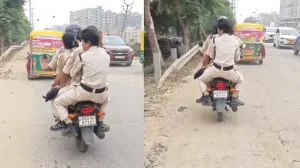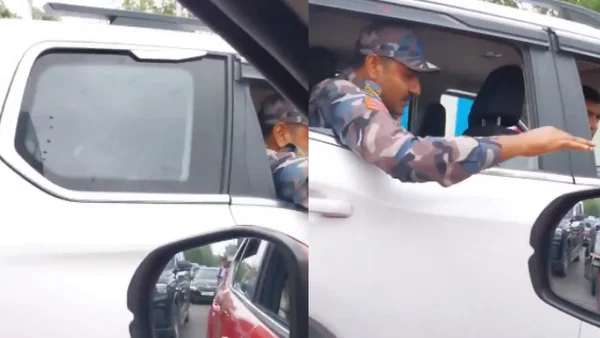
A late-night incident in Baran, Rajasthan, has sparked outrage on social media after a family alleged that police seized their newly purchased car and left a husband, wife, and their three-month-old baby stranded on a deserted road in the early hours of the morning.
According to the family’s account, Manish Summan was travelling with his wife and infant child to a Devi temple around 3 a.m. when police stopped their vehicle for inspection.
The family claims they were unable to produce the vehicle documents because they had accidentally left them at home. They allege that police suspected the vehicle was stolen and seized it.
These allegations have not been independently verified, and the police version of events has not been made public at the time of writing.
“Take the Car, But Please Drop Us Home”
According to the family’s allegations, Manish requested the officers to seize the vehicle if necessary but pleaded that they at least help the family reach home safely.
He claims the request was ignored.
The family further alleges that they were left alone on the roadside in the middle of the night despite travelling with a three-month-old infant.
They also allege that when they attempted to record the interaction on their mobile phone, police personnel threatened them.
These claims remain subject to official verification.
Law Enforcement or Lack of Humanity?
No one disputes that police have the authority to stop vehicles, verify ownership, and seize vehicles where the law permits.
Checking documents is a routine part of policing.
But the controversy is not merely about the seizure of a vehicle.
It is about how citizens are treated during enforcement.
Even if officials suspect a legal violation, many citizens expect that vulnerable individuals—including women, children, elderly persons, and patients—will be treated with basic compassion.
Power Must Be Exercised With Responsibility
Police officers are empowered by law to maintain order and enforce regulations.
However, every power comes with a corresponding responsibility.
Professional policing is measured not only by enforcing the law but also by exercising discretion, restraint, and empathy.
If the family’s allegations are established, the case is likely to raise questions about whether the officers balanced enforcement with humanitarian considerations.
The Viral Video Has Triggered Debate
The incident has quickly become a talking point on social media.
Many users have questioned whether leaving an infant and parents stranded in the early hours of the morning, if the allegations are accurate, reflects the standards expected from public servants.
Others have argued that police cannot ignore document-related violations and that the complete facts—including the officers’ reasons for their actions—must be examined before conclusions are drawn.
A Little Public Irony
The police slogan often speaks of service, security, and assistance.
Critics online sarcastically remarked:
“Apparently, the car got police protection. The family had to protect themselves.”
The remark reflects public sentiment circulating online and should not be taken as a factual description of the incident.
Should There Be an Inquiry?
If the allegations are correct, authorities may need to examine:
Why the vehicle was suspected of being stolen.
Whether the seizure complied with legal procedures.
Whether alternative arrangements could have been made for the family.
Whether any threats were issued when the family attempted to record the interaction.
A fair inquiry would also provide the police an opportunity to present their version of events.
The Bigger Question
Incidents like this resonate because they go beyond traffic enforcement.
Citizens expect police to uphold the law—but they also expect humanity.
A police uniform represents authority, but it also represents public service.
If a family with a three-month-old child was indeed left stranded on a deserted road despite requesting assistance, many will ask not whether the law was enforced, but whether it was enforced with compassion.
Because the true strength of law enforcement is not demonstrated by how much power it can exercise—it is demonstrated by how responsibly that power is used.