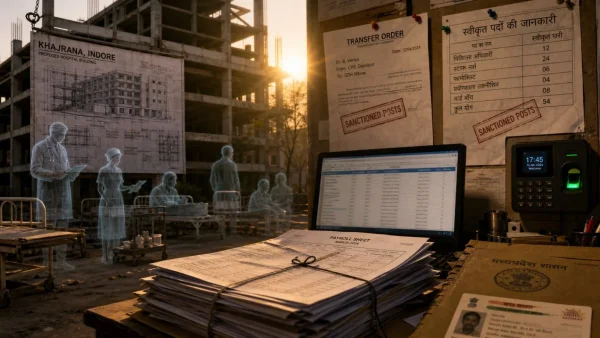
The recent controversy surrounding a proposed government hospital in Indore, Madhya Pradesh, has sparked widespread debate over administrative accountability. The reason? A hospital that has not yet been built reportedly had 87 sanctioned staff positions, with transfer orders issued in its name.
While social media quickly labelled it a "ghost hospital,” the state government clarified that the employees were working at other government healthcare facilities until the hospital is constructed. Even so, the incident has raised questions about project planning, staffing approvals and bureaucratic coordination.
What many people may not realize is that the Indore episode is not an isolated case. India has witnessed several instances where government records, official databases or administrative systems showed institutions, employees, students or beneficiaries that did not match the situation on the ground.
Some involved alleged fraud. Others resulted from outdated records, weak monitoring or procedural delays. Together, they reveal recurring challenges in public administration.
Here are five major “ghost” government cases that have drawn national attention over the years.
1. Indore’s ‘Ghost Hospital’: Staff Sanctioned Before the Hospital Existed
The latest case comes from Khajrana in Indore, where the Madhya Pradesh government had approved a 100-bed civil hospital several years ago.
However, the project reportedly never moved beyond the planning stage because land for construction had not yet been allotted.
Despite the absence of a hospital building, government records showed 87 sanctioned positions, including doctors, nurses, pharmacists, laboratory technicians and other healthcare personnel. Transfer orders continued to be issued against these sanctioned posts.
As reports spread online, many interpreted the case as one in which dozens of employees were drawing salaries for a hospital that did not exist.
The Health Department, however, clarified that this interpretation was inaccurate. According to officials, the sanctioned staff members had been temporarily posted to other government hospitals, including district hospitals and urban health centres, until construction of the new hospital begins.
Even with that clarification, the controversy highlighted an important governance question: Should staff positions be operational before a public infrastructure project is physically ready?
The case has become an example of how gaps between planning, approvals and implementation can create public confusion and erode trust.
2. Chandigarh’s Ghost Employee Scam
One of India’s most widely discussed payroll fraud cases emerged from the Government Medical College and Hospital (GMCH), Chandigarh.
Investigators alleged that a contractor created dozens of fake contractual employees using forged documents, attendance records and bank accounts.
According to the investigation, salaries intended for workers were allegedly diverted to these fictitious identities over an extended period before the irregularities were detected.
Unlike the Indore controversy—where the employees reportedly existed and were working elsewhere—the Chandigarh case involved allegations that some employees never existed at all.
The incident exposed weaknesses in:
- Payroll verification
- Attendance monitoring
- Identity authentication
- Internal financial audits
The case prompted calls for stronger digital payroll systems and stricter employee verification procedures across government institutions.
3. Ghost Faculty in Medical Colleges
India’s medical education sector has repeatedly faced scrutiny over the issue of ghost faculty.
Regulatory inspections over the years found that some private medical colleges allegedly listed doctors as permanent faculty members despite those doctors having resigned, worked elsewhere or never actually served in those institutions.
Maintaining adequate faculty strength is one of the key requirements for medical colleges seeking recognition and permission to admit students.
Investigators found instances where the same doctor appeared on faculty lists of multiple institutions or where names remained on official records long after individuals had left.
These practices distorted inspection results and raised concerns about the quality of medical education.
To address the problem, regulators gradually introduced:
- Biometric attendance systems
- Digital faculty databases
- Surprise inspections
- Centralized verification mechanisms
Although reforms have reduced such cases, ghost faculty remains one of the most discussed governance issues in India’s higher education sector.
4. Ghost Students in Government Schools
Education departments across several states have periodically uncovered fake or inflated student enrolments.
Schools allegedly reported higher student numbers than those actually attending classes in order to receive increased government funding under schemes such as:
- Mid-Day Meal Programme
- Free textbooks
- School uniforms
- Scholarships
- Infrastructure grants
In some investigations, authorities found names of students who had already left school, transferred elsewhere or never existed.
Not every discrepancy was found to be deliberate fraud. In many cases, delays in updating school records or weak administrative oversight contributed to inflated enrolment figures.
The issue nevertheless resulted in significant financial losses and prompted governments to modernize record-keeping.
Today, many states rely on:
- Aadhaar-linked student databases
- Digital attendance systems
- Unified education portals
- Regular enrolment verification
These measures aim to ensure that public funds reach genuine beneficiaries.
5. Ghost Patients and Health Insurance Fraud
Another recurring challenge has involved fake hospital admissions and ghost patients under government-funded health insurance schemes.
Investigations in different states have uncovered hospitals accused of generating medical records for patients who either never received treatment or whose procedures were exaggerated to claim higher reimbursements.
Authorities have also detected instances involving:
- Fake admissions
- Duplicate patient records
- Inflated treatment claims
- Forged discharge summaries
Such fraud not only causes financial losses but also diverts resources intended for genuine patients.
In response, governments have expanded the use of:
- Digital health records
- Electronic claim verification
- Biometric patient authentication
- AI-based fraud detection
- Real-time monitoring of insurance claims
These reforms are intended to reduce opportunities for fraudulent billing while improving transparency.
What Do These Cases Have in Common?
Although the five cases involve different sectors, they reveal remarkably similar administrative weaknesses.
1. Weak Record Verification
Many irregularities persisted because official records were not regularly matched with on-ground realities.
2. Lack of Departmental Coordination
Projects often move through multiple departments responsible for finance, staffing, construction and administration. Poor coordination can create situations where one part of the system advances while another remains stalled.
3. Delayed Digital Updates
Outdated records frequently remain active long after circumstances have changed, leading to confusion and inaccurate reporting.
4. Insufficient Audits
Routine inspections and independent audits often identify irregularities only after they have existed for months or even years.
5. Transparency Gaps
Public access to updated information remains limited, allowing rumours and misinformation to spread quickly whenever discrepancies emerge.
Are All ‘Ghost’ Cases Fraud?
Not necessarily.
The term “ghost” is often used broadly by the media and on social platforms, but it can describe very different situations.
For example:
- A ghost employee may refer to someone who never existed.
- A ghost teacher may actually be a real person whose records were incorrectly maintained.
- A ghost hospital may be a sanctioned project awaiting construction rather than an outright fraud.
Each case must therefore be evaluated on its own facts rather than assumptions.
In the Indore case, officials have maintained that the employees were genuinely working at other government facilities, even though the hospital itself has not yet been constructed.
How Digital Governance Is Reducing Such Cases
Over the past decade, governments have increasingly relied on technology to improve administrative accountability.
Key reforms include:
- Biometric attendance systems
- Aadhaar-based identity verification
- Online payroll management
- Digital health records
- GIS-based infrastructure monitoring
- Electronic procurement platforms
- Real-time audit dashboards
These tools have made it easier to detect inconsistencies, although governance experts note that technology alone cannot eliminate administrative failures. Effective supervision, timely audits and accountability remain equally important.
The Bottom Line
The Indore hospital controversy has renewed attention on how government systems manage approvals, staffing and infrastructure projects.
Whether the issue stems from procedural delays, administrative inefficiencies or deeper systemic problems, it illustrates the importance of ensuring that official records accurately reflect conditions on the ground.
More broadly, the episode joins a list of “ghost” cases—from fake employees and faculty to phantom students and patients—that have prompted governments to strengthen verification systems and embrace digital governance.
As India continues investing in healthcare, education and public infrastructure, the biggest lesson may be a simple one: records should never move too far ahead of reality.
Frequently Asked Questions (FAQs)
Why is the Indore hospital called a “ghost hospital”?
Because the proposed hospital had sanctioned staff positions even though the building has not yet been constructed.
Were the 87 employees working at a non-existent hospital?
According to the Madhya Pradesh government, no. Officials said the sanctioned employees were temporarily posted at other government hospitals until the new hospital becomes operational.
What is a ghost employee?
A ghost employee is a fictitious or improperly recorded employee whose name appears on payroll or official records despite not legitimately holding the position.
Why do ghost cases occur?
Common reasons include weak record verification, poor coordination between departments, outdated databases, inadequate audits and, in some cases, deliberate fraud.
Has India taken steps to reduce such cases?
Yes. Governments now increasingly use biometric attendance, Aadhaar verification, digital databases, online payroll systems and electronic audits to improve transparency and reduce administrative irregularities.