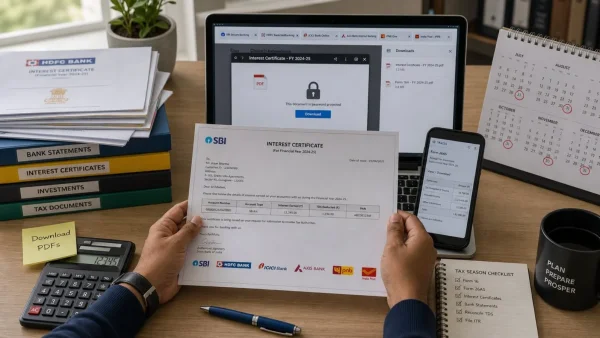
In some ways, ITR 2026 will be a test of due diligence for any saver or borrower. The one piece of paper that will see off notices, put refunds in motion and stand up for your deductions is the certificate from SBI, HDFC, ICICI, Axis, PNB or India Post. In my view, making sure you have it is the path of least resistance.
Why interest certificates matter for FY 2025-26
For the 2025-26 fiscal year, the certificate is the link between what you put in your return and what an institution has put on your statement. It is a record of the interest on your savings, fixed and recurring deposits, and may also show loan interest for the purpose of a deduction.
You will need it to back up the figures when you file, or in the event of an audit. It is also a good way to spot an oversight before it becomes a problem in your tax history. The consensus is to make sure the bank’s numbers are in line with your AIS and Form 26AS so there are no hiccups with the return.
Momentum builds ahead of deadlines
We have already seen over two crore returns come in for AY 2026-27. Getting in early with the proper documents is a way to sidestep the kind of mistakes that happen in a rush and to keep a refund on track.
Here are the dates to work with:
– ITR-1 and ITR-2 (Salary and capital gains): 31st July 2026
– ITR-3 and ITR-4 (Business, non-audit): 31st August 2026
– ITR-3 and ITR-4 (Business, where an audit is called for): 31st October 2026
– Transfer pricing for businesses (international or certain domestic deals): 30th November 2026
– A belated return: 31st December 2026
– To revise a return: 31st March 2027
India Post: for your savings and deposits
Head to the India Post Internet Banking site and put in your User ID and Password. New to the system? You can register at a post office. Once you are in, the dashboard has an Accounts tab where you can pull up an Interest Certificate for the right account and year and have the PDF ready to go.
It is a straightforward way to put all the interest from your postal schemes in one place for the ITR. Keep a copy for your files or for the return itself.
ICICI and HDFC: a few clicks
With ICICI, log in and find the Tax Centre under Payments & Transfer. Pick the account and the period you need, and the system will let you download the certificate as a PDF.
HDFC NetBanking has a similar setup. Go to your Accounts and you will see an option to Download Interest Certificate in the Quick Links. Make your selection for the year or date range, confirm, and you are done.
SBI and Axis: e-services and the like
For SBI, once you are in Personal Banking, look for e-Services in the top menu. Go to My Certificates and select Interest Certificate. Once you have the Financial Year in place, hit submit to see or save the PDF. It is the official number for your return.
With Axis Bank, head over to Internet Banking and find Deposits. In the Services section, an option for Interest Certificate will let you either download it or have it sent to your inbox. Make sure to put that file away where you can find it later.
PNB: a look at the process
Log in to PNB’s online portal and make your way to Manage Accounts > Deposit Accounts. The drop-down menu will let you put in your Customer ID and the right Financial Year. After you submit, the certificate will be on screen; from there, you can confirm and save the PDF. This is a good way to pull together data if you have several deposits under one ID.
What the certificate is for
It is proof of both ends of the ledger. On one side, you have the interest on your accounts and deposit products for the year. On the other, any interest levied on loans that you may be able to write off, per the tax code.
These are the numbers to put in your schedules for income and deductions. Keep the PDFs on hand. Should an audit or a verification come up, having the original document in front of you is the fastest way to put any questions to rest.
Reconcile to be safe
Do not file your ITR without running each certificate by your AIS and Form 26AS first. A little discrepancy can mean a notice or a held-up refund. It is much better to sort this out now than to deal with it when everyone is filing.
If you have accounts at a few different banks, be sure to get all the certificates. It is easy to overlook some interest from a small fixed or recurring deposit if you are adding up the figures by hand.
A few things to keep in mind
Make sure your log-in details are in order. If you have not been on Internet Banking in a while, reset your password before the deadline week.
And be sure you are on the right financial year. Portals often list the current and prior periods, so for FY 25-26, double-check that what you have selected is for the period you are filing.
The case for getting to it early
Downloading ahead of time means you have room to work out any kinks between your accounts and loans. You can also be certain that any late-arriving interest has made it into the certificate. For a borrower, a prompt loan interest certificate is a strong backstop for your claims. For a saver, it is the best way to sidestep penalties for anything left out of the report.
For ITR 2026, here is the approach
Get, check, and put away every certificate for your deposits and loans. Then run them against your AIS and Form 26AS before the return for AY 2026-27 goes up. It is a no-brainer for accuracy.
Whether you are with SBI, HDFC, ICICI, Axis, PNB or even India Post, the file is there for you to take. Download it and file with no worries.