The old risk playbook is being put aside as the market has to deal with the fact that a bit of geopolitics can turn prices on their head in a day. The steepest learning curve is in catastrophe modeling, where you have software made for hurricanes and quakes being put to work on the prospect of a new conflict or a government toppling.
There is no time to waste on this. When wars start to skew everything from the price of oil to your mortgage, you can see the problem with looking in the rear-view mirror. Lenders and underwriters are trying to figure out where the next fault line is and how fast it will revalue what they hold.
Why risk models are changing now
Instability has become an economic reality in its own right. The Institute for Economics and Peace says that since 2008, the count of nations in some kind of external dispute has come in at a little over 100 – almost double what it was.
Run the numbers and you find the cost of all that violence is in the neighborhood of $22 trillion. You are talking about 10% of global GDP, which is more than enough to put a crimp in trade, insurance and how you put your money to work.
In the industry, the talk about old-fashioned models has been direct. Citi has put out a word of caution on using ‘rear-view’ type thinking. Over at Morgan Stanley, they are making the case for a fresh look at how to factor in these risks when the world is coming apart at the seams.
The catastrophe-model pivot to conflict
All eyes are on what is happening at Verisk Maplecroft. They are the go-to for natural disaster models among the cat-bond crowd and insurers, but now they are putting those same methods to use to see if a war is in the offing.
“Our clients want to be able to look ahead,” says Sam Haynes, who is in charge of data and analytics at Verisk. “They don’t want to be told what went down last time. They want to know what is around the corner and where they are open to risk.”
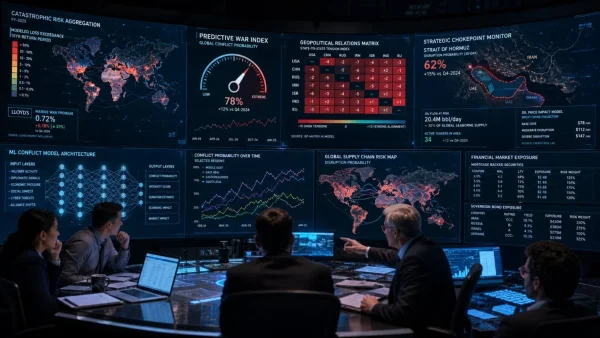
That is why they put the Predictive War Index in front of some of them in late May. It’s a machine learning setup that will tell you the odds of a country going to war in the year ahead, based on 27 years of social and economic data. (It doesn’t include the present situation in Iran.)
But even so, if you put it through the wringer, it holds up. Verisk says had you had it in January, it would have put the chance of an Iran war 1 1/2 months down the road at 66%.
Then there is the Geopolitical Relations Index, which is another one of Verisk’s offerings. It is a way to read the room between two countries by looking at past military run-ins, how similar their governments are and whether one can project power on the other’s turf.
Government stability forecasts enter the toolkit
Verisk has another model up and running since October 2023 that has been on point, calling six of the last seven times a government has fallen. They point to the end of Bashar al-Assad in Syria in 2024 and the ousting of Nicolas Maduro in Venezuela in January as examples.
With Maduro, it was a mix of the economy and a track record of trouble, according to Chris Boylan, a data scientist with the firm. For an investor, that kind of read can be the difference in how you hedge or set up your reinsurance.
Market stress tests are shifting shape
There is some hard math to it, not just the politics of it. “When you have sanctions and blockades, you aren’t looking at a normal distribution,” says Krishan Sharma of Citi, who is in model risk management.
A shock can change the whole equation. Correlations break, you can’t find any liquidity and the gaps in pricing don’t close. Relying on the same old assumptions for a stress test is a sure way to miss the tail risk in your underwriting or portfolio.
You can see the price of miscalculation in the shipping lanes. Once the Iran war was on in late February, Lloyds of London was asking for as much as 1% of a ship’s value to cover war risk in the Strait of Hormuz for a single trip, up from a pittance before, per Moody’s.
Gordon Woo of Moody’s puts it like this: in some ways, a conflict is like a terrorist act – not a lot of effort to put on, but the economic damage is out of proportion.
You can’t put a price on what’s to come, but new models are giving insurers a way to see the ripples of an event as they move along sea lanes and through supply chains, well beyond the hard damage to a given asset.
What investors have their eyes on
Portfolio managers and underwriters aren’t in the business of prediction for the fun of it. They want to build some scenario-aware odds into their pricing, set aside the right amount of capital and have a plan B as the global economy comes to terms with a multipolar world.
Verisk is putting out tools meant to slot right into an underwriter’s day job. The idea is to make war part of the regular decision-making process instead of something you only react to after the fact. Morgan Stanley put it in an April report: it’s a no-nonsense way to deal with a “fragmented, multipolar world” where the kind of efficiency we had in the age of globalization is a thing of the past. You’re going to see risk premia go up and hedges change.
A new kind of corporate risk
The market is already putting a number on fear. A May piece from Allianz has war edging out civil unrest as the political violence that has companies most on edge when they go to buy cover. “War is a rising fear for businesses around the world,” the assessment puts it. For a CFO, that means you’ll be looking at stiffer deductibles, more territorial exclusions and some hard talks about having a backup in your supply chain.
Three things are driving the conversation:
– Citi is saying don’t rely on what’s been.
– Morgan Stanley wants a wider view of geopolitics.
– And Allianz says war is the new top concern.
Where policy and probability cross
Some of this doesn’t just mean pulling back. There are ways to tie a policy to a measurable shift in risk. The Rand Corporation has been using AI to take a thorny question like regime change and turn it into a number.
We ran the model in mid-May and came up with a 20% chance Iran’s current leadership won’t be here in 2027. It’s a way to make sense of a situation where the data is either scarce or a step behind. Anthony Vassalo of the RAND Forecasting Initiative says it’s to show a policymaker how a sanction or a bit of diplomacy might move the needle. That has value for both statecraft and the markets.
Beyond the riot
You have experts who are reworking the old playbooks for strikes and civil disorder. War is a different animal with its own triggers, but the through-line is the same: you want to know how a hiccup in one place makes its way to the balance sheet.
Tina Fordham of Fordham Global Foresight, who used to be at Citi, would tell you volatility is no longer the norm; it’s picking up speed. She calls it “supercycle geopolitics” and it’s been breaking down guardrails. 2025 was a case in point, a wake-up call for the C-suite. If you’re a listed company, expect to be blindsided by non-economic factors and you’d better be up on your geopolitics.
If you want to know what to focus on, look at these:
– Chokepoints where insurance is getting pricier
– What predictive indices say about a regime
– Any sanctions or blockades that put a kink in trade
– How the demand for corporate cover is moving
The upside and the downside
For a trader, it’s a matter of timing. A good index can let you put on an options hedge before a flare-up or lock in a spread on a war-linked cover before the market does. But then there’s the risk of the model itself.
Verisk’s back-test on Iran will show you that even with data only to 2022 you can get some telling numbers. The trap is to put too much stock in one read. Citi is right to be cautious; you need ensembles and some rules for when to act.
This goes for sovereign risk and development finance, too. With over 100 countries in some form of external conflict, the cost of doing business across borders isn’t just about inflation and growth anymore. It’s also about how close you are to a flashpoint.
The writing is on the wall for the industry. You have capital allocators and insurers making room for forward-looking metrics and corporates rethinking their routes. It doesn’t make for a certain world. In fact, as wars make the past less of a guide, the cost of not changing with the times is high. The ones who come out on top will be the ones to put together a view of risk that is as flexible as the environment they’re in.