The numbers don’t lie: Australia is in range. The risk of a missile coming our way is on the up, according to the Lowy’s latest. They put it as a matter of what can be done rather than a prediction of war, but the days of being comfortable with the status quo are over.
There is a gap between what the public knows and how fast the Chinese military is modernising, the authors contend. For Sam Roggeveen, head of the institute’s International Security Program, the rise of the PLA is the most significant security story for this side of the world since the Soviet Union fell. He wants to see a better-informed debate in this country about it.
What the new assessment says
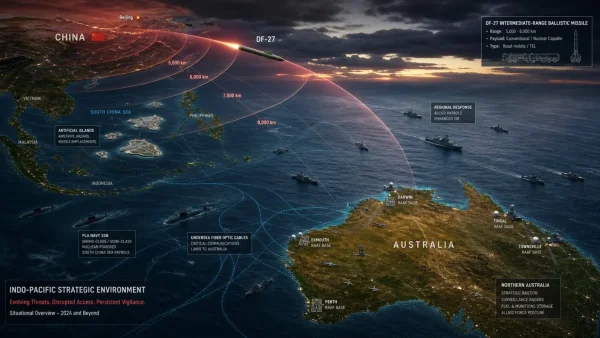
We are most exposed to fire from Chinese ships and subs, or from intermediate-range ballistic missiles that can make it to the mainland from their own soil or out in the South China Sea. Then you have the hypersonics and the means to deliver them.
The DF-27 is the one they are fixated on. The Americans put its range at 5,000 to 8,000 km. And if a conventionally armed ICBM comes into common use down the line, that reach will only be bolstered, the analysis suggests.
Routes to Australia’s north grow vulnerable
It is a more concrete worry when you factor in forward basing. A DF-26, for instance, could be on northern Australia if it were put in place on some of the man-made islands in the South China Sea. In a full-blown conflict, the PLA’s Rocket Force has a line of sight on our bases up north.
Why it matters for policy and planning
Canberra has been at it for three years, reworking its strategy to deter any moves from the north. Still, there has been some reticence in the government to talk openly about a strike on the mainland, even with AUKUS putting a premium on long-range denial.
The thing is, intent is fickle; capability is not. The report is an appraisal of what Beijing can do, not why it would, and a warning that in a regional crisis, we can no longer count on our distance to keep us safe.
To put things in perspective, the most present danger is still the ability to cut undersea cables, run cyber ops or block trade. But the bottom line is that the threat of a direct hit is no less real.
How the threat could escalate
Add in some long-range air power and you have a force multiplier. If China puts a crewed or uncrewed bomber in the field, or stations them and their ordnance on Pacific islands in our neighbourhood, the situation for Australia changes in a hurry.
On the water, the nuclear sub fleet is another matter. With numbers set to go from nine to 25 by 2035, they will be able to put in the hours for sustained operations, carrying everything from cruise to hypersonic missiles.
And then there is the rest of the navy – the carriers, the destroyers, the frigates. Put that together with the artificial islands and you have a network that makes the run to the north of Australia a lot shorter and a lot harder to plan for.
If you want to know where the key capabilities stand, here is what the analysis puts on the table:
– The DF-27 can cover 5,000 to 8,000 kilometres
– From a South China Sea base, the DF-26 is in on northern Australia
– Nuclear subs give you the option for a quiet, sustained strike
Implications for Australia and the region
We are in a tussle with China to make inroads in the South Pacific, to make sure we don’t end up with bombers or missiles on an island next door. You don’t want to be in a position where your warning time is shrunk and your northern defences are made to look weak.
Roggeveen doesn’t see this as a hard-line or a soft-headed piece of work. “The idea is to have a level-headed talk about what we are up against,” he says. Over the coming ten years, as the long-range systems and nuke-powered subs multiply, the map of the Indo-Pacific is going to be remade.
In the end, the Lowy says we are well within the scope of these new weapons. An attack is unlikely, but you have to plan for what can happen, not just what is intended. Now we have to make sure our diplomacy, our spending and the way we see the world are in step with that fact.