Gone are the times when they were just back offices. In Bengaluru and other parts of the country, multinationals are putting AI at the centre of things. The result? Quicker product rollouts, a slimmer marketing side, and operations that run a little tighter. Leaders in the room will tell you this is how brands are made, how regulators see things, and how clinicians do their work now.
India’s GCCs move from support to strategy
AI is more than a chatbot, according to those running the show. You have teams in HR, finance, content and marketing using it to put down some of the rote work, save a few dollars and make room for what really matters to the business.
Take Workday India. President Sunil Jose says they are in the process of co-developing AI for the likes of payroll and hiring with their global counterparts. “It is about building the whole model,” he says. In other words, the Indian side is an architect here, not merely a coder.
Marketing reinvention: diapers and department stores
Kimberly-Clark is using AI to put some pressure on its campaign schedules. There is an in-house system for sifting through social media to find the right influencers for Huggies, so they can get the word out to the right people, fast and in volume.
Over at the Bengaluru office of Catalyst Brands, they are trying out computer-generated imagery to make their videos and visuals without having to fly stock around the world. Nihar Nidhi, the India MD, puts it this way: “We are at the nose of the rocket” as we figure out how to do away with the expense of photo shoots and the like.
AI in life sciences: speed and safety
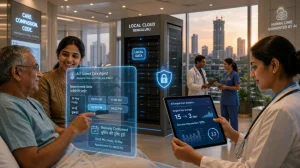
The changes are very visible in healthcare. Apollo has put in place a clinical assistant from Microsoft to pull in patient info and make sense of it. Puneet Chandok of Microsoft says it gives 20 per cent of a doctor’s time back, and 20 per cent to the patient.
Then there is drug development. Novo Nordisk in Denmark is on top of it with AI for regulatory paperwork and commercial analytics. You see the same thing with Amgen and AstraZeneca: they want to zero in on trial subjects and write up their safety reports in less time. It can be a matter of millions of dollars.
It is a simple story: the GCCs in India are using AI to get ahead, to cut out the friction in approvals, in sales, in care.
Public-good pilots and policy alignment
It is not all in the boardroom. Some of IBM India’s engineers have been with a local college and the authorities to put in place some AI for air-quality. On top of that, they are in talks with the government on upskilling, to make sure there is a steady supply of talent for what is to come.
So you have a two-part plan: make the tools that show results, and put some skin in the game to ready the workforce and the public for when AI goes mainstream.
What to watch next
Execution is the name of the game now. If you look at what the companies are saying, here is where your eye should be:
– A move by GCCs to take what was a prototype in Bengaluru and make it a global standard.
– Marketers who let the machine pick the influencers to widen the net.
– The hospitals that can put a number on the 20% a clinical assistant has given back.
– The pharma side of things, where faster safety reporting means real savings.
– More of these kind of partnerships between the state and industry to build skills.
There is a lot on the line. The ones that can put AI to work to trim a campaign or a regulatory review will be the ones calling the shots for their parent company.
For a global firm, India is a good place to put it to the test. You have the engineers, you have the heads in the room who know the regulated space, and you have the mandate to get it done. For the home front, it is a sign of how enterprise AI can make its way into the rest of the system.
If you listen to the top brass, the tone is the same. This is no longer a sideshow. AI is part of the product and the process. And for the GCCs in India, it is a move from being a service to being a partner in strategy, with the responsibility to show the way on quality and impact.