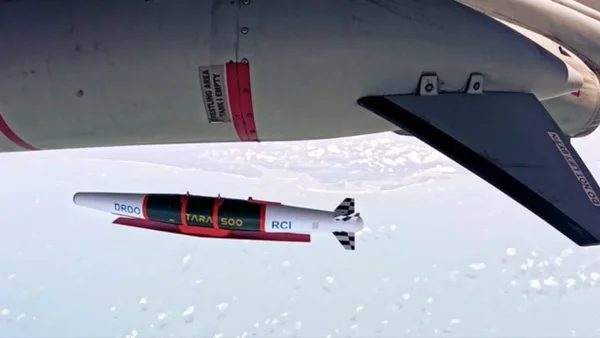
The new TARA kit should be able to turn India’s current supply of bombs into weapons that hit their exact target; the first test flight off the coast of Odisha proved this. The Ministry of Defence announced the success on Friday, saying it’s a big step forward in being able to make accurate strikes that don’t expensive. Production has already started with Indian companies, meaning these kits will be usable in the field very quickly.
Why TARA matters for frontline units
Unguided bombs are cheap and there are a lot of them, but they don’t reach their full potential because they aren’t accurate. TARA is a kit you attach to the bomb, extending its range and guiding it to a specific place on the ground.
For pilots, this means they’ll need to fly fewer missions to get the same result, and they can release the bombs from further away, improving their chances of survival.
The Ministry of Defence said TARA is the first glide weapon kit designed and built in India, and it’s meant to make attacks more powerful at a low price. It’s designed to hit ground targets accurately and provides that accuracy without the high cost of entirely new bombs, which is a benefit during long conflicts.
First flight-trial and what it proved
The Ministry of Defence said the first test flight was on Thursday, off the coast of Odisha. The IAF was involved and the successful flight showed the kit’s ability to be guided, how stable it is, and how accurately it hits the target at the end of its flight.
Dr Samir V Kamat, Chairman of the DRDO and Secretary of the Department of Defence R&D, complimented the teams on a perfect test. He said the performance shows TARA really can eliminate threats with a level of accuracy that hasn’t been seen before.
Defence Minister Rajnath Singh called it a “very important advancement” for India’s own capabilities. He congratulated the DRDO, the IAF, the companies developing and producing the kit, and other industry partners for this achievement.
Built in India, designed for scale
TARA was designed and developed by the Research Centre Imarat in Hyderabad, with help from other DRDO labs. It uses modern, cheap technology to get the best performance possible without making each kit too expensive.
And importantly, this has moved out of just being a project in a laboratory. The Ministry of Defence said Indian companies and the Development cum Production Partners have already begun making the kits, meaning they will be in use fairly soon.
Here is what the kit brings to the forces:
– Converts existing unguided warheads into precision gliders
– Cuts cost while boosting accuracy against ground targets
– Built with modular, state-of-the-art, low-cost tech
– Production underway with Indian industry and DcPP
The wider push: funding, tech transfer, momentum
This success fits with the country’s increasing focus on creating new defense technology and being able to supply its own. At the North Tech Symposium in New Delhi, Rajnath Singh said the DRDO has given 2,200 technologies to industry, broadening the number of companies making things and speeding up how quickly they’re used.
He also pointed to a big change in how money is being spent. Singh says 25% of the money for defense research and development is now going to private companies, universities, and new businesses. Over 4,500 crore rupees have already been given out.
Singh told defense workers, industry bosses, people making innovations, and those starting businesses that “defense research is the most important thing we are doing.” He said they must continue to focus on R&D to be ready for the future as technology changes quickly.
What comes next for TARA and the IAF
Now that the first test flight has been completed and production has begun, the next steps are to make a lot more of them and then have the Air Force test them more thoroughly. The Air Force being involved from the very start suggests they’ll be easily incorporated into training and how they fly missions.
If everything goes as planned, TARA could improve the accuracy of the bombs the Air Force already has, making them more effective without having to wait for new bombs to arrive.
For the whole of India’s aerospace industry, TARA provides a model: the DRDO labs (like RCI) come up with the design, work with DcPP to develop it further, and quickly move production to industry. This makes the time from an idea to actually having it in a plane much shorter, which is what a modern air force needs.
Essentially, the larger point is this: a glide kit made in India that can be added to bombs, is affordable, and is accurate, lets commanders be confident and flexible when planning attacks. It also means more of the work of creating and making these weapons happens in India, strengthening the country’s ability to be self-sufficient in research, development and manufacturing.