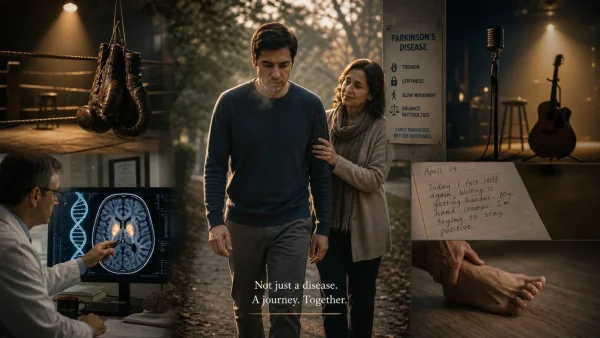
Parkinson’s doesn’t wait until you’ve retired to start. Doctors point out that while we associate it with getting older, young people are affected, and the first signs aren’t always obvious. Muhammad Ali and Ozzy Osbourne’s personal experiences with the illness became well-known, encouraging families to get help more quickly.
Why Parkinson’s is not only about ageing
Neurologists say Parkinson’s that starts before age 50 (young-onset) is more likely to be caused by genes than by things in the environment. Specific changes in the PARK2 (parkin), PINK1 and LRRK2 genes are linked to the disease starting earlier.
The environment can still be a factor, but with younger people who have Parkinson’s, their genes are more important than for older people.
Early clues young people often miss
The first changes are often quite mild, and happen a long time before the obvious shaking. You might feel depressed, anxious, have trouble sleeping, be exhausted, or be constipated – and these are often thought of as just being due to how you’re living.
The problems with movement can also be very subtle to begin with. You might have a slight shake when resting, not swing your arms as much when walking, speak very quietly, find your handwriting is small and cramped, have a face that doesn’t show much expression, or be slow when doing small things. Some younger people get painful cramping in their feet, and this is wrongly treated as a problem with their bones or joints.
Dr Sudhir Kumar, a neurologist in Hyderabad, explains that spotting it early can really improve someone’s life. He says these signs are commonly put down to getting older or being stressed, so people don’t get help until the illness has already caused a lot of difficulty.
Here is a quick check of red flags to track over weeks, not days:
– Tremor in one hand at rest
– Slowness in routine buttoning or rising
– Reduced arm swing while walking
– Softer or lower voice than usual
– Smaller, cramped handwriting
– Loss of facial expression
How the disease progresses and why diagnosis stalls
In younger people, the illness tends to get worse more slowly, and for a longer time they won’ مشکلات حافظه یا تغییرات در رفتار را تجربه نمی کنند. But this slower progression can actually be more upsetting for someone’s life goals.
Work, money and looking after other people all become harder at the same time as the symptoms, and this creates a lot of emotional and social difficulty that can be worse than the physical problems. Initially, many people think shaking is from stress, stiffness is from bad posture, and being tired is from being too busy – and this hides the actual illness.
Neurologists recommend keeping an eye on shaking that has no explanation, being persistently slow, or early cramping in the feet. Getting checked out promptly can make a big difference to how independent someone is in the long run.
Treatment today: what doctors do differently
The way the illness is treated is similar for younger and older adults, but is adjusted to suit the person’s age. Doctors are often careful about giving levodopa at first, because if you have it for a long time, it can cause other health issues.
Many people start with dopamine agonists and MAO-B inhibitors, and then move onto levodopa as the disease gets worse. When medication stops controlling the movements that are causing problems, deep-brain stimulation can help manage the symptoms and get function back.
Dr Kumar says, “Parkinson’s is a long-term illness, but it can be managed very well. Current treatments – including medicine, physiotherapy, changes to lifestyle, and sometimes more advanced things like deep brain stimulation – can significantly improve symptoms and let people continue to live independently for many years.”
Famous faces who changed the conversation
Muhammad Ali was diagnosed in 1984, a few years after he stopped boxing. By talking about his illness, he made people all over the world aware of it, and encouraged many to get help quickly.
Mohan Raj, a Malayalam actor who was in Kireedam and Hitler, also had Parkinson’s. This reminded his fans that it can affect people in any job and from any country.
George H.W. Bush had Parkinson’s caused by problems with blood vessels in the brain (vascular Parkinson’s disease). He lived to 94, and people all over the world followed his illness.
Pope John Paul II was diagnosed with Parkinson’s in 1984. Despite his decreasing ability to move and speak, he continued to lead the Catholic Church with determination.
Ozzy Osbourne, the heavy metal singer, told everyone he had Parkinson’s in 2019 and was open about how it was affecting him both emotionally and physically. He died in 2025 at the age of 76.
What this means for you
Don't ignore small symptoms. If shaking, slowness or painful cramping in the feet continue and you don’t know why, see a neurologist.
Finding it early and getting treatment tailored to you can slow down the development of the illness, help you continue working and with your family, and protect your quality of life. Celebrities get a lot of attention, but the important thing for each of us is to be aware of changes, ask about them, and get help quickly.