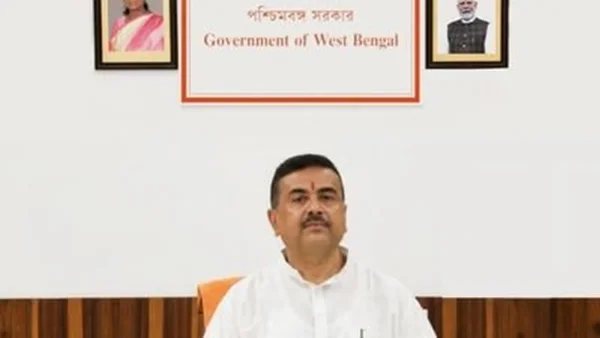
The state is taking a harder line on vandalism with a new law to recoup three times the value of any property put out of commission. Chief Minister Suvendu Adhikari has made it clear that those who go after industrial units will be met with heavy penalties – a message meant to serve as both a deterrent and a point of reassurance for investors.
“You have a right to protest, but it should not end up in violence or with a factory in tatters,” he told a room of civil society and business heads in Bhawanipur on Saturday. Should an accused fail to come up with the money for damages, the state will see to it by putting their assets up for auction, he said.
Why the penalty matters
Under Adhikari, vandalism is being treated as an economic hazard with the power to stifle jobs and investment. The idea is to link the financial responsibility to the harm done and move the burden from the exchequer to the one who did it.
He put it in plain numbers: for a piece of property worth Rs 1 crore, the tab will be for Rs 3 crore. And if an individual is responsible for a forced shutdown and the resulting mayhem, there is jail time and a penalty to match.
What the assembly cleared on June 28
Two bills to give the state more clout over public order and organised crime were put through the West Bengal assembly on June 28. The government is touting the package as a matter of deterrence and holding people to account.
They are the West Bengal Maintenance of Public Order (Amendment) Act and the West Bengal Public Safety and Control of Anti-Social Activities Bill. One is for dealing with the fallout of riots and unlawful assemblies; the other opens the door to 12 months of detention without trial.
The government’s case rests on a few key points:
– A recovery of three times the property’s value
– An umbrella for all manner of violent protests and unlawful gatherings
– The option to sell off a defaulter’s property to make good on the dues
– Up to a year in preventive detention
Enforcement signal to protest organisers
Adhikari was firm on the fact that while protest is a right, it does not extend to causing trouble for industry. The goal is to have those running a demonstration think twice before it gets out of hand.
Implications for business and protests
It is a no-nonsense message for the industry: try to close down a plant or wreck some equipment and you can expect to do time and pay a fine triple the amount. It is a way to put a figure on the kind of disorder that can be hard to quantify in a risk assessment.
Officials say the Maintenance of Public Order (Amendment) Act is about making sure there is accountability when property is destroyed, which in turn is supposed to put minds at ease for operators looking to put down roots or bring in new capital.
As for the rest of the citizenry and labour, the new rules draw a line in the sand between a lawful show of force and something that is punishable. Once a protest turns into an attack on public or private property, liability follows.
What comes next
Now it is a question of how it is put into practice. The onus is on the authorities to make the call on damage and then go after the money. Adhikari has signalled a more assertive approach than in the past, with property auctions on the table for those who don’t pay up.
There is a chance this rule of triple damages could alter the dynamics of street-level violence, particularly in the vicinity of factories. For the investor in Bengal, the government is waging a bet that a strict hand is what will keep things running smoothly.