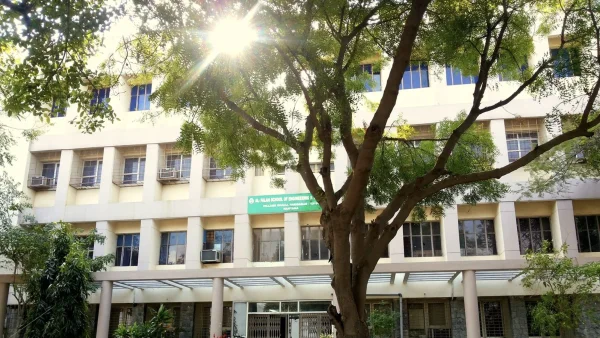
Official sources claim that the Directorate of Enforcement might apply the provisions of the law on prevention of money laundering to attach the campus of Al Falah University located in Faridabad. This step should be preceded by investigation to verify whether the funds utilized for constructing the campus were from the alleged proceeds of crime.
Why the ED is considering attachment
The entire matter is looked into right from the point where funds were collected through false representation and later on used for construction activities at the Dhauj campus. The probe is against the Al Falah Trust which holds the university and the other educational institutions also.
The Economic Directorate had placed charges of money laundering arrest on the chairman of Al Falah Group, Mr. Jawad Ahmed Siddiqui, way back in November. The trust is accused by the agency of being complicit in operating the institutions without proper authentication; hence, the students did not get any approvals, even though the respective institutions claimed that they were recognized.
The agency’s sources stated that an amount of money that was alleged to have been gotten through illegal ways was spent on the development of the buildings on the university grounds. Various experts are looking into and estimating all types of property and real estate that is associated with the trust so they can secure the property temporarily before any legal action is taken.
Implications of a PMLA attachment
In accordance with the provisions of the Prevention of Money Laundering Act (PMLA), the Enforcement Directorate (ED) has the power to attach the assets temporarily that it takes to be connected to the proceeds of crime so to prevent them from being dealt with or disposed of anyhow. The attachment in the first place is usually for a maximum of 180 days, during which the Adjudicating Authority may either confirm or revoke it.
If the case is filed, the embargo on the property is maintained until the outcome of the trial. As a precautionary measure, the asset can be put under the government-appointed receiver’s control who will take care of the asset’s operations and the stakeholders’ concerns.
It has been mentioned from sources in that situation, that students may be still allowed to take their courses even if the campus is being attached. The main purpose is to save the asset and also to provide academic continuity with the legal system running its course.
The allegations which are the subject of an investigation
The ED has told a court that, under Siddiqui’s direction, the group has made a minimum of Rs 415.10 crores of money. The agency asserts that the parents and students were deceptively misled to the payment of school fees on the basis of false accreditations and recognitions.
Moreover, the raids of the CBI and ED on the premises of Amnesty India and the home of its director, Aakar Patel, was 18651369 on October 25. The operation resulted in the seizure of several laptops, mobile devices, and several hard drives from Amnesty’s office, and the residence of the director.
Furthermore, the bureau accuses that the university made false claims about the University Grants Commission’s recognition and NAAC accreditation current situation. NAAC is an independent body doing the assessment and accreditation of higher education institutions in India.
The link to a larger security probe
After the police’s initial report on the bomb explosion on September 10, a city college came to the Security Service’s attention because its staff and students were allegedly involved in the incident as part of the international network.
Defence and due process
Siddiqui’s attorney argued in front of the court that his client was wrongly accused and the two police filings which the ED relied on were false and fabricated. The defendant’s position is that the universities have been acting in compliance with the law.
The ED lodged the case of money laundering in mid-November after considering the two Delhi Police FIRs. During the progress of the case, the Adjudicating Authority and then the appellate forums will examine the supporting proof behind any attachment.
Potential operational impact
If the campus is attached, the day-to-day operation may be taken over by a court-appointed or government-appointed administrator. Salaries, classes, tests, and admissions could be carried out under supervision, with no or limited asset transfer and new liabilities being allowed.
Students are usually not subject to the receiver’s punitive financial measures. Nonetheless, conformity with the rules and regulations, revealing of the fees, and securing of the certificates will be made more stringent, which will also affect the accreditation records and thus the area of employment for the students.
How the actions taken by PMLA
– The Enforcement Directorate identifies the properties believed to be connected to money laundering and attaches them provisionally.
– At Adjudicating Authority the evidence gets reviewed followed by the decision about the case of continuation.
– Proceeds of crime and money laundering are proved beyond the shadow of a doubt by the court, the assets are then likely to be confiscated.
– if a court later finds the assets are from money laundering, they may be confiscated. A “management company” can maintain the operations and thus be a direct source of cash flow to protect public interest and asset value.
This process prevents the transfer of the gains of the suspected crime and is at the same time set up with a view that the basic necessities provided by the institutions like schools/colleges be not disrupted in any way(I.e. the process is being carried out.)
The regulators’ focus
The regulatory authorities shall not only carry out their usual financial examination but also look into the structures of governance of the institutions like the trust, the role of the board, the existence of an internal audit system, and the efficacy of the compliance controls. Consistent and verifiable accreditation from bodies like UGC and NAAC will be the key in the process.
The importance of transparent disclosures, audited statements, and strict adherence to recognition norms in the wider higher education sector is highlighted by the case. The institutions might get even more thorough examinations of their promotional statements and tuition policies.
The governments’ next move
The ED will most likely move on with asset valuation and, if happy, subsequent to that, put an interim attachment order. It will be then over to the Adjudicating Authority for the proceedings, where the trust and individuals can challenge the action.
Any order could then go to the PMLA Appellate Tribunal and higher courts. Criminal litigations would be run at the same time, also with possible government moves to stabilize academic activities if necessary.
The impact of the situation on young learners and their families
In terms of the students, the things that matter now are the continuity of the class environment, degree validity, and the time required for the students to be absorbed in the job market. In most cases, the government looks into securing academic continuity and recognition of the work done, although the organizer’s control would only be temporarily moving.
Families are advised to keep track of the official communications of the university, the ED, and the relevant regulators. It is advisable to cross-check the accreditation and recognition status directly with the UGC and NAAC for the current programs and new admissions.
In summary
Al Falah University’s possible linking with the Prevention of Money Laundering Act denotes an uncompromising attitude toward financial wrong-doings in the academic sector. If it happens, the move will be to immobilize the suspected assets while continuing the teaching and learning activities.
This incident will be a test of how the PMLA mechanism will be able to maintain an equal distance between crime prevention on one hand and student concern on the other, and how efficiently universities will be able to show conformity to the law whenever their financial dealings are under the magnifying glass.