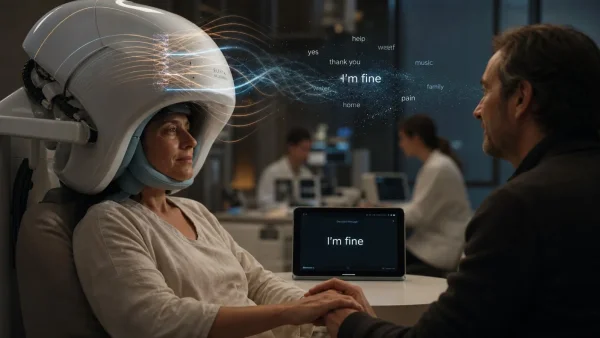
Think of being able to let a family member know you’re all right after a stroke, no words or typing needed. That is what Meta is after with Brain2Qwerty v2. The work is in its infancy, but for someone who has been left without a voice, the implications are profound.
Why this matters
Right now, if you want a dependable brain-computer interface, you have to have electrodes put in your skull. They do the job, but they come with some major surgery, so not everyone can have one. Meta is trying to do away with the operating room and the long convalescence by leaving the brain where it is.
The company is making a case for people with paralysis, lesions, or other neurological hurdles. A non-invasive way to communicate, they say, is not only safer but could be more open and less expensive than the surgical route.
The headline results
According to Meta, Brain2Qwerty v2 is 61 per cent accurate on average with words. Put that up against 8 per cent for some of the other non-invasive tech out there. In the case of the top user, we saw 78 per cent, with over half of the sentences coming through with at most a single error.
Don’t go looking to buy one, as the team will be the first to tell you. But Meta says it can put together a full sentence from what the brain is doing in near real time. And with enough training data, they think you can close in on the performance of the more invasive kind of systems.
How the system works
It’s all down to magnetoencephalography, or MEG. You put on a helmet – it has the look of a hair dryer you might find in a salon – and the sensors pick up on the subtle magnetic fields your neurons make when you type. No implants, no problem.
Non-invasive by design
There is a world of difference between MEG and a device with an electrode in your head. Meta makes a point of that to stress how safe and scalable it is for those who are not candidates for an operation.
Training the decoder
They had nine people put in about 10 hours in an MEG scanner, typing along. From the 22,000 or so sentences that came out of it, the AI was able to make sense of the patterns and link them to language.
What changed in v2
You won’t find the hand-crafted pipeline of the original here. Version two is built on end-to-end deep learning, which means it can read raw brain signals and figure out the language on its own, without a set of rules to follow.
On top of that, Meta has put some neural data through large language models. If a signal is a bit weak, the system can use context and grammar to put the pieces together, in much the same way a good autocorrect would.
Behind the scenes optimisations
Meta will have it that their AI agents were put to work on various training methods before the researchers made a call. It’s a matter of wanting something that is reliable in the real world, not just in the lab.
Comparisons and caveats
Then you have the likes of Neuralink and their brain chips, which are another story. Meta is of the mind that a helmet is the way to go for safety and scale, even if the numbers for accuracy are still in the favour of an implant for now.
For the time being, this is for the research facility. It is not going to be in your pocket. Meta sees it as a means to give back some form of communication to people who are making do with tools that are hard work to use.
A few things to bear in mind:
– It is an experiment, not something you can put on a shelf
– How well it does depends on the person
– There is more data to be had to make it better
Open research and the road ahead
In the interest of moving things along, Meta is putting out the code for both v1 and v2. The Basque Center on Cognition, Brain, and Language (BCBL), their partner in this, is also opening up the v1 dataset to the public.
It is part of the larger Digital Brain Project, which has Tribev2, NeuralSet and NeuralBench in it. There is even a $5 million pot of money for open neuroscience data.
Where it goes from here is a question of whether it holds up outside the lab, how the MEG hardware is to live with, and what patient groups make of it. Get past that and you have something that is a lifeline, not a parlor trick. For some, it would be a way to be heard again.