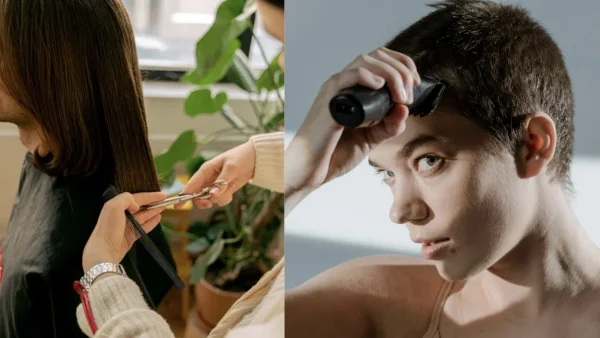
If your hair doesn’t seem to be getting longer, your trimming schedule might be the issue. As we said, trims don’t make hair grow quicker at the scalp, but they determine how much of the new growth you actually keep. Again, 8-12 weeks is a good guide for most, and it’s all about your hair’s condition and what you want.
What trims really change: the length you keep
Hair grows from the scalp, not from the ends. Because of this, you can’t make the hair roots grow faster by cutting it. On average, hair grows about 1 to 1.5 centimetres a month, so around 12 to 15 centimetres in a year if everything is healthy.
However, the important thing is keeping that growth. The ends of your hair get worn out like fabric, becoming split, dry and weak. If you leave them, splits will travel up the hair shaft, your hair will get thinner at the bottom, and breakage will remove the length. Regular, small trims get rid of the weakest part before it damages the rest.
Pick your timeline by condition and goals
First, think about what your hair is like. Hair that’s been coloured, bleached, or damaged by heat needs a trim every s6-8 weeks. This limits damage, stops fraying from getting worse, and protects the length you’re trying to achieve.
If you want really long hair, try to have a trim every 10-12 weeks. Ask for just a ‘dusting’ – taking off about half an inch to an inch – to freshen up the ends without losing too much of your growth. If your hair is generally in good condition, you could wait a little longer, but waiting too long will allow split ends to undo all your hard work.
Curly and heavily textured hair can hide split ends for a while, but it still needs to be looked after to stay nicely shaped. Getting a trim every and to 12 weeks will keep its shape and bounce, and stop damage that you can’t even see.
Short, carefully styled haircuts lose their shape the fastest. You’ll need one every 4-6 weeks – this isn’t so much about growth, as about keeping the lines neat and the style as you want it.
A quick length-based checkpoint
If you prefer to think in terms of length rather than goals, use this as a simple reference:
– Short hair: every 4-6 weeks
– Medium-length hair: every 6-8 weeks
– Long hair: every 8-12 weeks
How to tell it is time to book
You don’t need to put a reminder in your phone to get a trim. Your hair will tell you when it’s time! Look for rough ends, knots that appear for no reason, or ends that are very thin or almost see-through. A quick trim now can stop you needing a much shorter cut later.
Here are the most reliable cues to act on:
– Visible split ends at the tips
– Ends feel dry or straw-like
– Style loses shape quickly
– Tangling increases
– Noticeable loss of shine
Do trims speed growth? No, but they change outcomes
Trimming doesn’t make your hair grow faster at the scalp. But, it can make it look thicker and healthier by removing the most fragile bits. With less breakage, you keep more of the 1 to 1.5 centimetres of growth you get each month. That’s why regular trims often make it seem like your hair is growing faster.
If you are trying to grow your hair long, don’t go for a huge cut. Just maintain it. Protecting the ends of your hair is what allows the new length to be visible.
Boost growth at the source
To really affect how well your hair grows, focus on your scalp and your everyday routine. Getting enough nutrients is important: protein, iron and vitamins help create the right conditions for consistent growth. Try to eat practical, balanced meals with eggs, nuts, green leafy vegetables and fruit.
A healthy scalp means better growth. Gently oiling it, a light massage and keeping the roots clean all help create a good balance. Don’t use a lot of heat on your hair to avoid weakening the hair shaft, and treat your hair gently: don’t use tight styles, brush it roughly, or pull at it unnecessarily.
Managing stress isn’t just about how you look; it affects your hair growth cycle. Make sure you get enough sleep and look after your mental health to avoid slowing growth which will show up months later.
A simple, consistent routine that does the basics without being too complicated is also good. Trim every 2-3 months, oil your hair 1-2 times a week, use a gentle shampoo and conditioner that’s right for your hair type, don’t use too much heat, eat well and drink enough water.
The key is to have a balance. If you never get a trim, you’ll lose length to damage. If you get it cut too often, it’ll feel like you’re not making any progress. For most people, an trim every 8-12 weeks is ideal for keeping hair strong as it grows.
Healthy hair is always better than just long hair. A small trim at the right time can prevent needing a big cut later, and it will mean every centimetre you grow really shows.