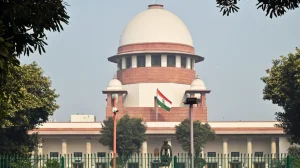
In its plea to the top court, the Centre has cautioned that an over-reliance on the fact of a protracted trial can be the undoing of a prosecution. Using the likes of Ajmal Kasab or Hafiz Saeed as examples, it has made the case for looking at the facts of the matter.
What triggered the push for a larger bench
For now, Justices Aravind Kumar and P B Varale have put off their orders on the bail applications of Tasleem Ahmed and Khalid Saifi, the two in the 2020 Delhi riots case. They will make their views known later today or by Monday, May 25.
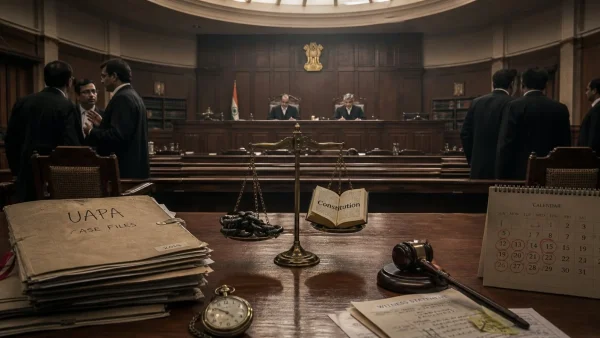
This comes from the same hearings where the Centre has been at odds with the idea that you can hand out bail in a serious terror case just because the trial has been slow. It’s a line of thinking they say can have some very odd results in the more severe of cases.
S V Raju, the Additional Solicitor General for the Delhi Police, was clear that you can’t apply the old maxims by rote in every UAPA case. He told the court to look at the nitty-gritty: the facts, the allegations, and what is involved in a complicated terror probe.
The legal split the Centre wants resolved
There is some history to this. On May 18, a pair of judges, B V Nagarathna and Ujjal Bhuyan, let Syed Ifthikar Andrabi out on bail in a UAPA case, in a move that went against two earlier rulings: Gurwinder Singh vs State of Punjab from February 2024, and Gulfisha Fatima vs State (NCT of Delhi) of January 5, 2026.
Take Gurwinder Singh, for instance; there the court said if the charges check out on the face of it, then jail is the way to go. And in the Gulfisha Fatima matter, while five were bailed, Umar Khalid and Sharjeel Imam were not, with the court making it plain that being in prison for a long time doesn’t give you a right to anything.
But the May 18 order had it that both of those benches didn’t do justice to the 2021 three-judge verdict in Union of India vs K A Najeeb. In Najeeb, the court held that your constitutional right to a quick trial trumps the statute, even under the UAPA.
May 18 ruling and its ripple effects
So the bench on May 18 made a point of saying that the presumption of innocence is what makes a legal system civilised, and that the rule of bail is enshrined in Articles 21 and 22. You can’t just lock someone up for good under the UAPA.
Raju, however, has his reservations about such a one-size-fits-all approach. He says it doesn’t leave room for the kind of evidence you have to gather in cross-border terror work.
He pointed to a part of the Gulfisha Fathima ruling – paragraph 52 – which sees Najeeb as a safeguard but not the be-all and end-all. The court there told you to consider the whole picture: the role the accused is said to have played, the record, the delays, and so on.
The Centre’s argument: delay cannot trump gravity
To put it in perspective, Raju put it to the court: would you be in a position to grant bail to an Ajmal Kasab if the trial dragged on because of the number of witnesses? When it came to the matter of Kasab, he pointed out that it was ‘7 or 8 years’ in the making before the case was put to rest.
He put a like scenario to Hafiz Saeed: if you have a man in pre-trial for five years while you are piecing together evidence from across the border, is that enough on its own to make a case for bail? “Will you let him go and say, well, 5 years is up?” was his way of putting it.
His position was that the UAPA is written with stiffer requirements in mind and you can’t put society’s interest aside. He also made the point that the two conditions that keep a UAPA accused behind bars don’t run afoul of Article 21.
A constitutional question with national impact
You see this in the Delhi riots case, which has been something of a proving ground. The 2020 unrest left more than 50 in their graves-53, as was put in court. The prosecution will have you believe the seriousness of it all, and the conspiracy they are alleging, means you have to be careful with bail.
Then there is the May 18 verdict, which has given new life to the view that you can’t just make a habit of long detentions. The message was clear: an open-ended pre-trial holding isn’t a way to get around the right to a quick trial.
On Friday, the bench observed that in cases where life or death is on the line, they have looked at delays not of the accused’s making and let it count for something. That has a bearing on how you read Najeeb in a UAPA matter.
Impact on Delhi riots bail pleas
During the hearing, it was made plain they would in all likelihood look at some form of interim relief for Saifi and Ahmed. The Delhi Police didn’t stand in the way, saying the pair were not the ringleaders.
Raju, for his part, wanted the bench to pass the wider legal issues to a larger one. You can’t put a hard-liner in the same boat as a side character, he said, and the Gulfisha Fatima method of sorting them out was the right call.
“Sure, you can give Saifi and Ahmed bail on the facts,” he told the court, “but you can’t have it that because two years have gone by, every UAPA defendant walks.”
Why this reference matters beyond one case
A reference would put an end to the different ways of looking at Najeeb, Gurwinder Singh and Gulfisha Fatima. It would also put a number on how much delay can trump the restrictions of Section 43D(5) and how you judge a person’s role at the bail stage.
The bench on May 18 was firm that Najeeb is the law and shouldn’t be watered down by a smaller bench. What you heard on Friday was an argument for a more measured approach, one that honours both the constitution and the statute.
It’s not a theoretical exercise. It will have a say in how investigators handle a complicated terror case and when an accused can use time against you, especially with evidence in multiple jurisdictions.
Key stakes as framed in court
The submissions distilled the stakes into clear propositions:
– Bail should not become automatic due to delay
– Role, gravity, and evidence must be weighed
– Najeeb is a safeguard, not a blanket rule
– UAPA’s twin conditions still matter
– Society’s interest must be considered
What comes next
For the moment, the bench has held off on any orders, whether on the individual pleas or the request for a larger bench. We may hear back later today or on the 25th.
If a larger bench is put in place, it will be the standard for UAPA bail country over. It will tell the trial courts how to weigh up the rights, the law and the clock.
But for now, the action is on Saifi and Ahmed. The question is whether the court will put in place a test that steers clear of either keeping someone in for no good reason or letting them out of hand simply because of the date.