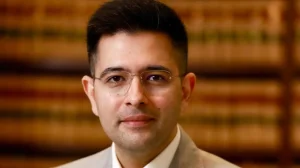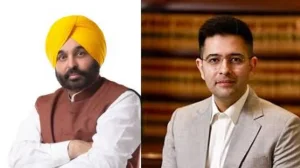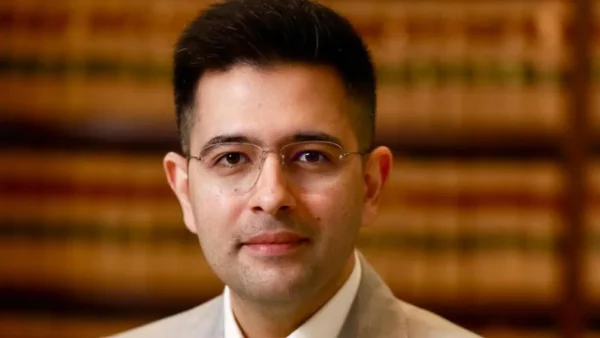
Raghav Chadha deliberately used a ceremonial moment in the Rajya Sabha to show how much he’s at odds with the Aam Aadmi Party. When congratulating Harivansh Narayan Singh, who had been chosen without opposition as the deputy chairperson of the Upper House, Chadha noted that older, more important members of his party weren’t there. He then specifically mentioned that he was present, after being taken off the role of deputy leader.
A pointed remark in the Upper House
Chadha got up to speak and started with a dig at the AAP’s leadership. Sanjay Singh, the leader of AAP in the Rajya Sabha, wasn’t there, he said. Ashok Kumar Mittal, the newly appointed deputy leader, wasn’t there either. Then he emphasized, “I am the deputy leader who was recently removed, and I am here in the House.”
He congratulated Harivansh Narayan Singh, and described their relationship in the past as “khatta-meetha,” which means sweet and sour. He said he hopes the new term will be more sweet than sour, and jokingly asked for an extra minute or two to speak during future debates.
Chadha also had praise for the person in charge of the session. He addressed C P Radhakrishnan, the Vice President of India and the chairperson of the Rajya Sabha, saying that more members are now able to speak during sessions, including Zero Hour, than was true previously.
From deputy leader to public dissent
Chadha’s comment followed a month of obvious awkwardness with his own party. On April 2nd, the AAP told the Rajya Sabha office that Ashok Kumar Mittal would be replacing Chadha as the party’s deputy leader. This made official a demotion that Chadha sees as being both about politics and about him personally.
The AAP has 10 members in the Rajya Sabha: seven from Punjab, and three from Delhi. In the Lok Sabha, they have three MPs, all from Punjab. Considering this, the deputy leader’s job is symbolically important, as they organize how the party acts and what they say during important debates.
Chadha’s response to being removed was a message that quickly became his main point. In a video, he said, “Don’t think my being quiet means I’ve been beaten.” A few days later, he mentioned receiving a copy of The 48 Laws of Power and pointed out the first rule: “Never be brighter than the boss.” These posts made people believe his relationship with the top people in AAP had broken down.
Accusations and rebuttals inside AAP
Leading figures in the AAP publicly criticized Chadha. Saurabh Bharadwaj, who leads the AAP in Delhi, accused Chadha of doing PR work that wasn’t very strong in Parliament. He pointed to Chadha’s statements about food prices at the airport and how quickly things are delivered as examples. Bharadwaj said Chadha should have saved his limited speaking time for more important issues facing the country.
Bhagwant Mann, the Chief Minister of Punjab, when asked if Chadha was being influenced by others, said, “Yes.” He said that by talking about less important things when the party was facing legal and political difficulties, people would start to wonder about Chadha’s motives and where his loyalties lay.
Atishi gave specific examples: Chadha’s refusal to sign a request to remove Gyanesh Kumar as the Chief Election Commissioner, and his apparent unwillingness to talk about a shortage of LPG (cooking gas) when the world’s energy markets were very unstable. Chadha says the accusations against him were planned, and he told his colleagues to name one time he didn’t join an Opposition walkout. He pointed out that for the impeachment vote, only 50 of the 105 Opposition members of the Rajya Sabha (the Upper House of Parliament) had to sign, and asked why he was the only one being criticized, as he believes many members of AAP also hadn’t signed.
Security row and the optics of dissent
The consequences of this went beyond what happened in Parliament itself. The Punjab state government took away Chadha’s top-level security. Almost immediately, the central government gave him a slightly lower, but still very high, level of protection. Security is usually about how much danger someone is in, but the timing of this change makes it seem like a political statement on top of an already tense situation.
For Chadha, who at 37 was seen as a fast-improving strategist for AAP, being given a lower position, publicly criticized, and having his security changed shows how quickly things can change within the party. Now, people are presenting two different ideas of Chadha; he’s either a parliamentarian who carefully does his job and focuses on what the public cares about, or someone who’s gone against what AAP is trying to achieve.
Parliamentary strategy under scrutiny
What happened in the Rajya Sabha also says something about how AAP works in Parliament. Smaller parties all compete for a limited amount of time to speak during important debates. If the leaders of a party are united, they can decide who gets to speak and make sure they all say the same thing on issues from central government investigations to how the economy is run.
When members of the party publicly disagree, that clear picture is lost. When the party’s leader and deputy leader aren’t in the Rajya Sabha during an important meeting, and the recently removed deputy leader is there, it’s a very obvious message. It suggests the party isn’t following procedures and makes you wonder who is deciding what AAP will do.
This disagreement happens as the wider Opposition is trying to work together on a plan for the Rajya Sabha. If parties within the Opposition don’t agree, it weakens their ability to influence things when they walk out of debates, call for votes to end a session, or negotiate with the chair about who gets to speak.
Signals beyond the soundbite
Chadha carefully mentioned things about power and being in charge in a way meant to be heard by people beyond the Rajya Sabha. By using the saying “Never outshine the master,” he portrayed his removal as being about feelings within the party, rather than a difference in political beliefs. People who disagree with him, however, say it was about how well he performed and whether he was loyal to the party’s main goals.
Each side is trying to appeal to a different group of people. AAP’s leaders have to convince their supporters the party is still strong against its opponents. Chadha is trying to get the votes of people who appreciate a parliamentarian who can point to actual work done and don’t like political actions done just for show. This difference could be important in Punjab, where Chadha is well known and the party gets a lot of support.
What to watch next
The next time Parliament meets will show if AAP will let Chadha speak as much as he used to, or if they will limit him even more. We’ll have to see if he’s involved in debates about running the country, the relationship between the central and state governments, or the economy, and if he clearly works with the Opposition when they are in conflict.
Also, we’ll need to see if AAP strengthens its leadership in the Rajya Sabha with Sanjay Singh and Ashok Kumar Mittal in charge. A consistent and unified group of leaders could lessen the effect of this argument. But if the split gets bigger, it could affect who is on which committees, what the party says to the media, and how much power AAP has to negotiate in the Rajya Sabha.
For now, Chadha’s statement – "I am the recently removed deputy leader, and I am here” – is both a news report and a way to present his own version of events. It keeps attention on the problems within AAP, while at the same time showing Chadha is taking part in the work of the Rajya Sabha and isn’t being ignored.