You may see cooking oil brands fall in line with uniform packaging before long. It’s a step to make pricing clearer at a time when demand is up and so are imports. On Monday, the Department of Consumer Affairs confirmed it is reviewing a plan to bring some standardisation to packs under Legal Metrology, having had its say with the kind of associations that make up 90% of the edible oil market.
Why we’re talking about standard packs again
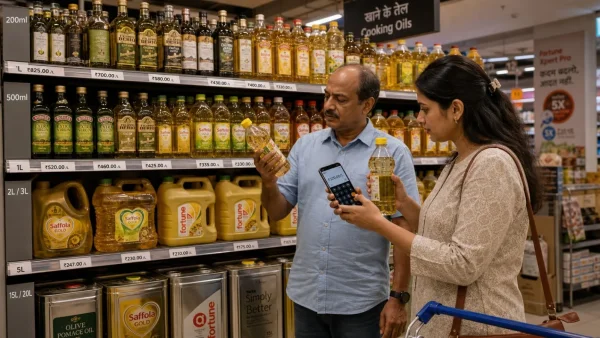
The industry has put in a word about how odd-sized, look-alike packs are making it hard to tell what you’re paying for at the counter. You’ll find 650 g, 700 g, 810 g, 850 g and 870 g jars on the shelf, and as the government has been told, it can be enough to put a shopper off making a well-informed call.
It’s more than just a matter of looks. A little change in volume means the unit price is different, and a quick glance at the shelf can be deceiving. The department is on top of these suggestions to put some teeth back into transparency and fair trade.
What’s being put on the table by the industry
Associations are calling for a go-back to the drawing board on quantities for the likes of palm, soybean, sunflower, mustard, groundnut, sesame, rice bran, cottonseed, corn and your typical blend. They have in mind 200 ml, 500 ml, 1, 2, 3, 4 and 5 litres, as well as 15 and 20 litre (or kg) options.
At the same time, they don’t want to make things unaffordable, so very small packs should be left alone. Their line is that anything under 200 ml should be exempt so as not to upend the lower end of the market.
Some rule changes in the mix
This is a possible U-turn from where we’ve been. Back in 2021, new rules made it a must to show the unit sale price on every package. Then in 2022, an amendment did away with Schedule II, which had been the stick for making sure you could only buy essential items like oil in set amounts.
That opened the door for manufacturers to do as they please with pack sizes, and non-standards have run amok. Now, the industry says that even with unit pricing, it’s still a problem when two packs side by side are deceptively similar.
Market backdrop
All this is happening while the numbers are on the move. In 2020-21, Indians were using 24.6 million tonnes of edible oil; by 2022-23, that figure was 28.9 million tonnes. The Solvent Extractors’ Association of India has the numbers: 2025-26 saw a 3% bump in imports, to 16.6 million tonnes.
Then there’s the demand side. A 2024 NITI Aayog report puts per capita consumption at some 19.7 kg a year, a far cry from the 8-9 kg we were seeing in the early 2000s. The market is worth more, too. TechSci Research values it at $4.39 billion for 2024 and has it on track for $6.49 billion in 2030, growing at 6.79% a year.
What it means for brands and shoppers
Should the new rules go ahead, you can expect a shift in how brands vie for your business. Take away the guesswork on pack size and you put a finer point on any discount or value proposition. It’s an apples-to-apples comparison that will put some heat on pricing, particularly for those who have been making a case with odd-sized packs.
On the other hand, the consumer gets to do less head-scratching at the shelf. When you can line up comparable packs from different makers, unit prices become something you can actually work with.
Who was in the room
The consumer affairs secretary presided over a get-together on 20 May 2026 with a who’s who of the industry: the Indian Vegetable Oil Producers’ Association, the Solvent Extractors’ and Soyabean Processors’ associations, the Central Organisation for Oil Industry and Trade, and the Mustard Oil Producers.
The department made it plain: if there is to be standardisation, home-grown and imported oils are in the same boat. They are also looking into some of the industry’s ideas to see what can be done for better transparency.
What to look out for
Assuming the plan moves forward, here is the likely scenario:
– No favours for domestic over imported
– A three-month or so run-up to make the change
– Some leeway for minor edible oils
– Anything under 200 ml left out of it
The government has made its position clear – they want to be practical and not cause a stir while they put in place some stronger consumer safeguards.
Where the competition stands
With standard packs, you can’t hide behind the packaging as much. It will come down to the brand, where you source from and how you promote. You may see private labels and value brands having to readjust, while the premium end of the market might like the level playing field.
We don’t have a date on the calendar yet, but the writing is on the wall. With the market this hot and imports on the rise, the policymakers seem intent on making things more open.
In the end, this is about the way the market is built. If you can make quantities uniform, you give the shopper something to believe in when they put down their money.