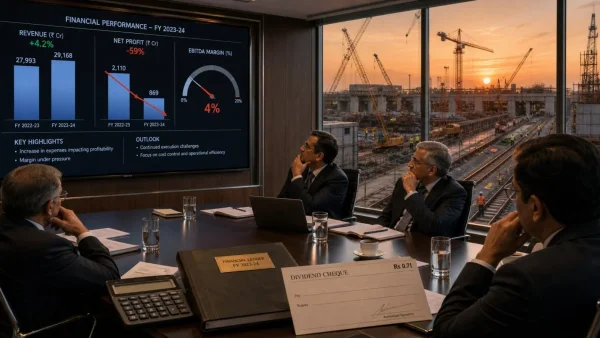
It was a case of steady topline but a harder road for profitability for the Navratna EPC major. Year on year, Q4 net profit was 59% lower at Rs 187 crore, with a 4.2% nudge in revenue to show for it. A final dividend has been put forward to send a signal to the market after earnings took a hit from pressure on the margins.
Profit squeeze despite the top line
On the March quarter, operations brought in Rs 6,696 crore, up from Rs 6,427 crore this time last year. If you look at total income, it’s at Rs 6,780.9 crore. But then you have profit before tax, which has given way to Rs 250.3 crore – a sign of the cost side of things as work picked up in the latter part of the year.
EBITDA is 38.4% off the pace of last year, at Rs 268.5 crore. You’re looking at a 4% margin where 6.8% used to be; a 300 bps or so slide that says it all about expenses. Total outgo has run up to Rs 6,534.6 crore from just over Rs 6,120 crore, leaving less room for profit.
Some sequential movement
Compared to the Q3 FY26 figure of Rs 4,684.5 crore, revenue has done better. But net profit is down from the Rs 324.1 crore we saw in the prior quarter. It seems in the March period, what kind of projects you had and the cost curve were more of a factor than sheer volume.
A look at the full-year tab
FY26 has seen operational revenue go up to Rs 20,412.1 crore from Rs 19,923.3 crore, and total income to Rs 21,187.4 crore. Earnings haven’t kept up, though. Net profit after tax is at Rs 875 crore, well short of the Rs 1,278 crore from before. Profit before tax is in the same boat, down to Rs 1,181.2 crore from Rs 1,646.4 crore.
There is some discipline on the balance sheet with finance costs coming in at Rs 419 crore versus Rs 544.9 crore. But overall, expenses have swelled to Rs 20,100 crore from Rs 19,368.2 crore. That’s the reality of rail EPC: inflation, sub-contracting, and the like will always put a strain on you.
When you put the revenue, expense and financing figures side by side, it’s clear that for FY27, how you price and phase your work will be what makes or breaks earnings. As old orders are put to bed and new ones come in, you’ll need to be efficient to make up the margin.
Dividends and other business
The board is on record for a final dividend of Rs 0.71 on each of the Rs 10 face value shares for FY26, pending what the shareholders say. Per the filing, the check will be in the mail within 30 days of the AGM declaration.
Then there’s the matter of the RVNL’s joint venture in Kyrgyzstan, Kyrgyzindustry-RVNL CJSC, which has been closed. It’s a way to tidy up the overseas side of the house and let the domestic rail work be what it is: the main driver of growth.
How the market has read it
The stock was at Rs 272.55 on May 25, a 0.52% or Rs 1.40 move. The dividend and the fact that revenue held up may have calmed some nerves. But with a reset on the margins, everyone is looking at how well they can manage their bids and convert cash, which is a must for an EPC firm with higher input bills.
In the Indian rail space, growing the top line doesn’t do it anymore. With an EBITDA of 4%, RVNL’s latest report is a reminder that when you’re vying for the kind of complex, hard-deadline packages out there, being the one who can turn a profit is what sets you apart.
To sum up the results and the rest of the filings:
– A 59% fall in Q4 net to Rs 187 crore
– 4.2% gain in Q4 revenue to Rs 6,696 crore
– EBITDA at 4%, down from 6.8%
– Rs 875 crore in net for the year
– Rs 0.71 per share in final dividend
– The end of the Kyrgyzindustry-RVNL CJSC
From here on in, it’s all about getting those margins back. After a mixed bag in FY26, we’ll be watching to see how RVNL handles the juggling act of execution, keeping a lid on costs and working capital in a very busy capex environment.