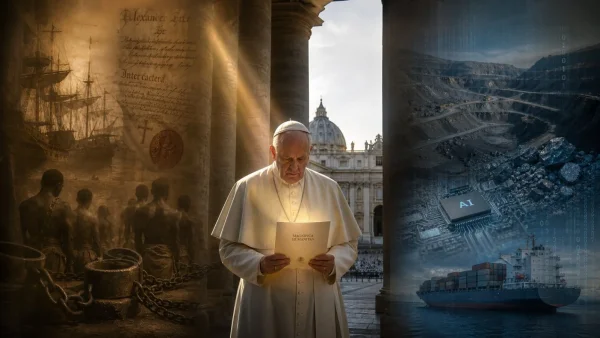
It is an unusual and far-reaching mea culpa from the pontiff over the Vatican’s record on legitimising slavery. He has called it a “wound in Christian memory” and drawn a line from that history to the abuses of the modern digital economy. The words were put forward on Monday in the form of his first encyclical, which is meant to be something of a moral guide for our high-tech times.
Condemning it late, and looking at the problems of the tech age
You won’t find this kind of candour in the past. Leo has put on the record not just the involvement of Christians in the trans-Atlantic trade, but the fact that popes once gave European rulers a free hand to subjugate and enslave those who were not of the faith. It is a direct answer to the calls for some accountability from Black American Catholics, as well as from scholars and activists.
There are plenty of general principles in the encyclical for upholding human dignity, but what makes it pressing is the way it puts the past in conversation with the present. Leo is on the record saying that the unregulated work behind things like artificial intelligence is of a piece with older ways of being dispossessed – down to the mining of rare minerals for your AI chips.
What you need to know from the encyclical:
– An apology from the Holy See for the way it once made slavery right
– A straight line from what was permitted then to the exploitation of now
– No room for AI-era labour ills; they must be called out
– If we don’t get it right, we may have to do this all over again
You can go back and find where former popes have shown regret for the deeds of the men and women who in the past held and sold slaves. But no one has been so forthright as to name and make amends for the role of their own predecessors in handing sovereigns the power to enslave “infidels.” This is what Leo is doing.
“When you think of the suffering and the humiliation of so many, set against the fact they are persons of such dignity and loved by the Lord, it is hard not to be filled with sorrow,” Leo wrote. “I ask for pardon for it, in the name of the Church.”
The pope is putting the apology in the context of a hard truth: it took the Catholic Church a very long time to come to terms with this. He points out that even as some of the church’s own institutions had slaves, it was left to Pope Leo XIII in 1888 to make a stand, well after most of the world had moved on.
He re-emphasises the doctrine of human dignity, but notes its “full incompatibility with slavery” was only “explicitly recognized” after “eighteen centuries.” “We cannot say we are not part of that wound in our Christian memory,” he says.
Then there is the matter of the digital revolution and what it brings with it. In Magnifica Humanitas, Leo cautions that the labour and supply chains of the new technology can be a way of repeating “slavery and colonialism.” We have to be on guard against it.
He is blunt about it. The church must denounce every form of trafficking that has to do with the technological changes of the day, “if we are to be in a position where we don’t have to come and ask for forgiveness later for not having the respect for human dignity our faith demands.”
Some old decrees and the Doctrine of Discovery
For a long time the Vatican has said it has always seen people as God’s children. And yet, in the 1400s, it put out orders allowing the Portuguese to make inroads in Africa and the Americas and to put non-Christians in chains.
What the 15th-century bulls were about
Back in 1452, with the issuing of Dum Diversas, Pope Nicholas V told the king of Portugal and those who would follow him that they could “invade, conquer, fight and subjugate” and take the lands of “Saracens, and pagans, and other infidels, and enemies of the name of Christ” where they found them. They were also given leave “to reduce their persons to perpetual slavery.”
Three years on came Romanus Pontifex. Between the two of them, they were the basis for the Doctrine of Discovery, the theory that made the taking of land in the New World and in Africa seem like a matter of law and theology. Then the Spanish crown was given the same kind of prerogatives for the New World.
As for the permissions that Nicholas V put in place, they were put to rest or made good on by a string of popes over the years: Callixtus III in 1456, Sixtus IV in 1481 and Leo X in 1514. That’s the account of the Rev. Christopher J. Kellerman, a Jesuit and the man behind “All Oppression Shall Cease: A History of Slavery, Abolitionism, and the Catholic Church.”
The Vatican has been clear in 2023 that it no longer stands by the Doctrine of Discovery. But you won’t find an official retraction of the bulls themselves. The line from the top is that with Sublimis Deus in 1537, the church had already made its position known: Indigenous people were not to be made into slaves or have their property and freedom taken from them.
Reactions, memory, and the pope’s own story
There was some welcome for the apology from those who wanted a more complete reckoning. Anthea Butler of the Koch History Center at Oxford thinks Leo has to do more if he wants to be taken seriously on the issue of “technological enslavement.” He has to make amends for the church’s part in the old days of slavery, she says.
“It is what the descendants of the enslaved have been waiting for,” Butler said, in a way that speaks to the need for some moral housekeeping.
Kellerman has his reservations about the phrasing but can’t deny the import of the day. “Pope Leo has put some moral heft back into the church with this,” he said. “I’d like to see a document down the road that goes into the nitty-gritty of our history with slaveholding. For now, it’s a very fine moment.”
You can go back to the 1980s for a sort of forerunner. In 1985, St. John Paul II was in Cameroon and offered up an apology for the Christians who were in on the slave trade. He did the same at Goree Island in 1992, where he called it out as a “tragedy of a so-called Christian civilization.” He never put the onus on the popes, though.
Leo’s words are all the more pointed because of his background. He is the first U.S.-born pontiff in history, and work by Henry Louis Gates Jr. has shown that his family tree is a mix of the haves and the have-nots. Some 17 of his American forebears were Black – mulatto, Creole, free person of color – as the census would have it.
Last month in Angola, he put in some time at the Sanctuary of Mama Muxima, a shrine built on what was once a busy stop on the Portuguese slave route. He spoke of the “great suffering” of the Angolans over the years, without using the S-word.
An encyclical doesn’t put right 400 years of complicity. What it does is put the church’s teaching in a hard line against any kind of control, old or new. Putting it in his first encyclical is no accident; it’s meant to tie together the social and the doctrinal.
What’s key is that Leo concedes the Holy See did its part to “regulate and legitimize” subjugation, even the enslavement of “infidels” in some instances. You can’t judge the past only by today’s measure, he says, but you can’t make light of how long it took to come around on slavery.
It’s a forward-looking stance. When he talks about the harm done in AI and on digital platforms, he is putting governments and companies to the test. If faith means you value human dignity, you don’t give your blessing to systems that make a profit off of force.
Where we stand after the apology
All eyes will be on the church from here. Some want to know if there will be some formal word on those 15th-century bulls, now that the Doctrine of Discovery has been put aside. Leo seems to be saying that being held to account is not something you can leave in the rearview mirror.
For the communities that have to live with the aftereffects of being enslaved, this is as much a provocation as it is an acknowledgment. It’s about being on guard when new tech starts to look like the old order.
In the end, Magnifica Humanitas is hardly a period at the end of a sentence. It is a start. It puts the papacy on record with a plain fact: you can’t build a future on chains you don’t see, and there is a price to be paid for putting things off.