The 40-minute communication loss happens because of where Orion is in relation to Earth and the Moon; it’s a straightforward matter of the Moon being in the way. Radio and laser signals go in straight lines, and the Moon is a solid object that completely blocks them. There isn’t a satellite orbiting the Moon to relay the signals for Artemis II, so the connection has to wait until Orion moves around the Moon.
NASA’s Deep Space Network uses very large antennas in California, Spain, and Australia. However, those antennas can’t “hear” Orion when the Moon is between them. This creates the roughly 40-minute break in communication, just like the Apollo astronauts experienced over fifty years ago.
Mission control considers this a normal part of the flight plan, and have accounted for it. The people on the ground will step back and let the spacecraft’s systems and the astronauts be in charge until the signal comes back. Once Orion has moved past the Moon, the communication should be restored almost immediately.
What the astronauts will do while out of contact
The astronauts won’t just be doing nothing though. They will work in pairs, using professional cameras to photograph the far side of the Moon, and then switch who is taking pictures. They’ll be photographing craters, large sunken areas and the rough, raised terrain that humans have never seen before, and they’ll be at their closest point to the Moon at this time.
At its closest, Orion will be approximately 4,070 miles from the Moon’s surface. From there, they might be able to see details, even parts of the Orientale Basin, that were too dim or at a bad angle during the Apollo missions. They have guides and have been trained to quickly recognize and describe what they are seeing.
The crew will also be able to view a total solar eclipse, but one only visible from space. The Moon will briefly cover the Sun, and the Sun’s corona (the outer atmosphere) will appear as glowing, wispy shapes. They’ll be wearing eclipse glasses and observing and taking pictures of any unusual things happening on the Sun for later study.
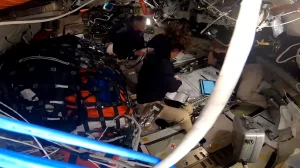
In between taking photos, the team will go through checklists, double-check the schedule, and make sure the spacecraft is in good condition. They’ll confirm the navigation information, look at the displays, and verify that the computer program controlling the flight is following the planned route. They’ll pace the work to avoid being overwhelmed and to maintain a relaxed atmosphere in the capsule.
This time of being cut off also has a psychological effect. Astronauts are trained to deal with being alone, and the silence can actually be a good thing. Astronauts from previous missions have often said that this radio silence is peaceful. The Artemis II team have said they plan to use the quiet to think before they regain contact with Earth.
Record-setting loop around the Moon
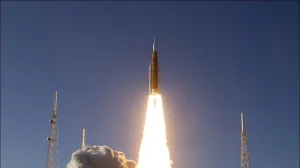
Artemis II started on April tth and is following a long, figure-eight path around the Moon before returning to Earth. It’s a test flight and a science mission, not a landing. On Monday, the crew will spend about six hours going past the Moon before heading for home.
The mission is expected to break the record for how far people have traveled from Earth, going over 4,100 miles further than Apollo 13. This shows how Orion and its flight path are going further into space, but are still keeping the astronauts safe with a lot of leeway.
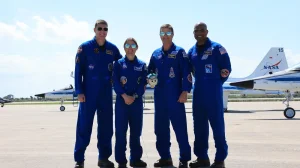
This trip around the Moon is also important because of who is on board. Reid Wiseman is the commander, Victor Glover is the pilot, and Christina Koch and Jeremy Hansen are mission specialists. Glover will be the first person of color to orbit the Moon, Koch will be the first woman, and Hansen the first non-American.
How Orion stays safe and on track without Mission Control
Orion is designed to work by itself. It uses multiple, backup sensors – including star trackers and inertial measurement units – to work out its location and speed. It also uses optical navigation, which means using pictures of planets and stars to get an even more accurate position.
The path Orion is taking is also a safety feature. It will use the pull of both the Earth and Moon to naturally “swing” it back toward Earth with very little fuel. Even if the crew lost communication or needed to fire the engines for a different reason, the spacecraft would still come back to Earth on a path that’s easy to predict.
During the communication blackout, information doesn’t stop being collected; it’s simply saved up to be sent later. Information about the spacecraft’s performance, photos, and notes are stored on the spacecraft and sent to the Deep Space Network as soon as the signal is re-established. The people on the ground then look at how the spacecraft did, compare it to what they expected, and adjust the schedule if necessary.
What happens after the flyby
Once Orion has swung around the Moon, it will take around four days to get back to Earth. The Orion capsule is planned to land in the Pacific Ocean near San Diego on April 10th, nine days after it took off from Florida.
On the way home, the crew will have the first-ever radio conversation with the astronauts on the International Space Station. Christina Koch on Orion and Jessica Meir on the ISS, both of whom were involved in the first all-female spacewalk in 2019, will be part of the discussion.
They will also sort through the images, write down their observations, and get ready for the landing. Since Artemis II is also a test of the spacecraft’s systems, the teams will carefully examine all of the information collected to improve the plans for Artemis III and later missions, when humans will return to the Moon’s surface.
Why this blackout matters for exploration
The 40-minute loss of contact isn’t a problem; it shows how ambitious Artemis II is. It proves Orion can operate independently, tests the systems for communicating in deep space, and gives the crew a unique place to do science. It also links the current missions to the experiences of the Apollo program.
When the signal comes back and Mission Control says hello, the crew will have new information, amazing pictures, and a spacecraft that is exactly where it should be. In that way, the silence while behind the Moon is not a pause in the mission. It’s an important step on the journey back to the Moon.