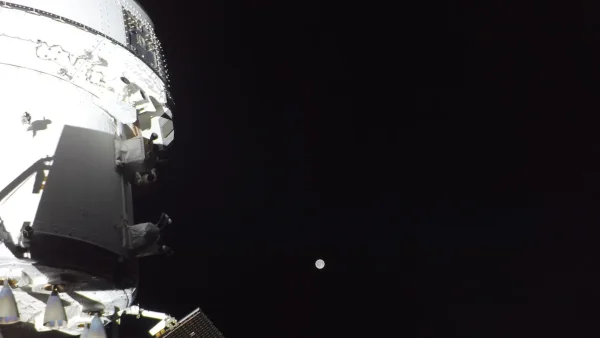
The Artemis II crew sent two very striking Earth photos, showing both how enormous Earth is and making it feel close up. The pictures, taken shortly after the engines fired to send Orion towards the Moon, show Earth glowing with blues and browns within the framework of the capsule itself. And you could actually buy the equipment used to take them at a regular camera store.
What the Artemis II images show
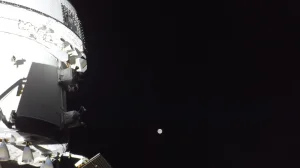
One photo shows part of Earth through Orion’s window, the spacecraft’s parts forming a frame around the view. The way the layers of the picture are arranged makes Earth look like it’s coming out from behind the capsule, a strong reminder that people are in the vastness of space.
The second picture shows most of Earth, with Africa very clear and the Iberian Peninsula visible on the curve of the planet. The line where day turns into night (the terminator) and the shimmering aurora near the North and South Poles are visible, meaning the astronauts had good viewing conditions when they snapped the shots.
These pictures aren’t just nice to look at. They are a record of what Earth looked like as Orion traveled, and they confirm the spacecraft is pointed the right way and what the environment is like in deep space. They also are standard documentation for the mission and will be used to tell people about it.
Which camera captured the Earth photos
The commander of the mission, Reid Wiseman, used a Nikon D5 to take both photos. The D5 is a professional DSLR that is known for being very good in dim light and being very tough – both important for a mission far beyond Earth’s orbit. It was the main camera on Artemis II for taking pictures by hand.
Orion also has a Nikon Z9 mirrorless camera. It’s being taken along to test it and for planning future missions. NASA is looking at how the Z9 performs during this mission to help create handheld cameras for taking pictures on the Moon during future Artemis flights. Having both cameras shows a sensible, practical approach to taking photos in deep space.
Why the Nikon D5 was selected for Artemis II
The Nikon D5 was chosen because it balances great image quality with being able to withstand a lot of wear and tear. It does well in low light and has been proven to work for professionals in difficult situations. Astronauts in a moving spacecraft need a camera that is reliable, that they are used to, and that won’t make their work more complicated.
Taking pictures by hand inside the capsule needs simple, dependable controls and quick, accurate focusing. The D5 does all of that and also produces high-resolution pictures that can be carefully studied. These technical advantages are why it was picked to be the main camera for the images from this mission.
Evaluating the Nikon Z9 for future lunar photography
The mirrorless Nikon Z9 is being tested as part of the development of a Handheld Universal Lunar Camera System. Mirrorless cameras are generally lighter, have more advanced focusing, and can take videos – all features that will be useful on future missions. If the Z9 does well in testing, it or a newer version of it could become the standard for taking pictures on the Moon’s surface and in orbit on Artemis missions.
Testing the Z9 in space will help engineers understand how mirrorless sensors and electronics work in the conditions of deep space. What they learn will influence which cameras are chosen for Artemis III and later, when the crews will likely need special cameras for taking pictures while they work on the Moon’s surface.
Operational value and what comes next
Aside from how good they look, the pictures also help with the technical goals of the mission. They show that the engines worked correctly to send Orion to the Moon, show how the spacecraft is aimed and the lighting conditions, and give the mission planners information they can use. They also help the public learn about the mission as Artemis II continues on its way to fly past the Moon.
The Artemis II crew, consisting of Christina Koch, Victor Glover, Jeremy Hansen and Reid Wiseman, are continuing their ten-day mission as planned. This flight isn’s landing on the Moon, but it is testing the systems and procedures needed to bring people back to the Moon later this decade. More pictures and updates about the mission will be sent as Orion gets closer to the Moon.
Context for future exploration and imaging strategy
These first pictures give a starting point for how cameras operated by the crew perform while traveling, and how pictures can be used for both scientific research and the practical running of the mission. Using professional cameras you can buy in a store (like the Nikon D5) and testing newer mirrorless options (such as the Z9) shows a sensible way to approach space photography.
As Artemis II continues, engineers will carefully look at the pictures for technical details and use what they find to plan the camera systems for future missions. The combination of careful testing and beautiful pictures means these Earth images can be used for science, to inform the public, and shows how photography is becoming more and more important as humans explore space.