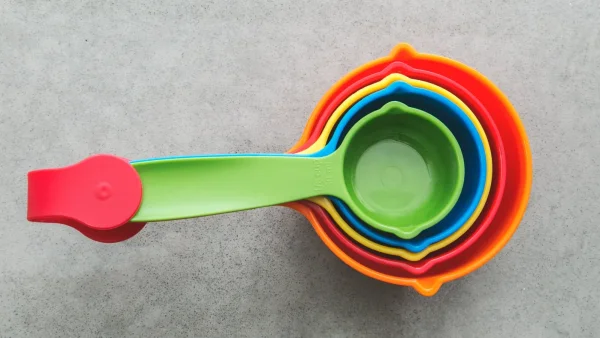
How many times have you been in the middle of baking and discovered your measuring cup is missing? Knowing how many ounces are in a cup can really save the day. This understanding will make cooking easier if you enjoy it a lot or are just trying a new recipe.
Liquid Measurements: 1 Cup Equals 8 Fluid Ounces
In the U.S., a cup is the same as 8 fluid ounces (written as ‘fl oz’). You need to know this for lots of things, not just reading recipes. If a recipe says “1 cup of milk,” it means you should use 8 fluid ounces of milk. Getting this basic conversion right will prevent errors and make sure your food is good.
Here are some quick conversions: 1/2 cup is 4 fluid ounces, 1/4 cup is 2 fluid ounces, and 1/8 cup is 1 fluid ounce. These are important and work with all liquids, helping you to follow any recipe as it’s written.
Dry Ingredients: A Bit More Complex
Measuring how to change cups to ounces for dry things like flour and sugar is a little more difficult. Unlike liquids, a cup of different dry ingredients doesn’t weigh the same. How heavy something is in a cup is affected by how tightly it’s packed and how much moisture is in the air.
For example, a cup of most dry ingredients will weigh about 4.25 ounces, but this can change depending on the weather and how you put the ingredient into the cup. In these situations, a kitchen scale is a great help for getting the amount just right.
The Importance of Precision: Measuring by Weight
Using a scale to measure ingredients by their weight in ounces or grams is more accurate than using cups. This is especially important when you need to be very precise, like in a science experiment or a home repair project.
Here’s how to use a scale: First, put your bowl on the scale and set the scale to zero (this is called “taring”). Then, put the ingredient in the bowl until the scale shows the amount you need, in ounces or grams.
If you do this, you’ll get the same result every time, no matter what you’re measuring.
Wrapping It Up
Knowing how to convert between ounces and cups is helpful in many parts of life. If you’re doing a lot of cooking or starting a DIY project, being able to do these conversions will save you time and trouble. Keep in mind that 1 cup equals 8 fluid ounces for liquids, but the weight of a cup of dry ingredients can be different. For the most accurate results, look up the weight of the ingredient and use a scale.