NASA is in the last phase of getting ready for Artemis II to go to the Moon. The countdown will begin at the Kennedy Space Center in Florida. The plan is to launch as early as Thursday, April 2, and the latest prediction says there’s a strong eighty percent chance of good weather. The team is still carefully watching for clouds and strong winds, because the timeframe for launching to the Moon is pretty small.
Final countdown at Kennedy Space Center
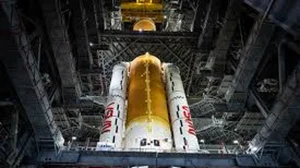
In the next few hours, the engineers and people controlling the mission will go through a very detailed plan for the launch at Launch Complex 39B. The Space Launch System rocket and Orion spacecraft will have their final checks, be connected to the range, and have practice runs for all the steps to the final countdown.
The main priority is to protect the opportunity to get the correct path to fly around the Moon. Even small issues with the weather or something not working correctly could cause the launch to be postponed, so the team will carefully make “go” or “no-go” decisions, and keep track of restrictions relating to clouds, the possibility of lightning, and high altitude winds.
The launch team will also work with the people in charge of safety and the flight path to be certain the mission plan will allow the Orion to get to the Moon quickly. Although the forecast is good, being able to adapt and sticking to the plan are still the most important things in the last few hours.
Artemis II mission profile
Artemis II is the first mission with people on board in NASA’s Artemis program and is a huge step towards regularly going to and exploring the Moon. For roughly ten days, Orion will take the astronauts around the Moon and bring them back to Earth, proving they can operate in deep space and preparing for future landings.
This mission will show how Orion performs with a crew for the first time, including navigating in the space between Earth and the Moon, and the important equipment for long trips. It’s the connection between the many years of testing without a crew and astronauts going near the Moon again.
Meet the Artemis II crew
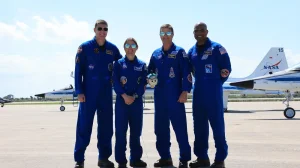
Reid Wiseman, Victor Glover, Christina Koch, and Jeremy Hansen from the Canadian Space Agency will be the four astronauts on Orion. They have experience as test pilots, running a space station, and leading expeditions, a variety of skills needed for a difficult trip into deep space.
Wiseman will be in charge of the astronauts, Glover will be the pilot, and Koch and Hansen will be mission specialists. All together they will test everything, see how the spacecraft handles, and confirm the plans for missions with people on board that go past low Earth orbit.
Key objectives and systems to be proven
A major point of Artemis II is to thoroughly test Orion’s life support systems with people actually in the spacecraft. These systems control the air, temperature, moisture and remove carbon dioxide from the cabin. They are vital to the astronauts’ health and ability to work on longer missions later this decade.
Engineers will also test communication and tracking from far away in space, including how the signals switch between ground stations and the spacecraft’s antennas. The mission will also test the guidance and navigation during all stages, from orbiting Earth, while traveling to the Moon, and returning to Earth as it enters the atmosphere. The astronauts and mission control will go over how things happen in the cockpit, what the screens show them, and the plan for how long things will take. What they learn from this will directly affect how later Artemis missions operate, especially the ones where they land on the Moon’s south pole. Any improvement to how things are done now lowers the chances of something going wrong with the more difficult things they’ll have to do later.
Weather outlook and launch risk management
There’s a good chance of good weather on the launch day, eighty percent in fact, which is good because the route the rocket needs to take to get into space is very specific. The main things they’re looking at with the weather are clouds and strong winds, because both of these can lead to problems with lightning and the stress on the rocket during takeoff.
Weather experts will be looking at the high winds, thick clouds and storm formations (called storm anvils) that could mean they can’t launch. They have plans to delay the launch if necessary to keep the mission safe. And if the team decides to wait, they expect to have other chances to launch because of how the Moon orbits.
Reducing the risks from the weather and from problems with the equipment is normal for launches where a lot is at stake. The Artemis team won’t go ahead unless everything is exactly as it should be to protect the astronauts, the rocket, and the Orion spacecraft.
Why Artemis II matters now
Artemis II is the first real step in sending people back to the Moon after more than fifty years. It’s part of a bigger plan to have people living and working on and around the Moon, doing research, trying out new technology, and getting ready for trips further into space.
The reasons for going to the Moon are the science we can do there and the materials we might find. In the permanently dark craters at the Moon’s poles there is water ice, which could be used for breathing and making rocket fuel. The Moon also contains a special history of the early solar system which scientists can get by bringing back new samples.
The mission will also develop the ability and skilled workforce to build and operate spacecraft for long human trips into space. Money spent on Artemis can be used for new technology, like improved materials and power sources, and help build a strong space industry.
Most importantly, the Moon is a good place to practice for Mars. If we can make reliable life support systems, places to live, and protection from radiation on the Moon, the dangers of missions to deep space that last for months will be lessened. They are intentionally using the Moon to perfect these systems.
Launch timing and what to watch
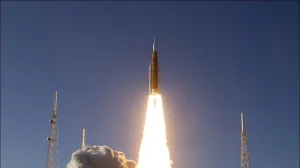
Currently, Artemis II is planned for April to launch at 3:54 in the morning Indian Standard Time. On launch day, listen for the final signal to fuel the rocket, the “go/no go” decision just before the final countdown, and the firing of the SLS core stage and boosters which will send Orion into space.
After the rocket lifts off, the important moments are getting clear of the tower, the boosters separating from the rocket, and the main stage of the rocket shutting down. Then the top part of the rocket will set Orion on the path to the Moon, and a final burst of power will put the spacecraft on course for the Moon. After that, they’ll check all the spacecraft’s systems and the astronauts will be evaluated as it goes further and further into space.
On the way back to Earth, Orion will be aimed for a very precise return and landing in the ocean. How well the heat shield works, the parachutes opening, and the recovery of the spacecraft are all important things to measure. Each of these is a part of proving the entire system works with a crew on board, before they attempt a landing on the Moon on a later mission.
With the equipment being checked and practice runs being done, excitement is growing for one of the most important spaceflights of the decade. If everything stays on schedule and the weather is good, Artemis II will be a major step forward in returning astronauts to the Moon and eventually going on to Mars.