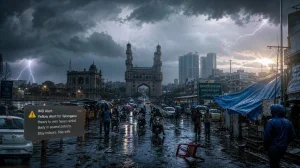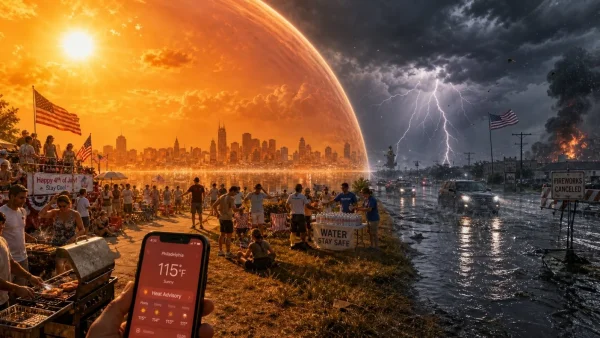
It’s a two-pronged problem for anyone with a 4th of July itinerary: you have a heat dome driving up the mercury to unseasonable levels, and then there are the odd storms that can put an end to parades, cookouts and the fireworks display. Some of us might be in for ‘potentially the hottest ever’ Independence Day, as one forecaster put it. In other places, they’re bracing for the wind, hail and the possibility of a flash flood or two.
If you’re in the eastern US, you’ll feel it most. We’re looking at numbers 10 to 20 degrees over the norm. And when you factor in the mugginess, federal forecasters say it could be like 115 in some towns.
What is driving the extreme July 4 heat
You can thank a high-pressure system for that. It’s a wide expanse of hot air being held in over the eastern third of the country, and NOAA is calling it a long and hazardous kind of event. They have a ‘major-to-extreme HeatRisk‘ in the cards for the East this holiday weekend.
The heat index is set to top out between 105 and 115 in a lot of places. Even after dark, it won’t cool down much, which means less of a break for those out for the evening and more of a health concern.
‘This could be the hottest Fourth of July ever recorded for some cities,’ says CBS News’ David Parkinson. You can bet some of the old records will be put to the test as we head into the weekend.
Regional split: where heat, storms and milder air will prevail
The East is going to be an oven, but don’t think the middle of the country is off the hook. There’s active weather in store for the Plains and Midwest – the kind of storm that can put up some damage with its winds and hail, not to mention the heavy rain that comes with it. Flash floods and a few hiccups in travel are in the mix.
Over in the West, AccuWeather has a big heat dome moving in before the 4th. We’re talking 90s and over 100 in spots. California, Nevada, Utah, Idaho, Oregon, Washington and some of Arizona are in for the worst of it.
Then you have southern Texas and the southwest corner of Louisiana. The weather is hot and dry there, and with the underbrush in such shape, there’s worry about fires. If things get any worse, you might see some rules put in place on the fireworks, or they could be called off altogether.
Cities and events on watch
Come Sunday, the Mid-Atlantic and the Southeast are in for some of the harshest conditions.
You can expect some of the country’s largest metros – Charlotte, D.C., Philadelphia and others – to see the thermometer hit the upper 90s or even 100. Add in the mugginess and it will be hard to put a number on, but it will feel like 100 to 110 in much of the region.
For a lot of people, that’s going to be the main thing to deal with for their Fourth of July plans. If you’re in a crowd at an open-air concert or a fireworks display, the afternoon and early evening could be anything but pleasant, and in some cases, a bit of a hazard.
Thunderstorms in the mix
There’s some unsettled weather around the periphery of the heat dome that is set to produce some scattered thunderstorms, from the Great Plains over to bits of the Southeast and East Coast. You might also spot an odd shower here and there in the Upper Midwest.
Our forecasters are putting out a word of warning: strong storms can mean high winds, big hail and a deluge of rain. That kind of thing has a way of causing some minor flooding and throwing a wrench in your outdoor event. It’s a good idea to give yourself some leeway and keep an ear to the ground for any local notices.
Hot and dry means more fire danger
“Building drought and dry thunderstorms over the interior West will boost the risk of wildfires,” says AccuWeather’s Chad Merrill. He and other meteorologists are seeing the conditions for it.
In some places, smoke from the bigger fires may make its way into the Rockies, the Plains and even the Midwest. In communities where the fire threat is high, you may find they have put a hold on or done away with fireworks to avoid a spark turning into something worse.
So what do you do? We’re hearing from officials and health pros to take a few no-brainer steps to stay safe while we’re in this window of heat and fire risk:
– Stay on top of your water intake, don’t wait until you’re parched
– Put on something light and of a lighter colour
– Get out of the sun and into some A/C when you can
– Don’t push yourself too hard in the thick of the day
– Be mindful of any rules on fire and fireworks in your area
– Make sure you check in with your older or more at-risk neighbours
When the let-up comes
This won’t go on forever. According to NOAA, a cold front is on its way to push some of the chill from the Midwest into the eastern U.S. by Monday, and we should see numbers come back down to something more like what we’re used to as the week goes on.
Of course, not everyone is in for a rough time of it. The day of the holiday is looking to be mostly fine and easy in the Midwest and in some of the Ohio Valley and Mid-Atlantic. We’re talking about parts of Iowa, Missouri, Illinois, Indiana, Kentucky, Ohio, West Virginia, Pennsylvania, Virginia, North Carolina and Tennessee.
“The Ohio Valley and the Northeast on the Fourth of July looks like the best weather in terms of having better opportunities to be dry and not too hot,” says Merrill. Then again, he’ll be the first to tell you summer can turn on a dime.
The upshot for Independence Day: be ready for whatever you get, be it the kind of heat that sticks to you or a storm that comes in fast. With things running well above normal in many spots and the humidity to make it worse, a little flexibility and common sense is what will separate a good time from a bad one.