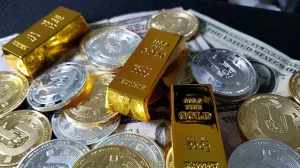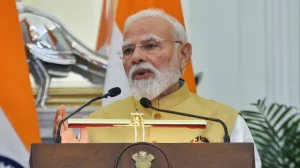
It’s a bold move from Prime Minister Narendra Modi to have us put our gold on ice for 12 months, but then you have the pull of tradition and the metal’s own allure. In some corners of the market, 24-carat is still going for as much as Rs 1.61 lakh for 10 grams.
Why the PM wants India to stand down
You can’t put on a wedding necklace in this country without it being a foreign exchange issue; we import just about all of our gold. There is worry among the policymakers that if crude prices keep running hot over the Iran situation and the Strait of Hormuz, it will put more of a crimp in the rupee and our reserves.
The bottom line for New Delhi is the dollar drain. We spent close to $72 billion on gold last financial year. So they hiked the import duty from 6 to 15 per cent, a way of putting a tax on what is essentially the nation’s preferred hedge to keep the currency in check.
We are the number two consumer in the world, bringing in 600 to 800 tonnes a year. And when there is a run on safe-haven assets around the globe, it rubs up against the kind of trade-offs we have to make at home, piling on to the current account.
Where policy and old habits collide
If you ask an economist, it’s a matter of head versus heart. Nikunj Saraf of Choice Wealth would tell you gold is in the very fabric of Indian life – in the dowries, the festivals, the weddings – and you can’t just advise your way out of that.
In fact, the opposite happened for a while. Right after the Prime Minister made his pitch, you saw a 15-20 per cent blip in bridal sales as people got ahead of any new rules or price hikes. Trying to put a lid on demand had the odd effect of creating a stampede to get in before it was too late.
But don’t expect a total walk-away. Surendra Mehta of the IBJA figures we might see a 10-12 per cent softening, no small thing given the PM’s clout. But it’s not so much that people are forgoing gold; they are just being more selective on the weight and the karat.
A view from the shop floor
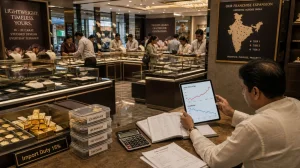
The retailers on the ground have felt the ebb and flow since the duty went up. Suvankar Sen, who runs Senco Gold and Diamonds, says at first everyone was in wait-and-see mode to see if the high numbers were here to stay. Now that things have mellowed, the customers are back in the door.
There was a bit of a shock at first. Sen put the drop in footfalls at 25-30 per cent for the first few days before it started to come back. You can feel the mood in the store with the news, but the wedding season has a way of keeping things steady.
The smaller outfits are seeing less of a browse and more of a purpose. Nitin Gupta of Swastik Jewels in Delhi said he was down to 70 or 75 in-store in early April, a 25 per cent slide. But most of them were there to buy, so his books are looking flat compared to last month.
That 15 per cent duty was a jolt, he says. It added close to Rs 4,500 to the 10-gram base price in one day and you had to do some quick math to make it work. Then there was the news of banks putting a stop to imports, he said, which put some pressure on those who had put off making up their minds in March.
But for a lot of families, having pre-ordered has been a buffer. “We figure 60 per cent of our June wedding work was already in the books back in March at 5 per cent duty and we will make good on it,” says Gupta. The new walk-ins, however, are looking for something more modest to keep to a budget.
You see it in the numbers: where you used to have a family in for an 80-gram set, they’ll come in for 45 or 50. We’re also seeing a move from 22K to 18K, with the average sale down by close to Rs 1.2 lakh. And if that 15 per cent duty is here to stay, I’d put money on Diwali being more about the gesture – a 5-gram coin, a simple pendant, or a Sovereign Gold Bond.
In short, this is what’s happening in the store:
– We’re trimming the weight to suit the same kind of budget
– Purity is going from 22K to 18K
– Pre-bookings are the only thing holding up some of the wedding orders
– You can put away the heavy sets; smaller pieces for the festival are in vogue
Gold’s unbreakable chemistry: why it does not rust
There is a science to gold’s appeal, not just tradition. It is a noble metal, so to speak, and doesn’t do well with air, water or much else. With 79 protons and a hold on its outer electrons, it won’t give them up to oxygen, which is what makes things rust.
Rust is just iron atoms ceding electrons to form that flaky red-brown oxide. Gold is too hard to come by for that to happen, even in damp conditions.
It is why you can pull an old coin out of a shipwreck and it still has its luster. The only thing that can break down its stable bonds is aqua regia, a particular mix of nitric and hydrochloric acid.
That is why, when you have war or your currency is under strain, you see people with bullion and not much else. Gold doesn’t go bad or default. It is a safe haven when you can’t be sure of anything.
What comes next for prices and policy
Himank Sharma at Crisil Ratings would tell you it is a matter of volume as much as value. Yes, there was a lull in the last few days after the hike, but he is of the view that the year will even out with better realisations.
The big players in the jewellery business are feeling it. A report has it that sales of everything from bars to bangles could be 13-15 per cent lower this fiscal than last, on top of an 8 per cent drop before that.
The government is on two fronts: some soft power to put off a purchase, and a hard line with the duty hiked to 15 per cent. They are trying to stem the flow of dollars without outlawing custom. It is a way of making the rupee stronger.
The bottom line for households
People aren’t going to stop buying for a wedding or a festival. But they are being smart about it. Lighter pieces, a lower karat, or a bond to sidestep the duty and the hassle of storage. Some will just get a token coin while prices are high.
Gold will always be a hedge. What is up in the air is how and when an Indian goes to buy it. The policy is for you to wait; the culture is to find a way around it.